Інформація призначена тільки для фахівців сфери охорони здоров'я, осіб,
які мають вищу або середню спеціальну медичну освіту.

Підтвердіть, що Ви є фахівцем у сфері охорони здоров'я.

Международный эндокринологический журнал Том 19, №4, 2023

Вернуться к номеру

Роль кортизолу у формуванні метаболічного синдрому в дітей: дані літератури та власне спостереження

Авторы: N. Gromnatska, I. Pasichnyuk, O. Tomashevska
Danylo Halytsky Lviv National Medical University, Lviv, Ukraine

Рубрики: Эндокринология

Разделы: Клинические исследования

Версия для печати


Резюме

Актуальність. Розглядається питання патогенетичного впливу кортизолу на розвиток метаболічного синдрому (МС) у дітей. Надпорогові значення кортизолу пропонують вважати маркером МС. Мета: вивчити зв’язок між кортизолом і компонентами МС у дітей. Матеріали та методи. Обстежено 44 дитини з МС (група дослідження; окружність талії > 90-го перцентиля розподілу згідно з віком і статтю) та 14 дітей без ознак МС (група контролю). Діти досліджуваних груп не відрізнялись за віком та статтю. Визначали антропометричні показники (маса тіла, зріст, індекс маси тіла, окружність шиї, талії та стегон, індекс окружність талії/окружність стегон), кортизол та лептин крові, ліпідний та вуглеводний спектр крові (загальний холестерин, холестерин ліпопротеїнів високої та низької щільності, тригліцериди, глюкоза та інсулін крові, HOMA-IR, індекс глюкоза/інсулін). Проводили триразове вимірювання артеріального тиску з підрахунком середнього показника. Діагноз сформований згідно з рекомендаціями IDF, 2007. Результати. Установлено, що рівень кортизолу крові в дітей із МС (362,9 (255,5–634,1) мкг/л) на 37,9 % нижчий, ніж у контрольній групі (р > 0,05). Частота надпорогових значень кортизолу крові в дітей двох груп становила 31,8 та 50,0 % відповідно (р > 0,05). Вивчення залежності кортизолу крові від антропометричних показників (rmax = 0,16; р > 0,05), показників ліпідного (rmax = 0,4; р > 0,05) та вуглеводного обміну (rmax = 0,26; p > 0,05), лептину крові (r = 0,19; р > 0,05) з використанням коефіцієнта кореляції Спірмена вірогідності не виявило. Установлено вірогідну залежність між кортизолом і систолічним артеріальним тиском. Висновки. У пацієнтів із МС не встановлено вірогідної різниці в рівнях кортизолу крові порівняно з дітьми без критеріїв МС. Не доведено асоціацію кортизолу крові з критеріями МС, крім систолічного артеріального тиску. Кортизол не може слугувати маркером МС, хоча і має патогенетичне значення у формуванні артеріального тиску в дітей із МС, тому що гемодинамічна складова не є критерій-утворюючою ознакою.

Background. The issue of the pathogenetic influence of cortisol on the development of metabolic syndrome (MS) in children is considered. The above-threshold values of cortisol are proposed to be taken as a marker of MS. The purpose was to study the relationship between blood cortisol and MS components in children. Materials and methods. We have examined 44 children with MS (study group; waist circumference > 90th percentile of the distribution according to age and sex) and 14 children without signs of MS (controls). The children of the study groups did not differ in age and gender. Anthropometric parameters (body weight, height, body mass index, neck, waist, and hip circumferences, waist/hip circumference index), blood cortisol and leptin, blood lipid and carbohydrate spectrum (total cholesterol, high- and low-density lipoprotein cholesterol, triglycerides, blood glucose, and insulin, HOMA-IR and glucose/insulin indices) were evaluated. The measurement of blood pressure with the calculation of the average level was conducted three times. The diagnosis of MS was formed according to the IDF guidelines, 2007. Results. It was found that the level of blood cortisol in children with MS (362.9 (255.5–634.1) µg/l) was 37.9 % lower than in controls (р > 0.05). The frequency of the above-threshold blood cortisol values in children of both groups was 31.8 and 50.0 %, respectively (р > 0.05). The study of dependence using the Spearman’s rank correlation coefficient between blood cortisol and anthropometric parameters (rmax = 0.16; p > 0.05), lipids (rmax = 0.4; р > 0.05), carbohydrate metabolism (rmax = 0.26; р > 0.05), and blood leptin (r = 0.19; р > 0.05) did not reveal any significance. A significant correlation was found between cortisol and systolic blood pressure. Conclusions. In children with MS, there was no significant difference in the level of blood cortisol compared to those without MS criteria. The association of blood cortisol and MS criteria other than systolic blood pressure has not been found. Although cortisol is important in the formation of systolic blood pressure, it cannot serve as a marker of MS in children since it is not a criterion-forming sign of MS.


Ключевые слова

метаболічний синдром; кортизол; діти

metabolic syndrome; cortisol; children

Introduction

Recently, the issue of the effect of cortisol on the deve–lopment of metabolic syndrome (MS) in children has been intensively discussed. MS is known to consist of a combination of metabolic and somatic disorders, such as insulin resistance (IR), hyperglycemia, dyslipidemia, elevated blood pressure, and visceral obesity [1]. From 6 to 39 % of children and adolescents with obesity have MS, depending on the applied diagnostic criteria [2]. There is a general agreement that timely identification of MS in children is extremely necessary in order to identify risk groups as early as possible and prevent its further formation [2].
The similarity between MS and Cushing’s syndrome is noted [3]. The relationship between physiological indicators of stress, cortisol directly, and signs of MS in children are ambiguous [4].
According to a systematic search of the databases PubMed, Embase, and PsycINFO from the selected 26 studies (19 cross-sectional and 7 case-control) regarding the relationship between the basal level of cortisol and MS, no significant difference between individuals with and without MS was proven [5]. Cortisol did not demonstrate a significant relationship with any parameter of MS in children [6] and therefore, according to the authors, does not have a decisive pathogenetic significance for the development of MS in children [7]. The obtained data refute the hypothesis of the leading role of glucocorticoids and cortisol directly in the development of stress on the one hand and obesity, as the main criterion-forming component of MS, on the other [8, 9].
According to some studies, children with excess body weight and obesity even had a decrease in blood cortisol levels [10].
On the contrary, some researchers do not reject the assumption that chronically elevated concentration of cortisol can be a potential factor contributing to the development of MS [8], and emphasize the possibility of a connection between the synthesis of cortisol and MS in obese children [11]. It has been proven that individuals with a higher level of free blood cortisol showed a higher chance of MS [4], which was correlated with adipokines — resistin and leptin [12], and was associated with a decrease in adiponectin [13].
Blood cortisol and adrenocorticotropic hormone levels were higher in children with MS than those without MS [11], and obese children with MS had higher blood cortisol levels than obese children without MS [6]. Biomarkers of stress were correlated with the risk of developing MS [13]. A significant dependence of basal cortisol levels on age, gender [5], and body weight at birth [14, 15] was observed. Children with higher cortisol quartiles had an increased risk of hypertension, hypercholesterolemia, high triglyceride levels, decreased high-density lipoprotein cholesterol (HDL-C), and insulin sensitivity [16].
Blood cortisol concentration was inversely associated with body mass index (BMI) and positively with glucose concentration and systolic blood pressure (SBP), but not IR and increased insulin, i.e. cortisol is associated only with some cardiometabolic risk markers [17]. The pathogenetic influence of cortisol on the development of MS is manifes–ted both at the central and peripheral levels [14, 18]. Recent data indicate that patients with MS have hyperactivity of the pituitary-hypothalamic-adrenal gland (PHA) axis, which leads to a state of chronic “functional hypercorticism”. The reasons for such activation remain unclear but may be partly related to long-term stress [18].
It is declared that long-term stress due to dysregulation of the PHA axis and an increase in cortisol contributes to the accumulation of visceral fat with the development of abdominal obesity [9, 14, 19], which in turn creates low-grade systemic inflammation mediated by the increased secretion of adipokines by adipose tissue. That is the pathogenetic connection between cortisol and abdominal obesity, as the main criterion-forming factor, and components of MS: IR and type 2 diabetes mellitus [9].
A pathogenetic link in the development of MS due to stress is that cortisol stimulates neuropeptide Y and reduces the sensitivity of the brain to insulin and leptin, increasing hyperinsulinemia, IR, and leptin resistance, thus creating preferences for high-fat and high-glucose foods [9, 19]. It is proposed to use blood cortisol as a diagnostic and prognostic marker of MS [20] and to screen individuals who are at risk of weight gain and further development of MS [19]. Therefore, data on the relationship between cortisol and MS in children are contradictory, which requires further research.
The purpose was to study the relationship between blood cortisol and MS and its criteria in children.

Materials and methods

Forty-four children with MS on the background of abdominal obesity (group 1; waist circumference (WC) greater than the 90th percentile of the distribution according to age and sex) and 14 children without MS with WC less than the 90th percentile of the distribution (control group) were studied. The age of the children was 11.0 ± 2.8 years; boys — 23; BMI was 28.2 ± 5.4 kg/m2. Children in the groups did not differ in age and gender. Anthropometric parameters (body mass, height, waist and hip circumference, waist/hip circumference index), such biochemical parameters as cortisol and blood leptin; blood lipid spectrum: total cholesterol, HDL-C, low-density lipoprotein cholesterol (LDL-C), blood triglycerides; carbohydrate metabolism (glucose, insulin, HOMA-IR, and glucose/insulin index) were determined. Blood pressure was measured three times with the calculation of the average value.
The blood cortisol level was determined by the solid-phase chemiluminescent immunoenzymatic method on the automatic analyzer Tecan Sunrise (Austria) with a set of reagents manufactured by DRG GmbH (Germany). The threshold value of blood cortisol was 550 μg/l. Diagnosis of MS was carried out according to the IDF guidelines, 2007 [1].
Ethical approval for the study has been obtained at the Danylo Halytsky Lviv National Medical University Ethical Commission on March 13, 2010 (Protocol No. 3).
The research data are presented in the form of Me (25–75), where Me is the median, 25th and 75th percentile. For the non-parametric nature of the distribution, pairwise intergroup comparison of quantitative parameters was performed using the Mann-Whitney U test, and for the parametric one — using the Student’s t-test. Research on the relationship between quantitative parameters was carried out using the Spearman pairwise linear correlation coefficient (r).

Results

Body mass, BMI, neck circumference, WC, and hip circumference were significantly higher in children with MS (Table 1).
Blood insulin levels, HOMA-IR, total cholesterol, LDL-C, triglycerides, and blood leptin were significantly higher in children with MS (Table 2). The hemodynamic components — systolic and diastolic blood pressure (DBP) in children with MS were higher than in children without MS.
It was found that the level of cortisol in children with MS was 37.9 % lower than in the control group, which was not significant (Table 3). The frequency of high cortisol values was found in 14 (31.8 %) children with MS, and in 7 (50.0 %) children of the control group (p > 0.05).
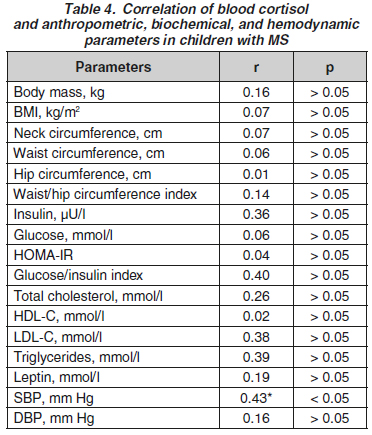
No significant correlation between cortisol and children’s age (r = 0.21; p > 0.05) and gender (r = 0.27; p > 0.05) was observed. The study of the correlation dependence bet–ween the blood cortisol level and anthropometric parameters of children with MS did not reveal significance (Table 4). A similar lack of connection was established between blood cortisol and parameters of lipid and carbohydrate metabolism (p > 0.05). Correlation dependence between blood cortisol and blood leptin was not statistically significant (p > 0.05).
Regarding the hemodynamic component of MS, blood cortisol was significantly correlated with SBP (r = 0.43; p < 0.05).

Discussion

Early detection of MS in children and screening for potentially related diseases, orienting children at risk to prevention with an emphasis on lifestyle and nutritional changes are extremely important. Effective interventions and identification of early markers help to reduce the level and severity of MS in children and adults, and the development of type 2 diabetes mellitus and cardiovascular diseases.
According to the results of the study, an elevated blood cortisol level was detected in 31.8 % of children with MS, which is identical to the literature data that overweight and obese children, regardless of the degree of obesity, may have an elevated blood cortisol level [6, 21]. However, we found that blood cortisol levels in children with MS did not differ from a similar parameter in children without MS, which corresponds to the literature data of normal or lower values of cortisol in children with MS than without MS [3, 10], and contradicts the data M.J. Weigensberg et al. [22] of significantly higher CT values in children with MS.
According to research, stress is considered an impor–tant risk factor for childhood obesity, and the absence of group differences in cortisol levels is explained by individual differences. It is inclined to think that the reaction from the cortisol is partially related to the individual’s genetically determined reaction to various types of stressors [9]. A greater or lesser tendency to mental or physical changes under stress is explained by the individual characteristics of the child [9].
According to the data of our study, the blood cortisol level did not correlate with the age and gender of children, which is consistent with the data of E.A. Kjölhede et al. [10]. However, it was claimed that girls showed significantly higher blood cortisol concentrations compared to boys, regardless of the stage of puberty [6].
We did not prove the relationship between blood cortisol in children with MS and anthropometric criteria: body weight, BMI, neck circumference, waist circumference, hip circumference, and waist/hip circumference index, that is, markers and the degree of severity of generalized and abdo–minal obesity, which corresponds to the data of the literature [22, 23].
No correlation was established between the blood cortisol and parameters of carbohydrate metabolism, which corresponds to the data of the literature [22]. However, we observed a tendency toward the significance of the dependence between cortisol and the glucose/insulin index. According to the data of separate studies, an increased morning cortisol blood level in obese children was associated with a higher fasting glucose level, regardless of the presence of IR [21].
It was established that cortisol through β-blockers and atrial and brain natriuretic peptide promotes lipolysis with the release of fatty acids and increases insulinemia and IR [19].
The relationship between cortisol and blood lipid para–meters has not been proven, which is consistent with the data obtained by M.J. Weigensberg et al. [22].
However, we observed a tendency toward dependence between cortisol and blood triglycerides. It is claimed that although MS as a whole is not associated with cortisol in girls, individual components are significantly dependent, so HDL-C is inversely correlated with cortisol, and triglycerides are directly correlated [7].
According to the data we obtained, cortisol production correlated only with SBP, which corresponds to the data of M.J. Weigensberg et al., that SBP has the greatest influen–ce on the level of cortisol. So, there may be a connection between cortisol production and MS in children [11]. Our determination of the correlation between cortisol and SBP in children without MS did not reveal significance (r = 0.28; p > 0.05). The pathogenetic influence of blood pressure on the concentration of cortisol is explained through the effect on 11beta-hydroxysteroid dehydrogenase-1 with stimulation of the conversion of cortisone to cortisol [14].
Of interest are the data of M.J. Weigensberg et al. [22] about the increase in blood cortisol with an increase in the number of MS criteria, i.e. each of the MS criteria has its own contribution to changes in blood cortisol.
So, although MS as a whole was not related to cortisol, a separate component SBP was in a direct significant relationship. It should be noted that elevated blood pressure values are not a criterion-forming pathogenetic sign of MS, such as abdominal obesity and IR. Therefore, it can be argued that CT does not have a decisive pathogenetic significance for the development of MS in children.
Further long-term observational studies with larger participant numbers are now needed to confirm the results of this study. The long-term cardiometabolic consequences of hypercortisolemia in obesity and MS in children require further study.

Conclusions

In children with MS, there was no significant difference in the level of blood cortisol compared with children without MS criteria. The association of blood cortisol with MS criteria other than systolic blood pressure has not been found. Although cortisol is important in the formation of systolic blood pressure, it cannot serve as a marker of MS in children since it is not a criterion-forming sign of MS.
 
Received 07.03.2023
Revised 25.04.2023
Accepted 08.05.2023

Список литературы

  1. Zimmet P., Alberti K.G., Kaufman F., Tajima N., Silink M. et al.; IDF Consensus Group. The metabolic syndrome in children and adolescents — an IDF consensus report. Pediatr. Diabetes. 2007 Oct. 8(5). 299-306. doi: 10.1111/j.1399-5448.2007.00271.x.
  2. Weihe P., Weihrauch-Blüher S. Metabolic syndrome in children and adolescents: diagnostic criteria, therapeutic options, and perspectives. Curr. Obes. Rep. 2019 Dec. 8(4). 472-479. doi: 10.1007/s13679-019-00357-x.
  3. Morton N.M., Seckl J.R. 11beta-hydroxysteroid dehydrogenase type 1 and obesity. Front. Horm. Res. 2008. 36. 146-164. doi: 10.1159/000115363.
  4. Vogelzangs N., Beekman A.T., Dik M.G., Bremmer M.A., Comijs H.C. et al. Late-life depression, cortisol, and metabolic syndrome. Am. J. Geriatr. Psychiatry. 2009 Aug. 17(8). 716-21. doi: 10.1097/JGP.0b013e3181aad5d7.
  5. Garcez A., Leite H.M., Weiderpass E., Paniz V.M.V., Watte G. et al. Basal cortisol levels and metabolic syndrome: a systematic review and meta-analysis of observational studies. Psychoneuroendocrinology. 2018 Sep. 95. 50-62. doi: 10.1016/j.psyneuen.2018.05.023. doi: 10.1016/j.psyneuen.2018.05.023.
  6. Reinehr T., Kulle A., Wolters B., Knop C., Lass N. et al. Relationships between 24-hour urinary free cortisol concentrations and metabolic syndrome in obese children. J. Clin. Endocrinol. Metab. 2014 Jul. 99(7). 2391-9. doi: 10.1210/jc.2013-4398.
  7. DuBose K.D., McKune A.J. The relation between salivary cortisol and the metabolic syndrome score in girls. J. Pediatr. Endocrinol. Metab. 2013. 26(9–10). 841-7. doi: 10.1515/jpem-2012-0415.
  8. Mazgelytė E., Mažeikienė A., Burokienė N., Matuzevičienė R., Linkevičiūtė A. et al. Association between hair cortisol concentration and metabolic syndrome. Open Med. (Warsaw). 2021 Jun 16. 16(1). 873-881. doi: 10.1515/med-2021-0298.
  9. Van der Valk E.S., Savas M., van Rossum E.F.C. Stress and Obesity: Are There More Susceptible Individuals? Curr. Obes. Rep. 2018 Jun. 7(2). 193-203. doi: 10.1007/s13679-018-0306-y.
  10. Kjölhede E.A., Gustafsson P.E., Gustafsson P.A., Nelson N. Overweight and obese children have lower cortisol levels than normal-weight children. Acta Paediatr. 2014 Mar. 103(3). 295-9. doi: 10.1111/apa.12499.
  11. Sen Y., Aygun D., Yilmaz E., Ayar A. Children and adolescents with obesity and metabolic syndrome have high circulating cortisol levels. Neuroendocrinol. Lett. 2008 Feb. 29(1). 141-5.
  12. Özçelik E., Uslu S., Kebapçı N., Kara M., Dokumacıoğlu A., Musmul A. Interrelations of serum leptin levels with adrenocorticotropic hormone, basal cortisol, and dehydroepiandrosterone sulfate levels in patients with metabolic syndrome. Diabetes and Metabolic Syndrome: Clinical Research and Reviews. 2010. 4(1). 13-17. doi: 10.1016/j.dsx.2010.01.005.
  13. Michels N., Sioen I., Schraven K., De Decker A., van Aart C., De Henauw S. Children’s cortisol and externalizing stress symptoms are predictors of adiponectin evolution over two years. Biol. Psychol. 2018 Jan. 131. 89-95. doi: 10.1016/j.biopsycho.2017.05.016.
  14. Anagnostis P., Athyros V.G., Tziomalos K., Karagiannis A., Mikhailidis D.P. Clinical review: the pathogenetic role of cortisol in the metabolic syndrome: a hypothesis. J. Clin. Endocrinol. Metab. 2009 Aug. 94(8). 2692-701. doi: 10.1210/jc.2009-0370.
  15. Jin S., Sun X., Liu Q., Liang H., Li C., Mao Z. et al. Steroid hormones in cord blood mediate the association between maternal prepregnancy BMI and birth weight. Obesity. 2019. 27. 1338-46.
  16. Ricotti R., Solito A., Mariotti Zani E., Caputo M., Genoni G. et al. The relationship between cortisol and IGF-I influences metabolic alteration in pediatric overweight and obesity. Eur. J. Endocrinol. 2020 Mar. 182(3). 255-264. doi: 10.1530/EJE-19-0792.
  17. Krishnaveni G.V., Veena S.R., Dhube A., Karat S.C., Phillips D.I., Fall C.H. Size at birth, morning cortisol and cardiometabolic risk markers in healthy Indian children. Clin. Endocrinol. (Oxford). 2014 Jan. 80(1). 73-9. doi: 10.1111/cen.12143.
  18. Kraemer W.J., Ratamess N.A., Hymer W.C., Nindl B.C., Fragala M.S. Growth Hormone(s), Testosterone, Insulin-Like Growth Factors, and Cortisol: Roles and Integration for Cellular Development and Growth With Exercise. Front. Endocrinol. (Lausanne). 2020 Feb 25. 11. 33. doi: 10.3389/fendo.2020.00033.
  19. Hewagalamulage S.D., Lee T.K., Clarke I.J., Henry B.A. Stress, cortisol, and obesity: a role for cortisol responsiveness in identifying individuals prone to obesity. Domest. Anim. Endocrinol. 2016 Jul. 56 Suppl. S112-20. doi: 10.1016/j.domaniend.2016.03.004.
  20. Gromnatska N., Lemishko B., Kulya O., Pasichna I., Beliusova V. Screening of metabolic syndrome in children and adolescents. International Journal of Endocrinology (Ukraine). 2022. 18(2). 94-99. doi: 10.22141/2224-0721.18.2.2022.1153.
  21. Martens A., Duran B., Vanbesien J., Verheyden S., Rutteman B. et al. Clinical and biological correlates of morning serum cortisol in children and adolescents with overweight and obesity. PLoS One. 2021 Oct 20. 16(10). e0258653. doi: 10.1371/journal.pone.0258653.
  22. Weigensberg M.J., Toledo-Corral C.M., Goran M.I. Association between the metabolic syndrome and serum cortisol in overweight Latino youth. J. Clin. Endocrinol. Metab. 2008 Apr. 93(4). 1372-8. doi: 10.1210/jc.2007-2309.
  23. Abraham S.B., Rubino D., Sinaii N., Ramsey S., Nieman L.K. Cortisol, obesity, and the metabolic syndrome: a cross-sectional study of obese subjects and review of the literature. Obesity (Silver Spring). 2013 Jan. 21(1). E105-17. doi: 10.1002/oby.20083.

Вернуться к номеру