
Международный эндокринологический журнал Том 22, №1, 2026
Вернуться к номеру
Амілін та параметри вуглеводного й ліпідного обміну в пацієнтів із цукровим діабетом 2-го типу в азербайджанській популяції
Авторы: Z.G. Akhmedova, D.I. Kagramanova
A. Aliyev Azerbaijan State Institute for Advanced Medical Studies, Baku, Azerbaijan
Рубрики: Эндокринология
Разделы: Клинические исследования
Версия для печати
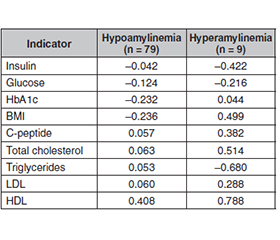
Актуальність. Цукровий діабет 2-го типу (ЦД2) та ожиріння — це два взаємопов’язані та взаємно посилюючі метаболічні захворювання, які з кожним днем привертають все більше уваги дослідників. Інсулін та амілін стосовно вуглеводного обміну виконують однакову роль. Але відносно впливу на ліпідний обмін дія цих гормонів суперечлива: інсулін як анаболічний гормон збільшує жирову масу, а амілін, навпаки, зменшує масу тіла. Можливо, це може пояснити відсутність цукрового діабету 2-го типу у деяких пацієнтів з ожирінням. Мета: оцінка рівня аміліну та його зв’язку з параметрами вуглеводного й ліпідного обміну в осіб із ЦД2 в азербайджанській популяції. Матеріали та методи. У дослідженні взяли участь 88 пацієнтів із ЦД2 та ожирінням, чий середній вік дорівнював 51,01 ± 7,34 року. Тривалість ЦД2 становила 7,14 ± 2,14 року. Результати. Рівень аміліну у хворих із ЦД2 був у середньому вірогідно нижчим (на 71,4 %) порівняно з контрольним значенням (p < 0,001). Гіпоамілінемія спостерігалася у 89,7 % пацієнтів, а гіперамілінемія — у 10,3 %. В осіб із гіпоамілінемією вміст аміліну вірогідно знижений (21,10 ± 7,05 пмоль/л) порівняно як з контрольною (50,40 ± 3,12), так і з групою гіперамілінемії (50,83 ± 6,75; p < 0,05), що є очікуваним, оскільки цей показник є основою розподілу пацієнтів. В обох групах (з гіпо- та гіперамілінемією) концентрація інсуліну вища, ніж у контрольній (22,99 і 22,37 проти 13,5 мкОд/мл). Гіпо- та гіперамілінемія пов’язані з тяжчими порушеннями вуглеводного й ліпідного обміну, але природа цих порушень відрізняється. Кореляційний аналіз виявив більш активну участь аміліну в метаболічній регуляції, про що свідчать позитивні зв’язки з індексом маси тіла, С-пептидом, загальним холестерином, ліпопротеїнами низької щільності й особливо виражена позитивна кореляція з ліпопротеїнами високої щільності, а також негативні зв’язки з рівнями тригліцеридів та інсуліну. Висновки. Гіпо- та гіперамілінемія є різними стадіями патогенетичного процесу: від компенсаторної гіперсекреції аміліну на тлі інсулінорезистентності до подальшого виснаження β-клітин і розвитку гіпоамілінемії з тяжкою метаболічною декомпенсацією.
Background. Type 2 diabetes mellitus (T2DM) and obesity are two interrelated and mutually aggravating metabolic diseases that are attracting more and more attention of researchers every day. Insulin and amylin in relation to glucose perform the same role. But in relation to lipids, the action of these hormones is contradictory: insulin as an anabolic increases fat mass, and amylin, on the contrary, reduces weight. Perhaps, this can explain the absence of T2DM in some patients with obesity. The purpose of the study was to evaluate the level of amylin and its association with the parameters of carbohydrate and lipid metabolism in patients with T2DM in the Azerbaijani population. Materials and methods. The study involved 88 patients with T2DM and obesity, the average age was 51.01 ± 7.34 years. The duration of T2DM was 7.14 ± 2.14 years. Results. Amylin in patients with T2DM was on average significantly lower (by 71.4 %) compared to the control value (p < 0.001). Hypoamylinemia was observed in 89.7 % of patients, and hyperamylinemia — in 10.3 % of patients. In hypoamylinemia, the amylin level is significantly reduced (21.10 ± 7.05 pmol/l) compared to both the control (50.40 ± 3.12) and the hyperamylinemia group (50.83 ± 6.75; p < 0.05). This is expected, since this indicator is the basis for identifying the groups. In both groups of patients (with hypo- and hyperamylinemia), the insulin concentration is higher than in the control (22.99 and 22.37 vs. 13.5 μU/ml). Hypo- and hyperamylinemia are associated with severe disorders of carbohydrate and lipid metabolism, but the nature of these disorders differs. Correlation analysis revealed a more active participation of amylin in metabolic regulation, as evidenced by positive relationships with body mass index, C-peptide, total cholesterol, low-density lipoprotein and a particularly pronounced positive correlation with high-density lipoprotein, as well as negative relationships with triglycerides and insulin. Conclusions. Hypo- and hyperamylinemia represent different stages of the pathogenetic process: from compensatory hypersecretion of amylin against the background of insulin resistance to subsequent depletion of β-cells and the development of hypoamylinemia with severe metabolic decompensation.
цукровий діабет 2-го типу; амілін; гіпо- та гіперамілінемія; вуглеводний обмін; ліпідний обмін; зв’язок
type 2 diabetes mellitus; amylin; hypo- and hyperamylinemia; carbohydrate metabolism; lipid metabolism; association
Для ознакомления с полным содержанием статьи необходимо оформить подписку на журнал.
- Lushchak VI, Covasa M, Abrat OB, Mykytyn TV, Tverdokhlib IZ, Storey KB, Semchyshyn H. Risks of obesity and diabetes deve–lopment in the population of the Ivano-Frankivsk region in Ukraine. EXCLI J. 2023 Sep 25;22:1047-1054. doi: 10.17179/excli2023-6296.
- NCD Risk Factor Collaboration (NCD-RisC). Worldwide trends in diabetes prevalence and treatment from 1990 to 2022: a pooled analysis of 1108 population-representative studies with 141 million participants. Lancet. 2024 Nov 23;404(10467):2077-2093. doi: 10.1016/S0140-6736(24)02317-1.
- Sulaieva O, Yerokhovych V, Zemskov S, Komisarenko I, Gurianov V, Pankiv V, et al. The impact of war on people with type 2 diabetes in Ukraine: a survey study. EClinicalMedicine. 2024 Dec 15;79:103008. doi: 10.1016/j.eclinm.2024.103008.
- Duncan BB, Magliano DJ, Boyko EJ. IDF Diabetes Atlas 11th edition 2025: global prevalence and projections for 2050. Nephrol Dial Transplant. 2025 Dec 23;41(1):7-9. doi: 10.1093/ndt/gfaf177.
- Tsaryk I, Pashkovska N, Pankiv V, Pashkovskyy V, Stankova N. Features of Anxiety and Depression Indicators in Patients with Autoimmune Diabetes Mellitus on the Background of Different Vitamin D Status. Romanian Journal of Diabetes Nutrition and Metabolic Disea–ses. 2025;32(2):203-209. doi: 10.46389/rjd-2025-1873.
- Schulze MB, Stefan N. Metabolically healthy obesity: from epidemiology and mechanisms to clinical implications. Nat Rev Endocrinol. 2024;20:633-646. doi: 10.1038/s41574-024-01008-5.
- Blüher M. Metabolically Healthy Obesity. Endocrine Reviews. 2020;41(3):bnaa004. doi: 10.1210/endrev/bnaa004.
- Park IR, Chung YG, Won KC. Overcoming β-Cell Dysfunction in Type 2 Diabetes Mellitus: CD36 Inhibition and Antioxidant System. Diabetes Metab J. 2025 Jan;49(1):1-12. doi: 10.4093/dmj.2024.0796.
- Kerper N, Ashe S, Hebrok M. Pancreatic β-Cell Development and Regeneration. Cold Spring Harb Perspect Biol. 2022 May 27;14(5):a040741. doi: 10.1101/cshperspect.a040741.
- Wang JW, Chen PY, Huang HH, Yeh C, Chen SC, Lee WJ, et al. Change of plasma amylin after bariatric surgery challenged by oral glucose is associated with remission of type 2 diabetes mellitus. J Chin Med Assoc. 2021;84:1001-1006. doi: 10.1097/JCMA.0000000000000602.
- Alanazi M, Al-Kuraishy HM, Albuhadily AK, Al-Gareeb AI, Abdelaziz AM, Alexiou A, et al. The protective effect of amylin in type 2 diabetes: Yes or no. European Journal of Pharmacology. 2025;996:177593. doi: 10.1016/j.ejphar.2025.177593.
- Dehestani B, Stratford NR, le Roux CW. Amylin as a Future Obesity Treatment. J Obes Metab Syndr. 2021 Dec 30;30(4):320-325. doi: 10.7570/jomes21071.
- Walker CS, Aitken JF, Vazhoor Amarsingh G, Zhang S, Cooper GJS. Amylin: emergent therapeutic opportunities in overweight, obesity and diabetes mellitus. Nat Rev Endocrinol. 2025 Aug;21(8):482-494. doi: 10.1038/s41574-025-01125-9.
- Lutz TA. Creating the amylin story. Appetite. 2022 May 1;172:105965. doi: 10.1016/j.appet.2022.105965.
- Volčanšek Š, Koceva A, Jensterle M, Janež A, Muzurović E. Amylin: From Mode of Action to Future Clinical Potential in Diabetes and Obesity. Diabetes Ther. 2025 Jun;16(6):1207-1227. doi: 10.1007/s13300-025-01733-8.
- Lee S. A Review of Amylin Peptide Receptor Activators for Obesity Pharmacotherapy. Curr Drug Targets. 2025 Aug 29. doi: 10.2174/0113894501398624250819070004.
- Chung CW, Kim J. Amylin Revisited: A 5-Year Perspective on Its Emerging Role in the Treatment of Diabesity. J Obes Metab Syndr. 2026 Jan 19. doi: 10.7570/jomes25085.
- Leslie RD, Ma RCW, Franks PW, Nadeau KJ, Pearson ER, Redondo MJ. Understanding diabetes heterogeneity: key steps towards precision medicine in diabetes. Lancet Diabetes Endocrinol. 2023;11:848-60. doi: 10.1016/S2213-8587(23)00159-6.
- Shchubelka K, Wolfsberger WW, Oleksyk O, Sverdliuk I, Kacur M, Tynta S, et al. Genomics of Type 1 Diabetes in Ukraine Initiative. International Journal of Endocrinology (Ukraine). 2025;21(4):343-350. doi: 10.22141/2224-0721.21.4.2025.1557.
- Cao J, Belousoff MJ, Liang YL, Johnson RM, Josephs TM, Fletcher MM, et al. A structural basis for amylin receptor phenotype. Science. 2022;375(6587):eabm9609. doi: 10.1126/science.abm9609.
- Martinez-Valbuena I, Valenti-Azcarate R, Amat-Villegas I, Riverol M, Marcilla I, de Andrea CE, et al. Amylin as a potential link between type 2 diabetes and Alzheimer disease. Ann Neurol. 2019 Oct;86(4):539-551. doi: 10.1002/ana.25570.
- Iglesias-Fortes S, González-Blanco C, García-Carrasco A, Izquierdo-Lahuerta A, García G, García-Aguilar A, et al. The overexpression of human amylin in pancreatic β cells facilitate the appearance of amylin aggregates in the kidney contributing to diabetic nephropathy. Sci Rep. 2024 Oct 21;14(1):24729. doi: 10.1038/s41598-024-77063-9.