
Международный эндокринологический журнал Том 22, №1, 2026
Вернуться к номеру
Ожиріння, надмірна маса тіла та гематологічні показники у хворих на злоякісні новоутворення органів черевної порожнини
Авторы: I.O. Malyshevskyi (1), V.P. Polyovyy (2), O.Y. Khomko (2), V.V. Petrynych (2), P.V. Kyfiak (2), O.I. Sydorchuk (3)
(1) - Chernivtsi Regional Clinical Oncology Centre, Chernivtsi, Ukraine
(2) - Bukovinian State Medical University, Chernivtsi, Ukraine
(3) - Bogomolets National Medical University, Kyiv, Ukraine
Рубрики: Эндокринология
Разделы: Клинические исследования
Версия для печати
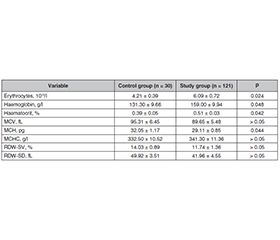
Актуальність. Існують докази того, що різні типи злоякісних новоутворень черевної порожнини можуть бути пов’язані з ожирінням та змінами гематологічних показників. Збільшення маси тіла й ожиріння можуть впливати на результати лікування. Мета: вивчити клінічні та патогенетичні зміни найбільш поширених гематологічних показників у пацієнтів зі злоякісними новоутвореннями черевної порожнини i надмірною масою тіла. Матеріали та методи. Обсерваційне дослідження охопило 151 хворого на злоякісні новоутворення черевної порожнини, розділених на основну (n = 121, індекс маси тіла (ІМТ) ≥ 30 кг/м2) та контрольну (n = 30, ІМТ ≤ 29 кг/м2) групи. Були проаналізовані діагноз, стадія, поширеність процесу та супутня патологія, низка антропометричних і статистичних параметрів, а також оцінені різні показники, що характеризують повний спектр гематологічних (еритроцити, лейкоцити, тромбоцити) змін. Результати. При тому, що кількісні дані відрізнялися в групах пацієнтів із надмірною масою та нормальним ІМТ, якість еритроцитів загалом була гірша, якщо ІМТ перевищував 30 кг/м2. Більшість мезенхімальних стовбурових клітин крові не мали суттєвої залежності від ІМТ у хворих на злоякісні новоутворення черевної порожнини, відмінності між обома групами були статистично вірогідними лише у випадку кількості ретикулоцитів та їх середнього об’єму. Тромбоцити, тромбокрит, середній об’єм тромбоцитів і ширина розподілу тромбоцитів були значно більшими в пацієнтів з ІМТ ≥ 30 кг/м2, що свідчить про вищий ризик тромботичних подій у цій когорті. Висновки. Зміни гематологічних показників в осіб зі злоякісними новоутвореннями черевної порожнини варіювали від незначних до дуже високих залежно від ІМТ. Найбільш клінічно значущі зміни при високому ІМТ спостерігалися в тромбоцитах, що свідчить про важливість ожиріння у виникненні тромботичних ускладнень у пацієнтів зі злоякісними новоутвореннями черевної порожнини.
Background. There is evidence that different types of abdominal malignancies may have associations with obesity and changes in haematological indices. Increased body weight and obesity may influence management and treatment results. The purpose was to study the clinical and pathogenetic implications of the most common haematological indices in patients with abdominal malignancies and excessive body weight. Materials and methods. This observational study involves a total of 151 patients with abdominal malignancies divided into study (n = 121, body mass index (BMI) ≥ 30 kg/m2) and control (n = 30, BMI ≤ 29 kg/m2) groups. The diagnosis, staging, prevalence of the process, concomitant pathology, a number of anthropometric and statistical parameters were analysed, and various indices characterizing full spectre of haematological (red blood cells, white blood cells, platelets) changes were assessed. Results. Whereas quantitative data is different in overweight and normal BMI groups of patients with abdominal malignancies, the quality of red blood cells is generally worse if BMI exceeds 30 kg/m2. Majority of the mesenchymal blood stem cell variables show no significant dependence on BMI in abdominal malignancies’ patients, differences between both groups were statistically reliable only in case of reticulocyte ratio and their mean volume. Platelets, thrombocrit, mean platelet volume, and platelet distribution width were significantly higher in patients with BMI ≥ 30 kg/m2, depicting higher risk for thrombotic events in these cohort. Conclusions. Changes in haematological indices in patients with abdominal malignancies varied from insignificant to very high in relation to BMI. The most clinically relevant changes depending on high BMI were observed in platelets, indicating importance of obesity in occurrence of thrombotic complications in patients with abdominal malignancies.
ожиріння; метаболізм; черевна порожнина; злоякісні новоутворення; хірургія; лейкоцити; еритроцити; тромбоцити; ускладнення; стовбурові клітини
obesity; metabolism; abdomen; malignancies; surgery; white blood cells; red blood cells; platelets; complications; stem cells
Для ознакомления с полным содержанием статьи необходимо оформить подписку на журнал.
- Ingram Y, Olujide O, Sheikh N, Robinson A, Ho JH, Syed AA, Adam S. The Relationship Between Obesity and Cancer: Epidemiology, Pathophysiology, and the Effect of Obesity Treatment on Cancer. Curr Oncol. 2025;32(6):362. doi: 10.3390/curroncol32060362.
- Sandeep Wagle N, Nogueira L, Devasia TP, et al. Cancer treatment and survivorship statistics, 2025. Cancer J Clinicians. 2025;75(4):308-340. doi: 10.1158/1055-9965.EPI-23-1006.
- Pati S, Irfan W, Jameel A, Ahmed S, Shahid RK. Obesity and Cancer: A Current Overview of Epidemiology, Pathogenesis, Outcomes, and Management. Cancers (Basel). 2023 Jan 12;15(2):485. doi: 10.3390/cancers15020485.
- Semianiv M, Sydorchuk L, Fedonyuk L, Nebesna Z, Kamyshnyi O, Sydorchuk A, et al. Metabolic and Hormonal Prognostic Mar–kers of Essential Arterial Hypertension Considering the Genes Polymorphism AGTR1 (rs5186) and VDR (rs2228570). Romanian J Diabetes, Nutrition Metab Diseases. 2021;28(3):284-91. Available from: https://www.rjdnmd.org/index.php/RJDNMD/article/view/1049.
- Sydorchuk A, Sydorchuk L, Gutnitska A, Vasyuk V, Tkachuk O, Dzhuryak V, et al. The role of NOS3 (rs2070744) and GNB3 (rs5443) genes’ polymorphisms in endothelial dysfunction pathway and carotid intima-media thickness in hypertensive patients. Gen Physiol Biophys. 2023;42(2):179-190. doi: 10.4149/gpb_2022060.7.
- Semianiv MM, Sydorchuk LP, Dzhuryak VS, et al. Association of AGTR1 (rs5186), VDR (rs2228570) genes polymorphism with blood pressure elevation in patients with essential arterial hypertension. J Med Life. 2021 Nov-Dec;14(6):782-789. doi: 10.25122/jml-2021-0018.
- Sydorchuk L, Lytvyn B, Sydorchuk A, Yarynych Y, Daruvuri SP, Semenenko S, et al. Alpha-adducin 1 (rs4961) gene and its expression associated with sodium sensitivity in hypertensive patients: a cohort study in the western Ukrainian population. Endocr Regul. 2024 Oct 1;58(1):195-205. doi: 10.2478/enr-2024-0023.
- Miranda BCJ, Tustumi F, Nakamura ET, Shimanoe VH, Kikawa D, Waisberg J. Obesity and Colorectal Cancer: A Narrative Review. Medicina. 2024;60(8):1218. doi: 10.3390/medicina60081218.
- Cobianchi L, Dal Mas F, Massaro M, et al. Diversity and ethics in trauma and acute care surgery teams: results from an international survey. World J Emerg Surg. 2022;17(44). doi: 10.1186/s13017-022-00446-8.
- De Simone B, Ansaloni L, Sartelli M, et al. The Operative management in Bariatric Acute abdomen (OBA) Survey: long-term complications of bariatric surgery and the emergency surgeon’s point of view. World J Emerg Surg. 2020;15(2). doi: 10.1186/s13017-019-0281-y.
- Aune D, Sen A, Prasad M, Norat T, Janszky I, Tonstad S, et al. BMI and all-cause mortality: Systematic review and non-linear dose-response meta-analysis of 230 cohort studies with 3.74 million deaths among 30.3 million participants. BMJ. 2016;353:i2156. doi: 10.1136/bmj.i2156.
- Coccolini F, Mazzoni A, Cremonini C. et al. Colorectal neoplastic emergencies in immunocompromised patients: preliminary result from the Web-based International Register of Emergency Surgery and Trauma (WIRES-T trial). Updates Surg. 2023. doi: 10.1007/s13304-023-01521-8.
- Wang W, Wang X, Jiang Y, et al. Normal weight obesity, circulating biomarkers and risk of breast cancer: a prospective cohort study and meta-analysis. Br J Cancer. 2025;132:203-211. doi: 10.1038/s41416-024-02906-1.
- De Simone B, Abu-Zidan FM, Saeidi S, et al. Knowledge, attitudes and practices of using Indocyanine Green (ICG) fluorescence in emergency surgery: an international web-based survey in the ARtificial Intelligence in Emergency and trauma Surgery (ARIES) — WSES project. Updates Surg. 2024. doi: 10.1007/s13304-024-01853-z.
- Rubio-Jurado B, Balderas-Peña LM, García-Luna EE, Zavala-Cerna MG, Riebeling-Navarro C, Reyes PA, Nava-Zavala AH. Obesity, Thrombotic Risk, and Inflammation in Cancer. Adv Clin Chem. 2018;85:71-89. doi: 10.1016/bs.acc.2018.02.006.
- Hess B, Cahenzli M, Forbes A; WFICC (World Federation of Intensive and Critical Care). Management of acute mesenteric ischaemia: Results of a worldwide survey. Clinical Nutrition ESPEN. 2023;54:194-205. doi: 10.1016/j.clnesp.2022.12.022.
- Wan T, Song J, Zhu D. Cancer-associated venous thromboembolism: a comprehensive review. Thromb J. 2025;23(1):35. doi: 10.1186/s12959-025-00719-7.
- Tsantes AG, Petrou E, Tsante KA, et al. Cancer-Associa–ted Thrombosis: Pathophysiology, Laboratory Assessment, and Current Guidelines. Cancers. 2024;16(11):2082. doi: 10.3390/cancers16112082.
- De Simone B, Agnoletti V, Abu-Zidan FM, ORSA Collaborative, et al. The Operating Room Management for emergency Surgical Activity (ORSA) study: a WSES international survey. Updates Surg. 2024. doi: 10.1007/s13304-023-01668-4.
- Reichert M, Sartelli M, Weigand MA, Hecker M, Oppelt PU, Noll J, et al.; WSES COVID-19 emergency surgery survey collaboration group. Two years later: Is the SARS-CoV-2 pandemic still having an impact on emergency surgery? An international cross-sectional survey among WSES members. World J Emerg Surg. 2022;17(1):34. doi: 10.1186/s13017-022-00424-0.
- De Simone B, Abu-Zidan FM, Chouillard E. et al. The ChoCO-W prospective observational global study: Does COVID-19 increase gangrenous cholecystitis? World J Emerg Surg. 2022;17(61). doi: 10.1186/s13017-022-00466-4.
- Sartelli M, Mossialos E, Coccolini F, et al. Global health at crossroads: uniting together to overcome challenges, restore trust and advance priorities for a sustainable future. World J Emerg Surg. 2025;20(84). doi: 10.1186/s13017-025-00656-w.
- Sydorchuk LP, Dzhuryak VS, Sydorchuk AR, Levytska SA, Knut RP, Sokolenko MO, et al. Association of lipids’ metabolism disorders with aldosterone synthase CYP11b2 (-344C/T) gene polymorphism in hypertensive patients depending on glomerular filtration rate. Pharmacology Online. 2020;2:230-242.
- Cobianchi L, Dal Mas F, Agnoletti V, et al. Time for a paradigm shift in shared decision-making in trauma and emergency surgery? Results from an international survey. World J Emerg Surg. 2023;18:14. doi: 10.1186/s13017-022-00464-6.
- Sydorchuk L, Sokolenko M, Skoda M, Nevinskyi D, Vyklyuk Y, Sydorchuk R, et al. Machine Learning Models in Classifying, Predicting and Managing COVID-19 Severity. Preprints. 2025;2025121803. doi: 10.20944/preprints202512.1803.v1.
- Finnigan D, Hajjaj OI, Othman M. Red blood cell changes due to cancer and cancer treatments: a narrative review. Curr Opin Hematol. 2025;32(2):93-103. doi: 10.1097/MOH.0000000000000859.
- Léniz A, Fernández-Quintela A, Arranz S, Portune K, Tueros I, Arana E, et al. Altered Red Blood Cell Fatty Acid and Serum Adipokine Profiles in Subjects with Obesity. Biomedicines. 2023;11(12):3320. doi: 10.3390/biomedicines11123320.
- Sarin A, Agarwal A, Dadagoudar C, et al. 285P Reticulocyte haemoglobin equivalent as an early predictor of iron deficiency anaemia in cancer patients. Annals of Oncology. 2022;33:S1543-S1544.
- Puccini M, Rauch C, Jakobs K, Friebel J, Hassanein A, Landmesser U, Rauch U. Being Overweight or Obese Is Associated with an Increased Platelet Reactivity Despite Dual Antiplatelet Therapy with Aspirin and Clopidogrel. Cardiovasc Drugs Ther. 2023;37(4):833-837. doi: 10.1007/s10557-022-07325-z.
- Li S, Lu Z, Wu S, et al. The dynamic role of platelets in cancer progression and their therapeutic implications. Nat Rev Cancer. 2024;24:72-87. doi: 10.1038/s41568-023-00639-6.