
Международный эндокринологический журнал Том 22, №2, 2026
Вернуться к номеру
Вплив ліраглутиду на самців щурів із надмірною вагою та стрептозотоцин-індукованим діабетом
Авторы: Hanadi A. Hafth (1), Nawras A. Alwan (2), Eman Aboud Al-Masoudi (2)
(1) - Department of Basic Science, College of Dentistry, Al-Kunooze University, Basrah, Iraq
(2) - Department of Physiology, Pharmacology and Biochemistry, College of Veterinary Medicine, Basrah University, Basrah, Iraq
Рубрики: Эндокринология
Разделы: Клинические исследования
Версия для печати
Актуальність. Останніми роками зросло вивчення методів лікування з акцентом на інкретиновому ефекті, який характеризується постпрандіальним посиленням секреції інсуліну. Ефективні два терапевтичні підходи на основі інкретину, розроблені для контролю надмірної маси тіла й цукрового діабету. Мета: вивчення впливу ліраглутиду на самців щурів із надмірною вагою та стрептозотоцин-індукованим діабетом. Матеріали та методи. Сорок два статевозрілі самці щурів були випадковим чином розділені на 7 груп (по 6 тварин у групі). Група 1 (контрольна) отримувала внутрішньоочеревинні ін’єкції фізіологічного розчину (1 мл/кг/день протягом чотирьох тижнів). Групу 2 розподілено на три підгрупи: перша отримувала ін’єкції фізіологічного розчину (1 мл/кг) щодня впродовж чотирьох тижнів, друга — ліраглутид (віктоза) у вигляді підшкірних ін’єкцій у дозах 0,6; 0,8 та 1,2 мг/кг щодня протягом чотирьох тижнів, третя — ліраглутид (саксенда) у вигляді підшкірних ін’єкцій в аналогічних дозах (0,6; 0,8 та 1,2 мг/кг) щодня впродовж чотирьох тижнів. Групу 3 (стрептозотоцин-індукований цукровий діабет 2-го типу) теж розподілили на три підгрупи: перша отримувала фізіологічний розчин (1 мл/кг) щодня протягом чотирьох тижнів, друга — ліраглутид (віктоза) у дозах 0,6; 0,8 та 1,2 мг/кг щодня впродовж чотирьох тижнів, третя — ліраглутид (саксенда) в аналогічних дозах (0,6; 0,8 та 1,2 мг/кг) щодня протягом чотирьох тижнів. Наприкінці експерименту тварин із кожної групи анестезували й умертвляли для забору крові для біохімічної та гормональної оцінки. Результати. Установлено вірогідне зниження (P ≤ 0,05) індексу HOMA-IR, інсуліну, поліпшення показників функціонального стану нирок і печінки в групі, яка отримувала ліраглутид (віктоза), порівнянo з групою ліраглутиду (саксендa). В обох групах продемонстровано вірогідне (P ≤ 0,05) зниження вмісту печінкових трансаміназ порівняно з контрольною групою. Висновки. Хімічний склад та первинні метаболічні ефекти свідчать про те, що ліраглутид (віктоза) може мати перевагу в пацієнтів із цукровим діабетом, поліпшуючи глікемічний контроль і захист нирок. У той же час ліраглутид (саксенда) може мати кращий ефект щодо лікування ожиріння з акцентом на втрату ваги при ретельному моніторингу параметрів нирок і печінки.
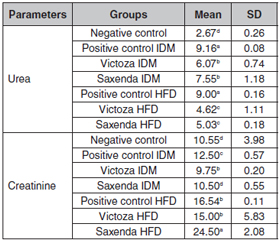
Background. Recent years have seen increased examination of therapies targeting the activity of the incretin hormone. The incretin effect is characterized by the postprandial augmentation of insulin secretion, and enhancers of two distinct incretin-based therapeutic approaches devised for overweight, and diabetes management. The purpose of the study was to use the treatment of liraglutide that mimics the composition of incretin, and in which case it is more efficient. Materials and methods. Forty-two mature male rats were randomly divided into 7 groups (6 animals each). Group 1 (control) was injected with normal saline intraperitoneally (1 ml/kg/day for 4 weeks). Group 2 is divided into three subgroups: positive controls were injected with normal saline (1 ml/kg) daily for 4 weeks; the victoza-treated group was injected with a graduated dose (0.6, 0.8, and 1.2 mg/kg) subcutaneously daily for 4 weeks, and the saxenda-treated group was injected with a graduated dose (0.6, 0.8, and 1.2 mg/kg) subcutaneously daily for 4 weeks. Group 3 (induced type 2 diabetes mellitus) is divided into three subgroups as well: positive controls were injected with normal saline (1 ml/kg) daily for 4 weeks; the victoza-treated group was injected with graduated doses (0.6, 0.8, and 1.2 mg/kg) subcutaneously daily for 4 weeks, and the saxenda-treated group was injected with graduated doses (0.6, 0.8, and 1.2 mg/kg) subcutaneously daily for 4 weeks. At the end of the experiment, all animals were anesthetized and sacrificed for blood collection for the biochemical and hormonal assessment. Results. The results show a significant decrease (P ≤ 0.05) in HOMA-IR, insulin hormone, kidney function tests, ALT, and alkaline phosphatase in the victoza-treated group as compared to the saxenda-treated group. Groups of IDM victoza and HFD victoza showed a significant (P ≤ 0.05) decrease in ALT levels as compared to the positive control DM, positive control HFD, and the same groups treated with saxenda. IDM saxenda group and HFD saxenda group showed a significant (P ≤ 0.05) decrease in ALT levels compared to the positive control DMG and the positive control HFD groups. Conclusions. The chemical formulations and primary metabolic effects suggest that victoza may be more suitable for patients with diabetes seeking improved glycemic control and renal protection, while saxenda may be preferable for obesity management with a focus on weight loss with careful monitoring of renal and hepatic parameters during rapid weight loss.
ліраглутид; глюкагоноподібний поліпептид-1; самці щурів зі стрептозотоцин-індукованим діабетом
liraglutide; glucagon-like-polypeptide-1; streptozotocin-induced diabetic male rats
Для ознакомления с полным содержанием статьи необходимо оформить подписку на журнал.
- Xie C, Alkhouri N, Elfeki MA. Role of incretins and glucagon receptor agonists in metabolic dysfunction-associated steatotic liver disease: Opportunities and challenges. World J Hepatol. 2024 May 27;16(5):731-750. doi: 10.4254/wjh.v16.i5.731.
- Santos-Hernández M, Reimann F, Gribble FM. Cellular me–chanisms of incretin hormone secretion. J Mol Endocrinol. 2024 Feb 22;72(4):e230112. doi: 10.1530/JME-23-0112.
- Nauck MA, Müller TD. Incretin hormones and type 2 diabetes. Diabetologia. 2023 Oct;66(10):1780-1795. doi: 10.1007/s00125-023-05956-x.
- Hamed K, Alosaimi MN, Ali BA, Alghamdi A, Alkhashi T, et al. Glucagon-Like Peptide-1 (GLP-1) Receptor Agonists: Exploring Their Impact on Diabetes, Obesity, and Cardiovascular Health Through a Comprehensive Literature Review. Cureus. 2024 Sep 1;16(9):e68390. doi: 10.7759/cureus.68390.
- Hammoud R, Kaur KD, Koehler JA, Baggio LL, Wong CK, et al. Glucose-dependent insulinotropic polypeptide receptor signaling alleviates gut inflammation in mice. JCI Insight. 2024 Dec 26;10(3):e174825. doi: 10.1172/jci.insight.174825.
- Holst JJ, Rosenkilde MM. GIP as a therapeutic target in diabetes and obesity: insight from incretin co-agonists. J Clin Endocrinol Metab. 2020;105(8):e2710-6. doi: 10.1210/clinem/dgaa327.
- El K, Campbell JE. The role of GIP in α-cells and glucagon secretion. Peptides. 2020;125:170213. doi: 10.1016/j.peptides.2019.170213.
- Murray-Thomas T, Dcruz JM, Harder-Lauridsen NM, Olsen AH, Williams R, Major-Pedersen A. Real-world use of liraglutide for weight management according to label in the United Kingdom: A cohort study using the Clinical Practice Research Datalink primary care databases. Diabetes Obes Metab. 2025 Jul;27(7):3705-3713. doi: 10.1111/dom.16393.
- Tomlinson B, Hu M, Zhang Y, Chan P, Liu ZM. Investigational glucagon-like peptide-1 agonists for the treatment of obesity. Expert Opin Investig Drugs. 2016;25(10):1167-79. doi: 10.1080/13543784.2016.1221925.
- Tak YJ, Lee SY. Long-term efficacy and safety of anti-obesity treatment: where do we stand? Curr Obes Rep. 2021;10:14-30. Available from: https://link.springer.com/article/10.1007/s13679-020-00422-w.
- Xu X, Chen J, Hu L, Liang M, Wang X, et al. Liraglutide re–gulates the viability of pancreatic α-cells and pancreatic β-cells through cAMP-PKA signal pathway. Life Sci. 2018;195:87-94. doi: 10.1016/j.lfs.2017.12.012.
- Kumar A, Mazumder R, Rani A, Pandey P, Khurana N. Novel approaches for the management of type 2 diabetes mellitus: an update. Curr Diabetes Rev. 2024;20(4):45-61. doi: 10.2174/0115733998261903230921102620.
- Tilinca MC, Tiuca RA, Burlacu A, Varga A. A 2021 Update on the Use of Liraglutide in the Modern Treatment of “Diabesity”: A Narrative Review. Medicina (Kaunas). 2021 Jun 29;57(7):669. doi: 10.3390/medicina57070669.
- Ismail A, Amer MS, Tawheed A. Glucagon-like peptide-1 receptor agonists: Evolution, gastrointestinal adverse effects, and future directions. World J Gastrointest Pharmacol Ther. 2025;16(3):107148. doi: 10.4292/wjgpt.v16.i3.107148.
- Nazaruddin N, Siregar TN, Sutriana A, Wahyuni S, Armansyah T. The Impact of Streptozotocin-Induced Diabetes on Testosterone Hormone and Androgen Receptor Expression and Correlation with Sperm Quality Impairment in Sprague Dawley Rats. Trends Sci. 2025;22(9):10409. doi: 10.48048/tis.2025.10409.
- Mai G, Fan L, Li M, Zhang P, Gan C, et al. A randomized phase 1 pharmacokinetic study comparing the potential biosimilar LRG201902 with liraglutide (Victoza®) in healthy male subjects. Front Pharmacol. 2021;11:610880. doi: 10.3389/fphar.2020.610880.
- Petrie A, Watson P. Statistics for veterinary and animal science. John Wiley & Sons; 2013. doi: 10.1136/vr.f7415.
- Guo J, Li C, Yang C, Li B, Wei J, et al. Liraglutide reduces hepatic glucolipotoxicity-induced liver cell apoptosis through NRF2 signaling in Zucker diabetic fatty rats. Mol Med Rep. 2018;17(6):8316-24. doi: 10.3892/mmr.2018.8919.
- Armstrong MJ, Gaunt P, Aithal GP, Barton D, Hull D, et al. Liraglutide safety and efficacy in patients with non-alcoholic steatohe–patitis (LEAN): a multicentre, double-blind, randomised, placebo-controlled phase 2 study. Lancet. 2016;387(10019):679-90. doi: 10.1016/S0140-6736(15)00803-X.
- Lee YS, Park MS, Choung JS, Kim SS, Oh HH, et al. Glucagon-like peptide-1 inhibits adipose tissue macrophage infiltration and inflammation in an obese mouse model of diabetes. Diabetologia. 2012;55(9):2456-68. doi: 10.1007/s00125-012-2592-3.
- Sturis J, Gotfredsen CF, Rømer J, Rolin B, Ribel U, et al. GLP‐1 derivative liraglutide in rats with β‐cell deficiencies: influence of metabolic state on β‐cell mass dynamics. Br J Pharmacol. 2003;140(1):123-32. doi: 10.1038/sj.bjp.0705397.
- Gniuli D, Calcagno A, Dalla Libera L, Calvani R, Leccesi L, et al. High-fat feeding stimulates endocrine, glucose-dependent insulinotropic polypeptide (GIP)-expressing cell hyperplasia in the duodenum of Wistar rats. Diabetologia. 2010;53(10):2233-40. doi: 10.1007/s00125-010-1830-9.
- Ansari S, Khoo B, Tan T. Targeting the incretin system in obesity and type 2 diabetes mellitus. Nat Rev Endocrinol. 2024;20(8):447-59. doi: 10.1038/s41574-024-00979-9.
- Kim SH, Abbasi F, Nachmanoff C, Stefanakis K, Kumar A, et al. Effect of the glucagon‐like peptide‐1 analogue liraglutide versus placebo treatment on circulating proglucagon‐derived peptides that mediate improvements in body weight, insulin secretion and action: A randomized controlled trial. Diabetes Obes Metab. 2021;23(2):489-98. doi: 10.1111/dom.14242.
- Mashayekhi M, Nian H, Mayfield D, Devin JK, Gamboa JL, et al. Weight loss-independent effect of liraglutide on insulin sensitivity in individuals with obesity and prediabetes. Diabetes. 2024;73(1):38-50. doi: 10.2337/db23-0356.
- Tamura K, Minami K, Kudo M, Iemoto K, Takahashi H, Seino S. Liraglutide improves pancreatic beta cell mass and function in alloxan-induced diabetic mice. PLoS One. 2015;10(5):e0126003. doi: 10.1371/journal.pone.0126003.
- Kaneto H, Kimura T, Shimoda M, Obata A, Sanada J, et al. Favorable effects of GLP-1 receptor agonist against pancreatic β-cell glucose toxicity and the development of arteriosclerosis: “the earlier, the better” in therapy with incretin-based medicine. Int J Mol Sci. 2021;22(15):7917. doi: 10.3390/ijms22157917.
- Challa TD, Beaton N, Arnold M, Rudofsky G, Langhans W, Wolfrum C. Regulation of adipocyte formation by GLP-1/GLP-1R signaling. J Biol Chem. 2012;287(9):6421-30. doi: 10.1074/jbc.M111.310342.
- Xiao S, Yang Y, Liu YT, Zhu J. Liraglutide Regulates the Kidney and Liver in Diabetic Nephropathy Rats through the miR‐34a/SIRT1 Pathway. J Diabetes Res. 2021;2021(1):8873956. doi: 10.1155/2021/8873956.
- Zhou Y, Xiong M, Niu J, Sun Q, Su W, et al. Secreted fibroblast-derived miR-34a induces tubular cell apoptosis in fibrotic kidney. J Cell Sci. 2014;127(20):4494-506. doi: 10.1242/jcs.155523.
- Castro NIQ, Almeida M, Orbea AF, Andrade DN, Carrera JF, et al. Efficacy of liraglutide for weight loss in overweight and obese non-diabetic adults: a systematic review and meta-analysis of randomized controlled trials. Cureus. 2025;17(4). doi: 10.7759/cureus.82479.
- Harper ME, Dent RRM, McPherson R. High-Quality Weight Loss in Obesity: Importance of Skeletal Muscle. Diabetes. 2025;dbi250003. doi: 10.2337/dbi25-0003.
- Kawanami D, Takashi Y. GLP-1 receptor agonists in diabetic kidney disease: from clinical outcomes to mechanisms. Front Pharmacol. 2020;11:967. doi: 10.3389/fphar.2020.00967.
- Dąbek B, Dybiec J, Frąk W, Fularski P, Lisińska W, et al. Novel therapeutic approaches in the management of chronic kidney disease. Biomedicines. 2023;11(10):2746. doi: 10.3390/biomedicines11102746.
- Awad ASM, Abd Al Haleem EN, El-Bakly WM, Sherief MA. Thymoquinone alleviates nonalcoholic fatty liver disease in rats via suppression of oxidative stress, inflammation, apoptosis. Naunyn Schmiedebergs Arch Pharmacol. 2016;389(4):381-91. Available from: https://link.springer.com/article/10.1007/s00210-015-1207-1.
- Jung CH, Mok JO. The effects of hypoglycemic agents on non-alcoholic fatty liver disease: focused on sodium-glucose cotransporter 2 inhibitors and glucagon-like peptide-1 receptor agonists. J Obes Metab Syndr. 2019;28(1):18. doi: 10.7570/jomes.2019.28.1.18.
- Newsome PN, Ambery P. Incretins (GLP-1 receptor agonists and dual/triple agonists) and the liver. J Hepatol. 2023;79:1557-1565. doi: 10.1016/j.jhep.2023.07.033.
- Guo T, Yan W, Cui X, Liu N, Wei X, Sun Y, et al. Liraglutide attenuates type 2 diabetes mellitus-associated non-alcoholic fatty liver disease by activating AMPK/ACC signaling and inhibiting ferroptosis. Mol Med. 2023;29(1):132. doi: 10.1186/s10020-023-00721-7.