
Журнал «Медицина неотложных состояний» Том 22, №2, 2026
Вернуться к номеру
Аналіз динаміки когнітивної функції у пацієнтів після ендопротезування кульшового суглоба під спінальною анестезією
Авторы: Дацюк О.І. (1, 2), Свіргун М.В. (2), Титаренко Н.В. (1, 2), Гончарук О.С. (2), Куцик О.В. (2, 3),
Мазур Г.М. (2), Козловський Ю.К. (2), Пашинський Я.М. (1, 2), Козловська І.Ю. (2), Дмитришин С.П. (1, 2), Балацький О.Р. (2), Вознюк Т.О. (1, 2), Бевз Г.В. (1, 2), Озимий В.А. (4)
(1) - Вінницька обласна клінічна лікарня імені М.І. Пирогова, м. Вінниця, Україна
(2) - Вінницький національний медичний університет імені М.І. Пирогова, м. Вінниця, Україна
(3) - Вінницька міська клінічна лікарня швидкої медичної допомоги, м. Вінниця, Україна
(4) - Військова частина А1065, 409-й військовий госпіталь, м. Житомир, Україна
Рубрики: Медицина неотложных состояний
Разделы: Клинические исследования
Версия для печати
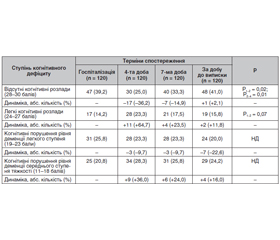
Актуальність. Одним із актуальних питань сучасної медицини у світі, зокрема в Україні, є проблема розвитку післяопераційної когнітивної дисфункції (ПОКД) в ортопедичних хворих, оперативні втручання яким проводились під спінальною анестезією. З розвитком медичної практики збільшується середня тривалість життя населення, вдосконалюється методики артропластики, зменшується тривалість оперативних втручань та вдосконалюються анестезіологічне ведення операцій. Ці фактори сприяють невпинному зростанню кількості тотальних ендопротезувань суглобів, що супроводжується збільшенням середнього віку пацієнтів, що підлягають артропластиці, та, відповідно, зростанням загального коморбідного навантаження. Мета: проаналізувати динаміку когнітивної функції у пацієнтів після ендопротезування кульшового суглоба під спінальною анестезією. Матеріали та методи. Кількість хворих, які були включені в дослідження, 120. Усі хворі лікувалися в травматологічному відділенні КНП «Вінницька міська клінічна лікарня швидкої медичної допомоги». Як одну з основних оціночних шкал ПОКД використовували шкалу Mini mental State Examination (MMSE). Нейрокогнітивне тестування для визначення стану вищої нервової дiяльностi проводили за добу до операції, повторну оцінку здійснювали на 4-ту та 7-му добу після операції та за добу до виписки зі стаціонару. Статистичну обробку даних проводили з використанням можливостей електронних таблиць Microsoft Excel і пакета статистичної обробки інформації SPSS 23.0. Результати. 1. У пацієнтів, які перенесли ендопротезування кульшового суглоба під спінальною анестезією, зафіксовано зниження середнього бала за ММSE на 5,9 % на 4-ту добу та на 3,4 % на 7-му добу. 2. На 10-ту добу післяопераційного періоду середній бал за ММSE наблизився до вихідного значення. Висновки. З огляду на отримані дані можливо говорити про певне порушення когнітивної функції в обстежених нами пацієнтів на 4-ту і 7-му добу, з максимальними змінами на 4-ту добу, після проведеного ендопротезування кульшового суглоба. Шкала MMSE в періопераційному періоді може бути використана для діагностики когнітивних порушень та як критерій ефективності корекції когнітивних порушень у цих хворих з метою проведення подальшої терапії.
Background. One of the pressing issues of modern medicine in the world, including in Ukraine, is the problem of the development of postoperative cognitive dysfunction in orthopedic patients who underwent surgical interventions under spinal anesthesia. With the development of medical practice, the average life expectancy of the population increases, arthroplasty techniques are improved, the duration of surgical interventions is reduced, and their anesthetic management is improved. These factors contribute to the continuous growth in the number of total joint replacements associated with an increase in the average age of patients undergoing arthroplasty, and, accordingly, in the total comorbid load. Purpose: to analyze the dynamics of cognitive function in patients after hip replacement under spinal anesthesia. Materials and methods. The number of patients included in the study was 120. All of them were treated in the trauma unit of the Vinnytsia City Clinical Emergency Hospital. The Mini Mental State Examination (MMSE) was used as one of the main assessment scales for postoperative cognitive dysfunction. Neurocognitive testing to determine the state of higher nervous activity was performed the day before the operation, repeated assessment was carried out on the 4th and 7th days after it, and the day before discharge from the hospital. Statistical data processing was performed using the capabilities of Microsoft Excel spreadsheets and the statistical information processing package SPSS 23.0. Results. 1. In patients who underwent hip replacement surgery under spinal anesthesia, a decrease in the average MMSE score by 5.9 % was recorded on the 4th day and by 3.4 % on the 7th day. 2. On the 10th day of the postoperative period, the average MMSE score approached the baseline. Conclusions. Given the data obtained, it is possible to state about a certain impairment of cognitive function on the 4th and 7th days in the patients examined by us, with maximum changes on the 4th day after the hip joint arthroplasty. The MMSE in the perioperative period can be used for the diagnosis of cognitive disorders and as a criterion for the effectiveness of the correction of cognitive disorders in these patients for the purpose of further therapy.
хірургічне втручання; ендопротезування кульшового суглоба; MMSE; когнітивні функції; нейропсихологічний дефіцит та його оцінка
surgical intervention; hip replacement; Mini Mental State Examination; cognitive functions; neuropsychological deficit and its assessment
Для ознакомления с полным содержанием статьи необходимо оформить подписку на журнал.
- Dubivska SS, Grigorov YB. The state of cognitive functions in the first week after surgery using general anesthesia. PMGP. 2019;4(2):e0402197.
- Livingston G, Huntley J, Sommerlad A, et al. Dementia prevention, intervention, and care. Lancet. 2020;396(10248):413-446. doi: 10.1016/S0140-6736(20)30367-6.
- Evered L, Scott, DA, Silbert B, Maruff P. Postoperative cognitive dysfunction is independent of type of surgery and anesthetic. Anesthesia and Analgesia. 2011;112(5):1179-1185.
- Abu-Amer L, Darwech J, Clohisy JC. Aseptic loosening of total joint replacements: mechanisms underlying osteolysis and potential therapies. Arthritis Res. Ther. 2007;1(9):6.
- Kreutzer J, Schneider M, Schiegel U, et al. Cemented total hip arthroplasty in Germany — an update. Z. Orthop. Ihre Grenzgeb. 2005;1(143):48-55.
- Skutek M, Bourne RB, MacDonald SJ. International epidemiology of revision THR. Orthoped. Trauma. 2006;3(20):157-161.
- Filippenko VA, Deduch NV, Schkodovskaja NY, et al. Clinical and morphological aspects of aseptic loosening of the hip endoprothesis. Orthop. Traumatol. Prosthetics. 2009;3:65-69.
- Abildstrom H, Rasmussen LS, Rentowl P, et al. Cognitive dysfunction 1–2 years after non-cardiac surgery in the elderly. Acta Ana–esthesiol. Scand. 2000;44:1246-51.
- Evered LA, Silbert BS. Postoperative Cognitive Dysfunction and Noncardiac Surgery. Anesth Analg. 2018;127(2):496-505.
- Mahanna-Gabrielli E, Schenning KJ, Eriksson LI, et al. State of the clinical science of perioperative brain health: report from the American Society of Anesthesiologists Brain Health Initiative Summit 2018. Br J Anaesth. 2018;123(4):464-478.
- Paredes S, Cortnez L, Contreras V, Silbert B. Post-opera–tive cognitive dysfunction at 3 months in adults after non-cardiac surgery: a qualitative systematic review. Acta Anaesthesiol Scand. 2016;60(8):1043-58.
- Vacas S, Cole DJ, Cannesson M. Cognitive Decline Associated With Anesthesia and Surgery in Older Patients. JAMA. 2021;2:10.1001/jama.2021.4773. doi: 10.1001/jama.2021.4773.
- Heyn P, Abreu BC, Ottenbacher KJ. The effects of exercise training on elderly persons with cognitive impairment and dementia: a meta-analysis. Arch Phys Med Rehabil. 2004;85(10):1694-1704.
- Moran J, Guinan E, McCormick P, et al. The ability of prehabilitation to influence postoperative outcome after intra-abdominal operation: A systematic review and meta-analysis. Surgery. 2016;160(5):1189-1201.
- Marra A, Pandharipande PP, Girard TD, et al. Co-Occurrence of Post-Intensive Care Syndrome Problems Among 406 Survivors of Critical Illness. Crit Care Med. 2018;46(9):1393-1401.
- Novitskaya-Usenko LV. Postoperative cognitive dysfunction in the practice of an anesthesiologist. Emergency Medicine. 2017;4(63):9-15.
- Netto MB, de Oliveira Junior AN, Goldim M, et al. Oxidative stress and mitochondrial dysfunction contributes to postoperative cognitive dysfunction in elderly rats. Brain Behav Immun. 2018;73:661-669.
- World Health Organization (WHO). The top 10 causes of death: fact sheet. Available from: https://www.who.int/news-room/fact-sheets/detail/the-top-10-causes-of-death. Accessed: December 9, 2020.
- World Health Organization (WHO). World health statistics 2019: monitoring health for the SDGs, sustainable development goals. Geneva: WHO; 2019. 120 p.