
Журнал «Медицина неотложных состояний» Том 22, №2, 2026
Вернуться к номеру
Когнітивні детермінанти особистості в контексті медико-психологічної та судово-психіатричної експертизи: міждисциплінарний підхід
Авторы: Візнюк І.М. (1), Пугач В.М. (2), Коваль І.А. (3), Долинний С.С. (1), Філоненко Л.В. (4), Карімулін Р.Ф. (5)
(1) - Вінницький державний педагогічний університет імені Михайла Коцюбинського, м. Вінниця, Україна
(2) - Вінницький навчально-науковий інститут економіки Західноукраїнського національного університету, м. Вінниця, Україна
(3) - Український католицький університет, м. Львів, Україна
(4) - Національна академія Національної гвардії України, м. Харків, Україна
(5) - Вінницький національний медичний університет імені М.І. Пирогова, м. Вінниця, Україна
Рубрики: Медицина неотложных состояний
Разделы: Клинические исследования
Версия для печати
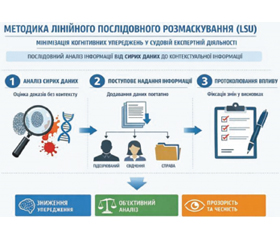
Актуальність. У статті розглянуто когнітивні детермінанти особистості як ключові елементи медико-психологічної та судово-психіатричної експертизи. Зазначено, що міждисциплінарний підхід поєднує психологічні, психіатричні та правові знання для комплексної оцінки когнітивної сфери. Висвітлено значення процесів сприймання, уваги, пам’яті, мислення, уяви та мовлення у визначенні здатності особи до усвідомлення своїх дій та надання вірогідних показань. Обґрунтовано важливість співпраці психолога, психіатра і юриста для підвищення точності експертного висновку. Метою статті є комплексне дослідження когнітивних детермінант особистості в умовах медико-психологічної та судово-психіатричної експертизи з урахуванням міждисциплінарного підходу. Матеріали та методи. Методологічною основою дослідження слугує підхід Linear Sequential Unmasking (LSU), запропонований І. Дрором як ефективний спосіб протидії контекстуальному викривленню судових висновків. У межах дослідження застосовано низку валідизованих психодіагностичних методик: «Знайди те, чого не вистачає» (оцінка сприймання), тест Мюнстерберга (увага), методика «10 слів» О. Лурії (пам’ять), «Класифікація предметів» (мислення), асоціативний експеримент (уява), а також методику оцінки розуміння інструкцій (мовлення). Результати. У дослідженні підтверджено ефективність підходу LSU для зниження впливу емоційного та контекстуального тиску при аналізі клінічного випадку булінгу. Показано, що поступове розкриття інформації допомагає майбутнім фахівцям формулювати більш об’єктивні висновки. Водночас встановлено, що емоційно насичений контекст значно підвищує ризик когнітивного упередження: частка респондентів, які розглядали ситуацію як травматичну, зросла з 62,0 ± 4,5 % до 86,0 ± 2,9 % після додавання емоційної інформації. Висновки. Усі методики обґрунтовано як інформативні інструменти для оцінки ключових когнітивних процесів, значущих у професійній діяльності експертів, а також для виявлення психічного стану особи в межах судово-експертної практики. Застосування LSU у поєднанні з комплексною психодіагностикою сприяє підвищенню об’єктивності, надійності та правової вірогідності експертних висновків.
Background. This article examines the cognitive determinants of personality as key elements in medical psychological and forensic psychiatric expertise. It is noted that an interdisciplinary approach integrates psychological, psychiatric, and legal knowledge for a comprehensive assessment of the cognitive domain. The significance of perceptual, attentional, memory, thinking, imagination, and language processes is highlighted in determining an individual’s ability to understand their actions and provide reliable testimony. The importance of collaboration between psychologists, psychiatrists, and legal professionals to enhance the accuracy of expert conclusions is justified. The purpose of the article is to conduct a comprehensive investigation of the cognitive determinants of personality within the context of medical psychological and forensic psychiatric expertise, taking into account an interdisciplinary approach. Materials and methods. The methodological basis of the study is the Linear Sequential Unmasking (LSU) approach, proposed by I. Dror as an effective way to counteract contextual bias in forensic conclusions. A series of validated psycho-diagnostic techniques were employed: “Find what is missing” (assessment of perception), the Münsterberg test (attention), A.R. Luria’s “10 words” method (memory), classification of objects (thinking), the associative experiment (imagination), and a technique for assessing comprehension of instructions (language). Results. The study confirmed the effectiveness of the LSU approach in reducing the influence of emotional and contextual pressure when analyzing a clinical case of bullying. It was shown that gradual disclosure of information helps future specialists formulate more objective conclusions. At the same time, it was found that emotionally charged context significantly increases the risk of cognitive bias: the proportion of respondents who viewed the situation as traumatic increased from 62.0 ± 4.5 % to 86.0 ± 2.9 % after the addition of emotional information. Conclusions. All techniques used are justified as informative tools for assessing key cognitive processes relevant to the professional activities of experts and for identifying an individual’s mental state within the framework of forensic practice. The application of the LSU in combination with comprehensive psychodiagnostics contributes to increased objectivity, reliability, and legal validity of expert conclusions.
особистість; медико-психологічна експертиза; судово-психіатрична експертиза; міждисциплінарний підхід; психічні процеси; експертний висновок
personality; medical psychological expertise; forensic psychiatric expertise; interdisciplinary approach; cognitive processes; expert opinion
Для ознакомления с полным содержанием статьи необходимо оформить подписку на журнал.
- Catanesi R, Mandarelli G, Ventriglio A, Bellomo A. Core topics in forensic psychiatry. Int Rev Psychiatry. 2024 Nov;36(7):673-675. doi: 10.1080/09540261.2024.2420307.
- DiCiro M, Sreenivasan S. A forensic science-based model for identifying and mitigating forensic mental health expert biases. JAAPL. 2025 May;53(2):1-11. doi: 10.29158/JAAPL.250019-25.
- Dror I, Melinek J, Arden JL, Kukucka J, Hawkins S, Carter J, et al. Cognitive bias in forensic pathology decisions. J Forensic Sci. 2021 Sep;66(5):1751-1757. doi: 10.1111/1556-4029.14697.
- Dror IE, Thompson WC, Meissner CA, et al. Letter to the Editor — Context Management Toolbox: A Linear Sequential Unmasking (LSU) Approach for Minimizing Cognitive Bias in Forensic Decision Making. J Forensic Sci. 2015 Jul;60(4):1111-1112. doi: 10.1111/1556-4029.12805.
- Kuznietsova NS, Prytyka YuD, Khomenko MM. Arbitrability of corporate disputes: national realities and foreign experience. Journal of Advanced Research in Law and Economics. 2020 Jun;11(4):1184-1190. doi: 10.14505//jarle.v11.4(50).14.
- Maksymenko SD, Vizniuk IM, Paikush MA, Dolynnyi SS, Drachuk MI, Karimulin RF. Neuropsychological care for patients with spinal cord injuries: a way to comprehensive recovery. Emergency Medicine (Ukraine). 2025;21(6):612-620. doi: 10.22141/2224-0586.21.6.2025.1934.
- Nikolaienko V. Revelative evidential markers in English-language dream reports: a corpus-based study. Cognition, Communication, Discourse. 2023;(27):56-66. doi: 10.26565/2218-2926-2023-27-04.
- Shapar AG, Mikheyev AV. Conceptual approaches to understanding the processes of anthropogenic destabilization of ecological systems. Visnyk of the National Academy of Sciences of Ukraine. 2018;(3):56-66. Ukrainian. doi: 10.15407/visn2018.03.056.
- AlMoghrabi N, Verhoef REJ, Smeijers D, et al. The effects of cognitive bias modification on hostile interpretation bias and aggressive behavior: a systematic review and meta-analysis. Cogn Ther Res. 2024;48(4):628-647. doi: 10.1007/s10608-023-10415-3.