
Журнал "Гастроэнтерология" Том 60, №1, 2026
Вернуться к номеру
Асоціація варіанта гена TAS1R1 rs17492553 зі смаковими уподобаннями при дитячому ожирінні
Авторы: А.E. Abaturov, A.O. Nikulina, D.L. Shulzhenko
Dnipro State Medical University, Dnipro, Ukraine
Municipal Non-Profit Enterprise “City Clinical Hospital 6” of the Dnipro City Council, Dnipro, Ukraine
Рубрики: Гастроэнтерология
Разделы: Клинические исследования
Версия для печати
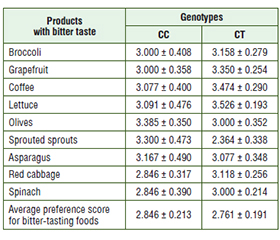
Актуальність. Генетичні варіації генів смакових рецепторів, включно з представником 1 смакового рецептора 1 (taste 1 receptor member 1 — TAS1R1), що бере участь у сприйнятті умамі, можуть змінювати смакову чутливість та обумовлювати формування несприятливих харчових моделей. Мета: оцінити смакові вподобання дітей із різними генотипами однонуклеотидного варіанта rs17492553 TAS1R1 та вивчити потенційні зв’язки з ожирінням. Матеріали та методи. Дослідження типу «випадок — контроль» включало 450 дітей віком від 6 до 18 років: 350 з ожирінням (основна група) та 100 з фізіологічною масою тіла (контрольна група). Смакові вподобання оцінювали за допомогою адаптованої анкети щодо вподобань у їжі та напоях і харчових щоденників. Генотипування однонуклеотидного варіанта rs17492553 TAS1R1 проводили за допомогою секвенування наступного покоління в групі з ожирінням (CeGaT GmbH, Тюбінген, Німеччина). Результати. Серед дітей з ожирінням гомозиготні за генотипом CC демонстрували сильніші вподобання до умамі (85 проти 31 %; p < 0,00001) та солоного смаків (90 проти 69 %; p = 0,02) порівняно з гетерозиготами CT. Носії генотипу CC мали вищі показники переваги до начос/піци (p < 0,05) і позитивну кореляцію зі споживанням стейків, бульйону й вершків. Щодо солодкого, носії генотипу CC віддавали перевагу шоколаду, тоді як носії генотипу CT — підсолодженим цукром газованим напоям (p < 0,05). Загалом не спостерігалося генотипзалежних відмінностей для кислого або гіркого смаків, хоча генотип CC корелював із більшим споживанням деяких гірких продуктів. Висновки. Варіант rs17492553 TAS1R1, ймовірно, модулює смакові уподобання в дітей з ожирінням. Генотип CC може бути пов’язаний із підвищеною схильністю до умамі та солоних продуктів, тоді як генотип CT — зі збільшенням споживання підсолоджених цукром напоїв. Ці відмінності обумовлюють формування несприятливих харчових моделей.
Background. Genetic variations in taste receptor genes, including taste 1 receptor member 1 (TAS1R1) involved in umami perception, may alter taste sensitivity and contribute to unfavorable dietary patterns. The purpose was to evaluate taste preferences in children with different genotypes of the single nucleotide variant rs17492553 in TAS1R1 and explore potential associations with obesity. Materials and methods. This case-control study included 450 children aged 6–18 years: 350 with obesity (main group) and 100 with normal body weight (controls). Taste preferences were assessed using an adapted Food and Beverage Preference Questionnaire and food diaries. Genotyping of rs17492553 in TAS1R1 was performed via next-generation sequencing in the obesity group at CeGaT GmbH (Tbingen, Germany). Results. Among children with obesity, those homozygous for the CC genotype showed stronger preferences for umami (85 vs 31 %; p < 0.00001) and salty tastes (90 vs 69 %; p = 0.02) compared to CT heterozygotes. CC carriers had higher preference scores for nachos/pizza (p < 0.05) and positive correlations with consumption of steak, broth, and cream. For sweet tastes, CC carriers preferred chocolate, whereas CT carriers favored sugar-sweetened carbonated drinks (p < 0.05). No genotype-dependent differences were observed for sour or bitter tastes overall, though CC genotype correlated with higher consumption of certain bitter foods. Conclusions. The rs17492553 variant in TAS1R1 appears to modulate taste preferences in children with obesity. The CC genotype may be associated with heightened preferences for umami- and salty-tasting foods, while the CT genotype is linked to increased consumption of sugar-sweetened beverages. These differences could contribute to adverse dietary patterns.
діти; ожиріння; однонуклеотидні варіанти; представник 1 смакового рецептора 1; смакові вподобання
children; obesity; single nucleotide variants; taste 1 receptor member 1; taste preferences
Для ознакомления с полным содержанием статьи необходимо оформить подписку на журнал.
- Boushey C, Ard J, Bazzano L, et al. Dietary Patterns and Growth, Size, Body Composition, and/or Risk of Overweight or Obesity: A Systematic Review. Alexandria (VA): USDA Nutrition Evidence Systematic Review; 2020 Jul. Available from: https://www.ncbi.nlm.nih.gov/books/NBK577644/.
- World Health Organization. Obesity and overweight. Geneva: WHO; 2024. Available from: https://www.who.int/news-room/fact-sheets/detail/obesity-and-overweight.
- Kelly AS, Armstrong SC, Michalsky MP, Fox CK. Obesity in Adolescents: A Review. JAMA. 2024;332(9):738-748. doi: 10.1001/jama.2024.11809.
- Yasin S, Hasnain M, Khan FR, et al. Association Between Obesity, Digital Screen Time, and Early-Onset Hypertension in Adolescents: A Prospective Cohort Study. Cureus. 2025;17(3):e79975. doi: 10.7759/cureus.79975.
- Abaturov A, Nikulina A. Taste preferences and obesity. Pediatria Polska — Polish Journal of Paediatrics. 2022;97(1):1-6. doi: 10.5114/polp.2022.115139.
- Costanzo A. Temporal patterns in taste sensitivity. Nutr Rev. 2024;82(6):831-847. doi: 10.1093/nutrit/nuad097.
- Brown JE, Morton L, Braakhuis AJ. Exploring genetic modi–fiers influencing adult eating behaviour: A scoping review. Appetite. 2025;214:108193. doi: 10.1016/j.appet.2025.108193.
- Ribeiro G, Oliveira-Maia AJ. Sweet taste and obesity. Eur J Intern Med. 2021;92:3-10. doi: 10.1016/j.ejim.2021.01.023.
- Pioltine MB, de Melo ME, Santos AS, et al. Genetic Variations in Sweet Taste Receptor Gene Are Related to Chocolate Powder and Dietary Fiber Intake in Obese Children and Adolescents. J Pers Med. 2018;8(1):7. doi: 10.3390/jpm8010007.
- Abaturov O, Nikulina A. Taste impairment in obese children: genetic aspects of reception. Gastroenterology. 2025;59(3):189-197. doi: 10.22141/2308-2097.59.3.2025.692.
- Hartley IE, Liem DG, Keast R. Umami as an “Alimentary” Taste. A New Perspective on Taste Classification. Nutrients. 2019;11(1):182. doi: 10.3390/nu11010182.
- Chaouche L, Marcotte F, Maltais-Payette I, Tchernof A. Glutamate and obesity — what is the link? Curr Opin Clin Nutr Metab Care. 2024;27(1):70-76. doi: 10.1097/MCO.0000000000000991.
- Abaturov A, Nikulina A, Shulzhenko D, et al. Association between umami taste preference and obesity. Poster presented at: 23rd Annual World Congress on Insulin Resistance, Diabetes & Cardiovascular Disease (WCIRDC); 2025 Dec 3-6; Universal City, CA, USA. Avai–lable from: https://www.wcir.org/.
- Nedovic D, Panic N, Pastorino R, et al. Evaluation of the Endorsement of the STrengthening the REporting of Genetic Association Studies (STREGA) Statement on the Reporting Quality of Published Genetic Association Studies. J Epidemiol. 2016;26(8):399-404. doi: 10.2188/jea.JE20150173.
- Chamarthi VS, Daley SF. Genetic and Syndromic Causes of Obesity: Diagnosis and Management. In: StatPearls. Treasure Island (FL): StatPearls Publishing; 2025. Available from: https://www.ncbi.nlm.nih.gov/books/NBK577644/.
- Centers for Disease Control and Prevention. Child and Teen BMI Calculator. Atlanta (GA): CDC; 2024. Available from: https://www.cdc.gov/bmi/child-teen-calculator/index.html.
- National Center for Biotechnology Information (US). RefSeq: NCBI Reference Sequence Database. Bethesda (MD): Natio–nal Center for Biotechnology Information. Available from: https://www.ncbi.nlm.nih.gov/refseq/.
- McInnes G, Tanigawa Y, Lavertu A, Correa S, Rivas MA, Ioannidis AG. Global Biobank Engine: enabling genotype-phenotype browsing for biobank summary statistics. Stanford (CA): Stanford University; 2019. Available from: https://biobankengine.stanford.edu/.
- Li H, Durbin R. Fast and accurate short read alignment with Burrows-Wheeler transform. Bioinformatics. 2009;25(14):1754-1760. doi: 10.1093/bioinformatics/btp324.
- Mose LE, Wilkerson MD, Hayes DN, et al. ABRA: improved coding indel detection via assembly-based realignment. Bioinformatics. 2014;30(19):2813-2815. doi: 10.1093/bioinformatics/btu376.
- Jilani HS, Intemann T, Bogl LH, et al.; I.Family consortium. Familial aggregation and socio-demographic correlates of taste pre–ferences in European children. BMC Nutr. 2017;3:87. doi: 10.1186/s40795-017-0202-0.
- Faul F, Erdfelder E, Lang AG, Buchner A. G*Power 3: A fle–xible statistical power analysis program for the social, behavioral, and biomedical sciences. Behav Res Methods. 2007;39(2):175-191. doi: 10.3758/bf03193146.
- Broad Institute. gnomAD browser. Cambridge (MA): Broad Institute; 2023. Variant 1-6576401-C-T (GRCh38). Available from: https://gnomad.broadinstitute.org/variant/1-6576401-C-T?dataset=gnomad_r4.
- Bachmanov AA, Bosak NP, Lin C, et al. Genetics of taste receptors. Curr Pharm Des. 2014;20(16):2669-2683. doi: 10.2174/13816128113199990566.
- Rawal S, Hayes JE, Wallace MR, et al. Do polymorphisms in the TAS1R1 gene contribute to broader differences in human taste intensity? Chem Senses. 2013;38(8):719-728. doi: 10.1093/chemse/bjt040.
- Andres-Hernando A, Cicerchi C, Kuwabara M, et al. Umami-induced obesity and metabolic syndrome is mediated by nucleotide degradation and uric acid generation. Nat Metab. 2021;3(9):1189-1201. doi: 10.1038/s42255-021-00454-z.
- Bleich SN, Vercammen KA, Koma JW, et al. Trends in Beve–rage Consumption Among Children and Adults, 2003-2014. Obesity (Silver Spring). 2018;26(2):432-441. doi: 10.1002/oby.22056.
- Malik VS, Hu FB. The role of sugar-sweetened beverages in the global epidemics of obesity and chronic diseases. Nat Rev Endocrinol. 2022;18(4):205-218. doi: 10.1038/s41574-021-00627-6.
- Calcaterra V, Cena H, Magenes VC, et al. Sugar-Sweetened Beverages and Metabolic Risk in Children and Adolescents with Obesity: A Narrative Review. Nutrients. 2023;15(3):702. doi: 10.3390/nu15030702.
- Zafar TA, Alkazemi DUZ, Muthafar H, et al. Sugar-Sweete–ned Beverage Consumption and Associated Health Risks Awareness Among University Students in Kuwait: A Cross-Sectional Study. Nutrients. 2025;17(10):1646. doi: 10.3390/nu17101646.
- Ma S, Lu S. Bitter taste sensitivity, cruciferous vegetable intake, obesity, and diabetes in American adults: a cross-sectional study of NHANES 2013-2014. Food Funct. 2023;14(20):9243-9252. doi: 10.1039/d3fo02175k.
- Liszt KI, Wang Q, Farhadipour M, et al. Human intestinal bitter taste receptors regulate innate immune responses and meta–bolic regulators in obesity. J Clin Invest. 2022;132(3):e144828. doi: 10.1172/JCI144828.
- Descamps-Solà M, Vilalta A, Jalsevac F, et al. Bitter taste receptors along the gastrointestinal tract: comparison between humans and rodents. Front Nutr. 2023;10:1215889. doi: 10.3389/fnut.2023.1215889.
- Lela L, Carlucci V, Kioussi C, et al. Humulus lupulus L.: Evaluation of Phytochemical Profile and Activation of Bitter Taste Receptors to Regulate Appetite and Satiety in Intestinal Secretin Tumor Cell Line (STC-1 Cells). Mol Nutr Food Res. 2024;68(21):e2400559. doi: 10.1002/mnfr.202400559.