
Інформація призначена тільки для фахівців сфери охорони здоров'я, осіб,
які мають вищу або середню спеціальну медичну освіту.

Підтвердіть, що Ви є фахівцем у сфері охорони здоров'я.

Журнал «Травма» Том 27, №2, 2026

Вернуться к номеру

Клініко-епідеміологічна характеристика посттравматичної нейропатії сідничного нерва в постраждалих із пошкодженням кульшової западини
Авторы: S.O. Guryev (1), M.L. Ankin (2), M.M. Barylovych (2), H.P. Kushnir (3)
(1) - Ukrainian Scientific and Practical Center of Emergency Medical Care and Disaster Medicine of MHU, Kyiv, Ukraine
(2) - Shupyk National Healthcare University of Ukraine, Kyiv, Ukraine
(3) - Central Polyclinic of the MIA of Ukraine, Kyiv, Ukraine

Рубрики: Травматология и ортопедия

Разделы: Клинические исследования

Версия для печати


Резюме

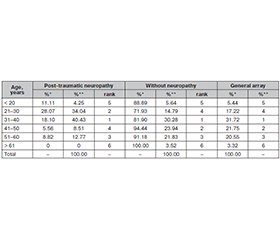
Актуальність. Пошкодження кульшової западини, за даними джерел наукової інформації, виникає внаслідок високоенергетичної травми. До 33 % таких випадків може супроводжуватися розвитком посттравматичної нейропатії сідничного нерва. Мета: вивчити клініко-епідеміологічні характеристики посттравматичної нейропатії сідничного нерва в постраждалих із переломом кульшової западини. Матеріали та методи. Проведено ретроспективний аналіз 331 випадку пошкодження кульшової западини. Загальний масив розподілено на дві групи: 284 пацієнти з пошкодженням кульшової западини без посттравматичної нейропатії та 47 — із посттравматичною ней­ропатією сідничного нерва. Дослідження проведено із застосуванням параметричних і непараметричних методів статистики, а також елементів фрактального аналізу. Результати. Встановлено, що всі клініко-епідеміологічні ознаки є факторами ризику посттравматичної нейропатії в постраждалих із переломом кульшової западини. Серед осіб із нейропатією переважають чоловіки (74,47 %), але ризик полінейропатії є вищим у жінок. Посттравматична нейропатія при переломі кульшової западини в основному зустрічається в постраждалих найбільш активного, працездатного віку 21–40 років (74,47 %). Найчастіше посттравматична нейропатія виникає при отримані пошкодження під час прямого удару — 91,50 %. Основними обставинами травми є дорожньо-транспортні пригоди (91,48 %), за яких найчастіше розвивається посттравматична нейропатія в постраждалих із переломом кульшової западини, а найрідше — при побутовій травмі (2,13 %). Висновки. 1. Встановлено, що клініко-епідеміологічні ознаки пацієнтів із переломами кульшової западини мають вірогідний вплив на виникнення посттравматичної нейропатії сідничного нерва. 2. Найчастіше вона трапляється внаслідок перелому кульшової западини у жінок (19,35 % цієї статевої групи), осiб віком 21–30 років (28,07 % цієї вікової групи), внаслідок прямого удару (28,10 % групи «механізм пошкодження») та при дорожньо-транспортних пригодах (20,38 % групи «обставини травми»). 3. Усі клініко-епідеміологічні ознаки є факторами ризику нейропатії сідничного нерва в постраждалих із переломами кульшової западини. 4. Потрібні подальші ризик-орієнтовані дослідження клініко-епідеміологічних аспектів виникнення посттравматичної нейропатії сідничного нерва як ускладнення переломів кульшової западини.

Background. According to the scientific sources, hip socket damage in victims occurs as a result of high-energy trauma. Up to 33 % of such cases may be accompanied by the development of post-traumatic sciatic nerve neuropathy. The purpose was to study and form the clinical and epidemiological characteristics of post-traumatic sciatic nerve neuropathy in victims with hip fracture. Materials and methods. A retrospective analysis of 331 cases of hip socket injury was conducted. The total array was divided into two groups: 284 patients with hip socket injury without post-traumatic neuropathy, and 47 cases with post-traumatic sciatic nerve neuropathy. The study was conducted using parametric and non-parametric statistical methods, as well as ele­ments of fractal analysis. Results. It was found that all clinical and epidemiological signs are a risk factor for the occurrence of post-traumatic neuropathy in hip fractures. Among victims with neuropathy, men predominate (74.47 %), but the risk of polyneuropathy is higher in women. Post-traumatic neuropathy in hip fractures mainly occurs in people of the most active, able-bodied age of 21–40 years (74.47 %). Most often, post-traumatic neuropathy is a result of a direct impact — 91.50 %. The main circumstance of injury are road accidents (91.48 %), in which post-traumatic neuropathy most often develops in victims with hip fracture, and most rarely — with household trauma (2.13 %). Conclusions. 1. It has been found that the clinical and epidemiological characte­­ristics of patients with hip fractures have a probable influence on the occurrence of post-traumatic sciatic nerve neuropathy. 2. Most often, post-traumatic sciatic nerve neuropathy occurs as a result of hip fracture in women (19.35 % of this gender group), people aged 21–30 years (28.07 % of this age group), as a result of direct impact (28.10 % of this group by mechanism of injury) and in traffic accidents — 20.38 % (group of circumstances of injury). 3. All clinical and epidemiological signs are risk factors for the occurrence of sciatic nerve neuropathy in hip fractures. 4. Further risk-based studies of the clinical and epidemiological aspects of the occurrence of post-traumatic sciatic neuropathy as a complication of hip fractures are needed.


Ключевые слова

нейропатія; сідничний нерв; кульшова западина; перелом; постраждалі

neuropathy; sciatic nerve; hip socket; fracture; injured


Для ознакомления с полным содержанием статьи необходимо оформить подписку на журнал.


Список литературы

1. Stavrakakis IM, Kritsotakis EI, Giannoudis PV. Sciatic nerve injury after acetabular fractures: a meta-analysis of incidence and outcomes. Eur J Trauma Emerg Surg. 2022;48:2639-2654. doi: 10.1007/s00068-022-01896-0.
2. Guryev S, Kushnir V, Soloviov O, Kushnir G. Traffic injury as a medical and sanitary consequence of a man-made emergency in Ukraine. Report two: comparative characte–ristics of clinical and epidemiological signs (gender and age). Emergency Medicine. 2023;19(7):465-74. Available from: https://emergency-journal.com/index.php/journal/article/view/1629.
3. Lehmann W, Hoffmann M, Fensky F, Nchtern J, Groterlinden L, et al. What is the frequency of nerve injuries associated with acetabular fractures? Clin Orthop Relat Res. 2014;472(11):3395-3403. doi: 10.1007/s11999-014-3838-9.
4. Issack PS, Helfet DL. Sciatic nerve injury associated with acetabular fractures. HSS J. 2008;5(1):12-18. doi: 10.1007/s11420-008-9099-y.
5. Hakeem NN, Al-Maslmani S, Al-Asiri J, Shaalan FN. Systematic review and meta-analysis of sciatic nerve injury in acetabular fractures. J Orthop Bone Disord. 2023;7(1):000229. doi: 10.23880/jobd-16000229.
6. Arbash M, Alzobi, OZ, Salameh M, et al. Incidence, risk factors, and prognosis of sciatic nerve injury in acetabular fractures: a retrospective cross-sectional study. International Orthopaedics (SICOT). 2024;48:849-856. doi: 10.1007/s00264-024-06087-7.
7. Guryev OS, Yaroviy DM, Kushnir VA. The structure of disability among the victims of road accidents in Ukraine. Travma. 2021;19(4):47-50. doi: 10.22141/1608-1706.4.19.2018.142105 (in Ukrainian).
8. Simske N, Krebs J, Heimke I, Scarcella N, Vallier H. Nerve injury with acetabulum fractures: incidence and factors affecting recovery. J Orthop Trauma. 2019;33(12):628-634. doi: 10.1097/BOT.0000000000001604.
9. Guryev SO, Kusnir VA, Soloviov OS. Clinical and epidemiological characteristics of road traffic injuries in the conditions of a metropolis. Travma. 2023;24(1):14-9. doi: 10.22141/1608-1706.1.24.2023.926 (in Ukrainian).
10. Yildiz FG, Uzuncakmak-Uyanik H, Aghamirzayeva Kh, Temucin CM. Electrodiagnostic Features of Sciatic Neuropathy: Six-year Referral Center Experience. Neurological Sciences and Neurophysiology. 2023 Jul-Sep;40(3):145-151. doi: 10.4103/nsn.nsn_46_23.
11. Franceschina K. Sonographic Evaluation of Periphe–ral Sciatic Nerve Injury: A Case Study. Journal of Diagnostic Medical Sonography. 2021;37(3):276-281. doi: 10.1177/8756479320988296.
12. Feinberg J, Sethi S. Sciatic neuropathy: case report and discussion of the literature on postoperative sciatic neuropathy and sciatic nerve tumors. HSS J. 2006 Sep;2(2):181-7. doi: 10.1007/s11420-006-9018-z.
13. Dietmann A, von Martial R, Scheidegger O. Spontaneous ischemic neuropathy of the sciatic nerve due to arterial occlusion — a rare cause of acute neuropathy not to be missed, a report of two cases. BMC Neurol. 2022;22:410. doi: 10.1186/s12883-022-02944-3.
14. Saroyan JM, Winfree CJ, Schechter WS, Roye D, Gold AP. Sciatic neuropathy after lower-extremity trauma: successful treatment of an uncommon pain and disability syndrome in an adolescent. Am J Phys Med Rehabil. 2007 Jul;86(7):597-600. doi: 10.1097/PHM.0b013e31806dbdd2.
15. Zhou P, Zhang R, Xian L, et al. Selection of sciatic nerve injury models: implications for pathogenesis and treatment. Front Neurol. 2025;16:1521941. doi: 10.3389/fneur.2025.1521941.
16. Jones PE, Meyer RM, Faillace WJ, et al. Combat Injury of the Sciatic Nerve — An Institutional Experience. Mil Med. 2018 Sep 1;183(9–10):e434-e441. doi: 10.1093/milmed/usy030.
17. Ozturk V, Dastan AE, Adali Rusen Y, Baris E. Complications and Therapeutic Approaches in a Sciatic Nerve Injury Rat Model. Journal of Advances in VetBio Science and Techniques. 2025;10(1):42-47. doi: 10.31797/vetbio.1564478.
18. Liu Z, Tao F, Xu W, et al. Incidence of traumatic sciatic nerve injury in patients with acetabular fractures and factors affecting recovery: a retrospective study. J Orthop Surg Res. 2023;18:35. doi: 10.1186/s13018-023-03515-z.
19. Gupta S, Mittal N, Virk JS. Use of tricortical iliac crest strut autograft in comminuted posterior wall acetabular fractures: A case series. Chin J Traumatol. 2018 Feb;21(1):58-62. doi: 10.1016/j.cjtee.2017.08.005.
20. Zhao X, Fede C, Petrelli L, et al. The Impact of Sciatic Nerve Injury on Extracellular Matrix of Lower Limb Muscle and Thoracolumbar Fascia: An Observational Study. International Journal of Molecular Sciences. 2024;25(16):8945. doi: 10.3390/ijms25168945.
21. Kline DG, Kim D, Midha R, Harsh C, Tiel R. Mana–gement and results of sciatic nerve injuries: a 24-year experience. J Neurosurg. 1998 Jul;89(1):13-23. doi: 10.3171/jns.1998.89.1.0013.
22. Ahmed M, Abuodeh Y, Alhammoud A, Salameh M, Hasan K, Ahmed G. Epidemiology of acetabular fractures in Qatar. Int Orthop. 2018;42(9):2211-2217. doi: 10.1007/s00264-018-3824-z.
23. Liu Z, Fu B, Xu W, et al. Incidence of Traumatic Sciatic Nerve Injury in Association with Acetabular Fracture: A Retrospective Observational Single-Center Study. Int J Gen Med. 2022;15:7417-7425. doi: 10.2147/IJGM.S385995.
24. Guryev SO, Kushnir VA. Clinic-anatomical characte–ristic of the traffic-transport trauma in the megapolis environment. First communication: the damage volume. The Ukrainian Journal of Clinical Surgery. 2022;89(9–10):29-33. doi: 10.26779/2522-1396.2022.9-10.29.

Вернуться к номеру