
Архив офтальмологии Украины Том 14, №1, 2026
Вернуться к номеру
Вплив дерматологічної фототерапії на здоров’я очей: проспективне обсерваційне дослідження
Авторы: Ahmed Abdulhussein Kawen, Muataz Hasan Jaaz
College of Medicine, University of Thi-Qar, Thi-Qar, Iraq
Рубрики: Офтальмология
Разделы: Клинические исследования
Версия для печати
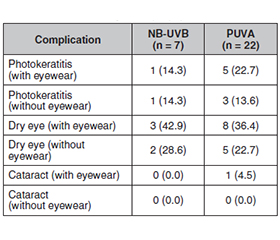
Актуальність. Фототерапія, зокрема з використанням вузькосмугового ультрафіолету B (NB-UVB) і псоралену та ультрафіолету A (PUVA), стала основним методом лікування хронічних дерматологічних захворювань, як-от псоріаз, вітиліго й екзема. Однак очні ризики, пов’язані з впливом ультрафіолету під час фототерапії, недостатньо вивчені. З огляду на схильність ока до пошкоджень, індукованих ультрафіолетом, існує критична потреба в науково обґрунтованій оцінці очних ускладнень, що виникають унаслідок дерматологічної фототерапії. Мета: оцінити частоту й тяжкість очних ускладнень в осіб, які проходять NB-UVB- та PUVA-фототерапію. Матеріали та методи. Це проспективне обсерваційне дослідження включало 120 пацієнтів, розподілених у групи NB-UVB (n = 60) та PUVA (n = 60), яких було відібрано протягом 12-місячного періоду в багатопрофільному дерматологічному й офтальмологічному центрі. Комплексні офтальмологічні обстеження, включаючи перевірку гостроти зору, тест Ширмера, час розриву слізної плівки (TBUT), обстеження з використанням щілинної лампи й офтальмоскопію, проводили на початку дослідження та кожні чотири тижні протягом 12-тижневого курсу лікування. Було надано захисні окуляри з УФ-блокуванням та виконано моніторинг дотримання режиму. Очні ускладнення класифікували за тяжкістю. Результати. Після 12 тижнів фототерапії спостерігалося вірогідне зниження TBUT, причому в групі PUVA воно було значнішим (42,9 %) порівняно з групою NB-UVB (12,7 %). Незважаючи на схожі початкові значення TBUT, PUVA-терапія викликала більш виражене порушення поверхні ока. Очні ускладнення виникали в обох групах, причому синдром сухого ока був найчастішим ускладненням загалом, особливо в пацієнтів, які отримували NB-UVB-терапію (71,4 %), тоді як фотокератит частіше зустрічався в осіб, які отримували PUVA-терапію (36,4 %). Утворення катаракти було рідкісним явищем, але відбувалося виключно в групі PUVA (4,5 %). Хоча носіння окулярів, що захищають від ультрафіолету, зменшило частоту ускладнень, воно не повністю запобігло травмам очей, особливо в когорті PUVA. Демографічний розподіл був добре збалансованим між групами, що мінімізує потенційні фактори, які впливають на зір, а результати дослідження підкреслюють, що кумулятивний вплив, особливо при PUVA-терапії, збільшує ризик очних захворювань. Висновки. Фототерапія як NB-UVB, так і PUVA пов’язана з ризиками для очей, однак при використанні PUVA частота й тяжкість ускладнень значно вищі. NB-UVB демонструє безпечніший профіль для органів зору і має бути методом вибору, коли це можливо. Суворе дотримання протоколів носіння захисних окулярів та регулярний офтальмологічний моніторинг є важливими, особливо при лікуванні PUVA, для мінімізації ускладнень, що загрожують зору, та забезпечення комплексного догляду за пацієнтами.
Background. Phototherapy, particularly narrowband ultraviolet B (NB-UVB) and psoralen plus ultraviolet A (PUVA), has become a cornerstone treatment for chronic dermatological conditions such as psoriasis, vitiligo, and eczema. However, the ocular risks associated with ultraviolet exposure during phototherapy are underexplored. Given the eye’s susceptibility to UV-induced damage, there is a critical need for evidence-based evaluations of ocular complications arising from dermatological phototherapy. This study purposed to evaluate ocular complications in patients undergoing NB-UVB and PUVA phototherapy. Materials and methods. This prospective observational study included 120 patients, equally divided between the NB-UVB (n = 60) and PUVA (n = 60) groups, recruited over a 12-month period at a multidisciplinary dermatology and ophthalmology center. Comprehensive ophthalmological evaluations, including visual acuity testing, Schirmer’s test, tear breakup time (TBUT), slit-lamp examination, and fundoscopy, were performed at baseline and every four weeks during the 12-week treatment course. UV-blocking protective eyewear was provided and compliance monitored. Ocular complications were categorized by severity. Results. After 12 weeks of phototherapy, a significant decline in TBUT was observed, with a greater reduction in the PUVA group (42.9 %) compared to the NB-UVB group (12.7 %). Despite similar baseline TBUT values, PUVA therapy induced more pronounced ocular surface disruption. Ocular complications occurred in both groups, with dry eye syndrome being the most frequent complication overall, particularly in NB-UVB-treated patients (71.4 %), while photokeratitis was more common among PUVA-treated patients (36.4 %). Cataract formation was rare but occurred exclusively in the PUVA group (4.5 %). Although adherence to UV-protective eyewear reduced the incidence of complications, it did not fully prevent ocular injuries, especially in the PUVA cohort. The demographic distribution was well balanced between groups, minimizing potential confounders, and the findings emphasize that cumulative exposure, particularly with PUVA therapy, increases the risk of ocular morbidity. Conclusions. Both NB-UVB and PUVA phototherapy are associated with ocular risks; however, PUVA carries a significantly higher incidence and severity of complications. NB-UVB demonstrates a safer ocular profile and should be preferred when feasible. Strict adherence to protective eyewear protocols and regular ophthalmological monitoring are essential, particularly for patients undergoing PUVA treatment, to minimize vision-threatening complications and ensure holistic patient care.
фототерапія; PUVA; NB-UVB; очні ускладнення; синдром сухого ока; фотокератит; дерматологія; УФ-захист
phototherapy; psoralen plus ultraviolet A; narrowband ultraviolet B; ocular complications; dry eye syndrome; photokeratitis; dermatology; UV protection
Для ознакомления с полным содержанием статьи необходимо оформить подписку на журнал.
- Ibbotson SH. A perspective on the use of NB-UVB phototherapy vs PUVA photochemotherapy. Front Med (Lausanne). 2018;5:1-6. doi: 10.3389/fmed.2018.00184.
- Lapolla W, Yentzer BA, Bagel J, Halvorson CR, Feldman SR. A review of phototherapy protocols for psoriasis treatment. J Am Acad Dermatol. 2011;64(5):936-949. doi: 10.1016/j.jaad.2009.12.054.
- DePry JL, Brescoll J, Szczotka-Flynn L, Rambhatla PV, Lim HW, Cooper KD. Phototherapy-related ophthalmologic disorders. Clin Dermatol. 2015;33(5):571-579. doi: 10.1016/j.clindermatol.2014.10.017.
- El-Fattah MM, Esmat SM, El-Hadidi H, El-Hanafi G, El-Mofty M, Ezzat BA. The effect of phototherapy and photochemotherapy on the eye. Med J Cairo Univ. 2011;79(2):55-59. Available from: https://www.medicaljournalofcairouniversity.net/index.php/2014-10-22-23-17-19/vol-79-june-2011/738-the-effect-of-phototherapy-and-photochemotherapy-on-the-eye.
- Darukarnphut K, Rattanakaemakorn P, Rajatanavin N. A retrospective study on the risk of non-melanoma skin cancer in PUVA and narrowband UVB treated patients. Arch Clin Biomed Res. 2017;1(3):116-121. doi: 10.26502/acbr.50170014.
- Hearn RM, Kerr AC, Rahim KF, Ferguson J, Dawe RS. Incidence of skin cancers in 3867 patients treated with narrow-band ultraviolet B phototherapy. Br J Dermatol. 2008;159(5):931-935. doi: 10.1111/j.1365-2133.2008.08776.x.
- Pattamadilok B, Poomputsar T. A retrospective, descriptive study of patients with Mycosis fungoides treated by phototherapy (oral PUVA, NB-UVB) with a twice-weekly regimen at the Institute of Dermatology, Bangkok, Thailand, with an experiential timeline of 13 years. Photodermatol Photoimmunol Photomed. 2021 Jan;37(1):49-55. doi: 10.1111/phpp.12611.
- Englert K, Kłosowicz A, Pelc P, Pastuszczak M, Wojas-Pelc A. The impact of therapeutic modalities on patients with atopic dermatitis, pso–riasis and vitiligo treated with phototherapy in the Jagiellonian University Outpatient Clinic. Pol Merkur Lekarski. 2019;46(273):125-129.
- Calzavara-Pinton P, Arisi M, Tonon F, Calzavara-Pinton I, Venturini M, Rossi M. Bath-PUVA still represents a valuable treatment option for the subsets of psoriatic patients who are not eligible to or rejecting systemic treatments and are not responsive to NB-UVB phototherapy. Photodermatol Photoimmunol Photomed. 2023 Jul;39(4):351-356. doi: 10.1111/phpp.12846.
- Elmets CA. PUVA vs NB-UVB: The controversy continues. NEJM J Watch. 2006;2(3):22-24.