
Архив офтальмологии Украины Том 14, №1, 2026
Вернуться к номеру
Системні запальні маркери як предиктори ефективності лікування вторинної неоваскулярної глаукоми: результати 24-місячного спостереження
Авторы: Гузун О.В. (1), Задорожний О.С. (1), Вичужанін В.В. (2), Величко Л.М. (1), Богданова О.В. (1), Король А.Р. (1)
(1) - ДУ «Інститут очних хвороб і тканинної терапії імені В.П. Філатова НАМН України», м. Одеса, Україна
(2) - Національний університет «Одеська політехніка», м. Одеса, Україна
Рубрики: Офтальмология
Разделы: Клинические исследования
Версия для печати
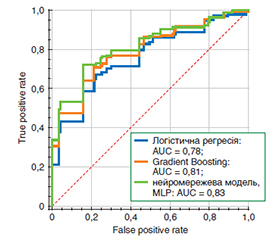
Актуальність. Неоваскулярна глаукома залишається однією з найбільш агресивних форм вторинної глаукоми, а прогноз ефективності її лікування потребує інтеграції клінічних даних із системними біомаркерами та сучасними аналітичними підходами. Мета: оцінити прогностичне значення показників системного запалення та ендотеліальної активації (SII, SIRI, AISI, ICAM-1 (CD54)) у прогнозуванні клінічного результату лікування вторинної неоваскулярної глаукоми через 24 місяці з використанням багатофакторного статистичного аналізу та методів машинного навчання. Матеріали та методи. Проведено ретроспективний аналіз результатів лікування 258 пацієнтів (258 очей) із вторинною неоваскулярною глаукомою. Кінцевою точкою був клінічний результат лікування через 24 місяці: група клінічного успіху (success — досягнення та підтримання ВОТ < 22 мм рт.ст. без зниження гостроти зору) та група з неефективним лікуванням (failure). Оцінювали інтегральні індекси системного запалення (SII, SIRI, AISI) та рівень маркера ендотеліальної активації ICAM-1 (CD54). Застосовано кореляційний аналіз Спірмена, багатофакторну логістичну регресію та моделі машинного навчання (Gradient Boosting, multilayer perceptron). Результати. Пацієнти з неефективним лікуванням через 24 місяці характеризувалися статистично значущо вищими вихідними рівнями SII, SIRI, AISI та ICAM-1 (CD54) порівняно з групою клінічного успіху, з підвищенням показників у 1,3–2,2 раза (p < 0,05). Усі системні запальні індекси та ICAM-1 (CD54) демонстрували значущі негативні кореляції з клінічним результатом лікування (p < 0,05). Модель багатофакторної логістичної регресії та моделі машинного навчання на основі системних маркерів забезпечили помірно високу дискримінаційну здатність щодо прогнозування клінічного успіху (AUC до 0,83). SHAP-аналіз підтвердив домінуючий негативний вплив підвищених значень SIRI та AISI на ймовірність досягнення клінічного успіху. Висновки. Показники системного запалення та ендотеліальної активації у пацієнтів з вторинною неоваскулярною глаукомою мають прогностичне значення, асоціюються з довгостроковим клінічним результатом лікування та можуть бути використані для ранньої стратифікації ризику неефективного лікування.
Background. Neovascular glaucoma remains one of the most aggressive forms of secondary glaucoma, and predicting treatment outcomes requires integration of clinical parameters with systemic biomarkers and advanced analytical approaches. The purpose was to evaluate the prognostic value of systemic inflammatory indices and endothelial activation markers (SII, SIRI, AISI, ICAM-1 (CD54)) for predicting treatment outcomes in secondary neovascular glaucoma at 24 months using multivariate statistical analysis and machine-learning approaches. Materials and methods. A retrospective analysis included 258 patients (258 eyes) with secondary neovascular glaucoma. The primary endpoint was the clinical treatment outcome at 24 months: clinical success group (achievement and maintenance of intraocular pressure < 22 mmHg without reduction in visual acuity) and group with ineffective treatment (failure). Systemic inflammatory indices (SII, SIRI, AISI) and the endothelial activation marker ICAM-1 (CD54) were assessed. Spearman correlation analysis, multivariate logistic regression, and machine-learning models (gradient boosting and multilayer perceptron) were applied. Results. Patients with treatment failure at 24 months demonstrated significantly higher baseline levels of SII, SIRI, AISI, and ICAM-1 (CD54) compared to the clinical success group, with a 1.3–2.2-fold increase (all p < 0.05). All systemic inflammatory indices and ICAM-1 (CD54) showed significant negative correlations with clinical treatment outcome (p < 0.05). Multivariate logistic regression and machine-learning models, based on systemic markers, provided moderate-to-high discriminative performance in predicting clinical success, with an area under the ROC curve of up to 0.83. SHAP analysis identified increased SIRI and AISI as the dominant negative contributors to treatment success probability. Conclusions. Systemic inflammation and endothelial activation markers in patients with secondary neovascular glaucoma have prognostic significance, are associated with long-term clinical treatment outcomes, and can be used for early risk stratification of treatment failure.
неоваскулярна глаукома; системне запалення; ICAM-1 (CD54); машинне навчання; прогноз
neovascular glaucoma; systemic inflammation; ICAM-1 (CD54); machine learning; prognosis
Для ознакомления с полным содержанием статьи необходимо оформить подписку на журнал.
- Senthil S, Dada T, Das T, Kaushik S, Puthuran GV, Philip R, et al. Neovascular glaucoma — A review. Indian J Ophthalmol. 2021 Mar;69(3):525-534. doi: 10.4103/ijo.IJO_1591_20.
- Urbonavičiūtė D, Buteikienė D, Janulevičienė I. A Review of Neovascular Glaucoma: Etiology, Pathogenesis, Diagnosis, and Treatment. Medicina. 2022;58(12):1870. https://doi.org/10.3390/medicina58121870.
- Aplin AC, Ligresti G, Fogel E, Zorzi P, Smith K, Nicosia RF. Regulation of angiogenesis, mural cell recruitment and adventitial macrophage behavior by Toll-like receptors. Angiogenesis. 2014 Jan;17(1):147-61. doi: 10.1007/s10456-013-9384-3.
- Beyer S, Koch M, Lee YH, Jung F, Blocki A. An In Vitro Model of Angiogenesis during Wound Healing Provides Insights into the Complex Role of Cells and Factors in the Inflammatory and Proliferation Phase. Int J Mol Sci. 2018 Sep 25;19(10):2913. doi: 10.3390/ijms19102913.
- Noma H, Mimura T, Yasuda K, Shimura M. Role of soluble vascular endothelial growth factor receptors-1 and -2, their ligands, and other factors in branch retinal vein occlusion with macular edema. Invest Ophthalmol Vis Sci. 2014 Jun 3;55(6):3878-85. doi: 10.1167/iovs.14-13961.
- Peter ME, Krammer PH. The CD95 (APO-1/Fas) DISC and beyond. Cell Death Differ. 2003;10(1):26-35. doi: 10.1038/sj.cdd.4401186.
- Minaker SA, Mason RH, Bamakrid M, Lee Y, Muni RH. Changes in Aqueous and Vitreous Inflammatory Cytokine Levels in Retinal Vein Occlusion: A Systematic Review and Meta-analysis. Journal of VitreoRetinal Diseases. 2019;4(1):36-64. doi: 10.1177/2474126419880391.
- Hu B, Yang XR, Xu Y, Sun YF, Sun C, Guo W, et al. Systemic immune-inflammation index predicts prognosis of patients after curative resection for hepatocellular carcinoma. Clin Cancer Res. 2014;20(23):6212-6222. doi: 10.1158/1078-0432.CCR-14-0442.
- Fois AG, Paliogiannis P, Scano V, Cau S, Babudieri S, Calvisi DF, et al. The systemic inflammation index on admission predicts in-hospital mortality in COVID-19 patients. Molecules. 2020;25(23):5725. doi: 10.3390/molecules25235725.
- Bai X, Cheng L, Wang H, Deng Y, Tong X, Wen W, et al. The aggregate index of systemic inflammation (AISI) and the risk of all-cause, cardiovascular, and cardio-cerebrovascular mortality in congestive heart failure patients: results from NHANES 1999–2018. Sci Rep. 2025;15(1):18282. doi: 10.1038/s41598-025-01196-8.
- Hasan MM, Phu J, Sowmya A, Meijering E, Kalloniatis M. Artificial intelligence in the diagnosis of glaucoma and neurodegene–rative diseases. Clin Exp Optom. 2024 Mar;107(2):130-146. doi: 10.1080/08164622.2023.2235346.
- Kłodnicka K, Januszewski J, Tyc H, Michalska A, Forma A, Teresińska B, et al. From Pathophysiology to Innovative Therapies in Eye Diseases: A Brief Overview. Int J Mol Sci. 2025 Sep 1;26(17):8496. doi: 10.3390/ijms26178496.
- Guzun O, Zadorozhnyy O, Vychuzhanin V, Khramenko N, Velychko L, Korol A, et al. A neural network model for predicting the effectiveness of treatment in patients with neovascular glaucoma associated with diabetes mellitus. Rom J Ophthalmol. 2024;68(3):294-300. doi: 10.22336/rjo.2024.53.
- Mishra D, Chakraborty R, Biswas J. Mechanisms of iris neovascularization: Current insights. Eye (Lond). 2022;36:1234-1245. doi: 10.1038/s41433-021-01688-7.
- Abcouwer SF, Shanmugam S, Muthusamy A, Lin CM, Kong D, Hager H, et al. Inflammatory resolution and vascular barrier restoration after retinal ischemia reperfusion injury. J Neuroinflammation. 2021 Aug 26;18(1):186. doi: 10.1186/s12974-021-02237-5.
- Pan H, He M, Liu R, Brecha NC, Yu AC, Pu M. Sulforaphane protects rodent retinas against ischemia-reperfusion injury through the activation of the Nrf2/HO-1 antioxidant pathway. PLoS One. 2014 Dec 3;9(12):e114186. doi: 10.1371/journal.pone.0114186.
- Noma H, Yasuda K, Shimura M. Cytokines and Pathogenesis of Central Retinal Vein Occlusion. J Clin Med. 2020 Oct 27;9(11):3457. doi: 10.3390/jcm9113457.
- Chen KH, Hsiang EL, Hsu MY, Chou YC, Lin TC, Chang YL, et al. Elevation of serum oxidative stress in patients with retina vein occlusions. Acta Ophthalmol. 2019;97:e290-e295.
- Zhang A, Ning L, Han J, Ma Y, Ma Y, Cao W, et al. Neutrophil-To-Lymphocyte Ratio as a Potential Biomarker of Neovascular Glaucoma. Ocul. Immunol. Inflamm. 2021;29:417-424.
- Guzun OV, Zadorozhnyy OS, Velychko LM, Bogdanova OV, Dumbrăveanu LG, Cuşnir VV, et al. The effect of the intercellular adhesion molecule-1 and glycated haemoglobin on the management of diabetic neovascular glaucoma. Rom J Ophthalmol. 2024;68(2):135-142. doi: 10.22336/rjo.2024.25.
- Topol EJ. High-performance medicine: the convergence of human and artificial intelligence. Nat Med. 2019;25(1):44-56. doi: 10.1038/s41591-018-0300-7.
- Lundberg SM, Lee SI. A unified approach to interpreting model predictions. Adv Neural Inf Process Syst. 2017;30:4765-4774.