
Журнал «Здоровье ребенка» Том 21, №2, 2026
Вернуться к номеру
Гігієна порожнини рота, харчові звички й ознаки тривожності в дітей внутрішньо переміщених осіб під час воєнного стану
Авторы: A.S. Mosiienko, O.V. Sheshukova, T.V. Polishchuk, A.V. Marchenko, E.V. Nikolishyna, N.M. Lokhmatova, Yu.V. Popelo
Poltava State Medical University, Poltava, Ukraine
Рубрики: Педиатрия/Неонатология
Разделы: Клинические исследования
Версия для печати
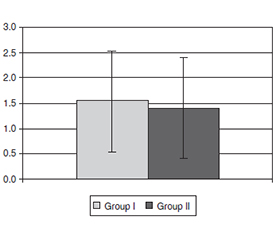
Актуальність. Карієс залишається однією з найпоширеніших проблем дитячого віку, що відображає вплив не лише біологічних, а й психосоціальних чинників. В умовах війни особливого значення набуває вплив вимушеного переміщення, стресу та змін у способі життя на стоматологічне здоров’я дітей. Матеріали та методи. Проведено перехресне порівняльне дослідження 330 дітей віком 6–7 років: 230 внутрішньо переміщених осіб (ВПО, І група) та 100 місцевих дітей (ІІ група). Використовували анкету й клінічні індекси: гігієни порожнини рота, резистентності емалі (TER-тест), стану пародонта (PMA) та карієсу (dmft + DMFT). Через ненормальний розподіл даних застосовано непараметричні тести (U-критерій Манна — Уїтні, χ2) та корекцію FDR для множинних порівнянь. Результати. Діти І групи мали гіршу гігієну порожнини рота (1,52 ± 0,03 проти 1,42 ± 0,02, p = 0,031) та нижчу резистентність емалі (TER: 4,24 ± 0,18 проти 2,64 ± 0,12, p < 0,001, r = 0,23). Поширеність карієсу була вищою серед ВПО (79,6 проти 68,0 %; χ2 = 5,12, p = 0,024), із більшою інтенсивністю уражень (dmft + DMFT: 3,31 ± 0,21 проти 1,91 ± 0,21, p < 0,001). Діти ВПО мали вищий рівень хронічної тривожності, порушень сну та концентрації уваги, нерегулярний режим харчування, споживали більше солодощів і газованих напоїв. Батьківський контроль за гігієною рота також був нижчим у І групі (60,9 проти 80,0 %, p = 0,001). Висновки. Діти ВПО мали вищу поширеність карієсу і гірші показники гігієни рота й резистентності емалі. Ці дані узгоджуються з гіпотезою щодо впливу психосоціальних факторів та обмеженого доступу до стоматологічної допомоги на погіршення здоров’я ротової порожнини в переміщених дітей.
Background. Dental caries remains one of the most widespread health issues in childhood, reflecting the influence not only of biological but also psychosocial factors. Under the war conditions, the impact of forced displacement, stress, and lifestyle changes on oral health of children becomes particularly significant. Materials and methods. A cross-sectional comparative study was conducted involving 330 children aged 6–7 years: 230 internally displaced children (group I) and 100 local children (group II). Data were collected using a custom questionnaire and clinical indices, including oral hygiene (hygiene index), enamel resistance (TER test), periodontal status (PMA), and caries indices (dmft + DMFT). Due to non-normal data distribution, non-parametric tests (Mann-Whitney U, χ2) and FDR correction for multiple comparisons were applied. Results. Children in group I were found to have poorer oral hygiene (1.52 ± 0.03 vs. 1.42 ± 0.02, p = 0.031) and lower enamel resistance (TER: 4.24 ± 0.18 vs. 2.64 ± 0.12, p < 0.001, r = 0.23). Caries prevalence was higher among internally displaced children (79.6 vs. 68.0 %; χ2 = 5.12, p = 0.024), with greater lesion severity (dmft + DMFT: 3.31 ± 0.21 vs. 1.91 ± 0.21, p < 0.001). Internally displaced children also demonstrated higher levels of chronic anxiety, sleep disturbances, and attention difficulties, along with irregular eating patterns, higher consumption of sweets and carbonated drinks, and lower parental supervision of oral hygiene (60.9 vs. 80.0 %, p = 0.001). Conclusions. Internally displaced children demonstrated higher caries prevalence, poorer oral hygiene, and lower enamel resistance. These findings support the hypothesis that psychosocial stressors and limited access to dental care contribute significantly to poor oral health outcomes in displaced pediatric populations.
карієс; внутрішньо переміщені діти; воєнний стан; гігієна порожнини рота; психосоціальний стрес
dental caries; internally displaced children; martial law; oral hygiene; psychosocial stress
Для ознакомления с полным содержанием статьи необходимо оформить подписку на журнал.
- Özdemir Z. The multifactorial etiology of dental caries disease (master’s thesis). Vilnius: Vilniaus Universitetas; 2024. Available from: https://epublications.vu.lt/object/elaba:210541843/.
- Faustova MO, Ananieva MM, Basarab YO, Dobrobolska OV, Vovk IM, Loban’ GA. Bacterial factors of cariogenicity (literature review). Wiad Lek. 2018;71(2 Pt 2):378-382.
- Ananieva MM, Faustova MO, Basarab IO, Loban GA. Kocuria rosea, Kocuria kristinae, Leuconostoc mesenteroides as caries-causing representatives of oral microflora. Wiad Lek. 2017;70(2 Pt 2):296-298.
- Kazeminia M, Abdi A, Shohaimi S, et al. Dental caries in primary and permanent teeth in children worldwide, 1995 to 2019: a systematic review and meta-analysis. Head Face Med. 2020;16(1):22. doi: 10.1186/s13005-020-00237-z.
- Hamamra B, Mahamid F, Mayaleh A. Childhood under siege: battling malnutrition, disease, and despair during genocide in Gaza. J Health Popul Nutr. 2025;44(1). doi: 10.1186/s41043-025-00948-6.
- Boiko DI, Shyrai PO, Mats OV, et al. Mental health and sleep disturbances among Ukrainian refugees in the context of the Russian-Ukrainian war: preliminary results from an online survey. Sleep Med. 2023. doi: 10.1016/j.sleep.2023.12.004.
- United Nations. Sustainable Development Goal 16 Review: Peace, Justice and Strong Institutions. New York: United Nations; 2023. Avai–lable from: https://unstats.un.org/sdgs/report/2023/.
- Kovalecz G, Márton S, Gáll T, Mahrouseh N, Varga O. Childhood caries management in the European Union: a cross-sectional study. Heliyon. 2021;7(3):e06198. doi: 10.1016/j.heliyon.2021.e06198.
- Hummel R, Bruers J, van der Galiën O, et al. Outcome measures for oral health based on clinical assessments and claims data: feasibility evaluation in practice. BMC Oral Health. 2017;17(1):125. doi: 10.1186/s12903-017-0410-5.
- D’Elia G, Floris W, Marini L, et al. Methods for evaluating the effectiveness of home oral hygiene measures: a narrative review of dental biofilm indices. Dent J (Basel). 2023;11(7):172. doi: 10.3390/dj11070172.
- World Health Organization. Global oral health status report: towards universal health coverage for oral health by 2030. Geneva: World Health Organization; 2022. Available from: https://iris.who.int/handle/10665/364538.
- Righolt AJ, Sidorenkov G, Faggion CM Jr, Listl S, Duijster D. Quality measures for dental care: a systematic review. Community Dent Oral Epidemiol. 2019;47(1):12-23. doi: 10.1111/cdoe.12429.
- Choi SE, Fayyad R, Normand SL. Racial disparities in quality of dental care among publicly insured children. Med Care. 2025;63(9):646-655. doi: 10.1097/MLR.0000000000002184.
- Barma MD, Bhadauria US, Purohit B, Malhotra S, Agarwal D, Priya H. Impact of war on oral health: a systematic review. Evid Based Dent. 2024;25(3):167-168. doi: 10.1038/s41432-024-01006-6.
- Sheshukova OV, Mosiienko AS, Polishchuk TV, Lokhmatova NM, Bauman SS, et al. Armed conflicts as a risk factor for the deve–lopment of dental caries in children. Child’s Health. 2025;20(4):264-270. doi: 10.22141/2224-0551.20.4.2025.1847 (in Ukrainian).
- Yen ET, Chiu SH, Tsai WD, Lin GM, Tsai KZ. Dental ca–ries prevalence and age-related patterns among populations remaining in war-affected regions of Ukraine. J Dent Sci. 2026;21(1):620-623. doi: 10.1016/j.jds.2025.4003.
- Habal W, Alkattan R, Hajeer MY, Alkhouli M, Al-Nerabieah Z, et al. Impact of Syrian conflict on the oral health of adolescents: a cross-sectional study. Cureus. 2024;16(2):e54613. doi: 10.7759/cureus.54613.
- Sangeeta Devi M, Devi TD, Sorokhaibam B, Ranjan R. Reflection of stress in the oral cavity. Indian J Forensic Med Toxicol. 2021;15(1):1847-1852. doi: 10.37506/ijfmt.v15i1.13579.
- Mohammad R. The relationship of traumatic exposure, perceived stress, and resilience with salivary cortisol and salivary alpha-amylase diurnal rhythm in Palestinian children aged 10–12 years exposed to chronic war violence (dissertation). 2009.
- Ponomarenko M, Kaifie A. Oral health, stress and barriers to accessing dental health care among war-affected Ukrainian refugees in Germany. BMC Oral Health. 2023;23:804. doi: 10.1186/s12903-023-03513-x.
- Cianetti S, Viarchi A, Lombardo G, et al. Real-world dental health of Ukrainian war refugee children and adolescents in Umbria, Italy: preliminary data. BMC Oral Health. 2025;25:512. doi: 10.1186/s12903-025-05543-z.