
Інформація призначена тільки для фахівців сфери охорони здоров'я, осіб,
які мають вищу або середню спеціальну медичну освіту.

Підтвердіть, що Ви є фахівцем у сфері охорони здоров'я.

Журнал «Здоровье ребенка» Том 21, №2, 2026

Вернуться к номеру

Кардіоензими порівняно з МРТ серця для ранньої діагностики міокардиту в дітей
Авторы: Hussein A. Alsalkhi
Najaf Cardiac Center, Faculty of Medicine, University of Kufa, Kufa, Iraq

Рубрики: Педиатрия/Неонатология

Разделы: Клинические исследования

Версия для печати


Резюме

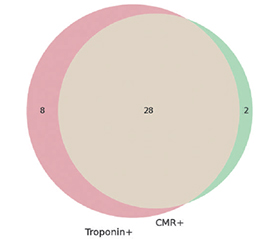
Актуальність. Діагностика міокардиту в дітей залишається складною через неспецифічну клінічну картину й відсутність будь-якого інструменту оцінки. Кардіотропоніни не є специфічними для цього захворювання, а магнітно-резонансна томографія серця (МРТС) забезпечує детальну характеристику тканини міокарда. Мета: визначення діагностичної ефективності високочутливого кардіотропоніну та МРТС за допомогою критеріїв Lake Louise 2018 року в дітей із підозрою на гострий міокардит, а також оцінка додаткової користі поєднаного використання обох тестів. Матеріали та методи. Це проспективне діагностичне дослідження проведене в Кардіологічному центрі провінції Наджаф (Куфа, Ірак) з січня 2024 року до січня 2026 року. Було залучено сто дітей віком від 6 місяців до 16 років із клінічною підозрою на гострий міокардит. Усі пацієнти пройшли серійне визначення високочутливого кардіотропоніну протягом перших 24 годин і стандартизовану МРТС відповідно до критеріїв Lake Louise 2018 року. МРТС використовували як еталонний метод. Були розраховані показники діагностичної точності (ROC-аналіз, тестування узгодженості) та кореляції між рівнем тропоніну й параметрами МРТС. Результати. МРТС підтвердила міо­кардит у 30 % пацієнтів. Високочутливий тропонін продемонстрував високі чутливість (93,3 %) і негативну прогностичну цінність (96,4 %), але нижчу специфічність (87,1 %) та позитивну прогностичну цінність (77,8 %). МРТС мала високу специфічність (97,1 %) і загальну діагностичну точність. Узгодженість між вимірюванням тропоніну й МРТС була суттєвою (коефіцієнт κ Коена = 0,78). Рівні тропоніну вірогідно корелювали з набряком міокарда, його пошкодженням та ступенем пізнього посилення гадолінієм під час МРТС, але не з фракцією викиду лівого шлуночка. Комбіноване використання тропоніну й МРТС мало 100% чутливість та негативну прогностичну цінність. Висновки. Високочутливий кардіотропонін є корисним методом раннього скринінгу при підозрі на дитячий міокардит, однак сам по собі він не має достатньої специфічності. МРТС із використанням критеріїв Lake Louise 2018 року забезпечує більш точну діагностичну верифікацію. Поєднання обох методів значно підвищує діагностичну ефективність та впевненість у встановленні діагнозу: оптимальною є поетапна стратегія — ранній скринінг тропоніну із подальшим цільовим проведенням МРТС.

Background. Diagnosis of myocarditis in children is still difficult because of nonspecific clinical presentation and lack of any specific tool. Cardiac troponins are not disease-specific and cardiac magnetic resonance imaging (CMR) offers detailed myocardial tissue characterization. This study was designed to determine the diagnostic performance of high-sensitivity cardiac troponin and CMR using the 2018 Lake Louise Criteria (LLC) in children with suspected acute myocarditis, and to evaluate the incremental benefit of both tests used together. Materials and methods. This was a prospective diagnostic study performed at the Najaf Cardiac Center from January 2024 to January 2026. One hundred children (ages 6 months to 16 years) with clinical suspicion of acute myocarditis were enrolled. All patients underwent serial high-sensitivity cardiac troponin testing within the first 24 h and a standardized CMR read based upon the 2018 LLC. CMR was used as the standard of reference. Diagnostic accuracy measures (receiver operating characteristic analysis, agreement testing) and correlations between troponins and CMR parameters were calculated. Results. CMR confirmed myocarditis in 30 % of patients. High-sensitivity troponin demonstrated high sensitivity (93.3 %) and negative predictive value (96.4 %) but lower specificity (87.1 %) and positive predictive value (77.8 %). CMR showed high specificity (97.1 %) and overall diagnostic accuracy. Agreement between troponin and CMR was substantial (Cohen’s κ = 0.78). Troponin levels correlated significantly with myocardial edema, injury, and extent of late gadolinium enhancement on CMR but not with left ventricular ejection fraction. Combined use of troponin and CMR achieved 100 % sensitivity and negative predictive value. Conclusions. High-sensitivity cardiac troponin is a useful early screen for suspected pediatric myocarditis; however, it does not have adequate specificity alone. CMR with the 2018 LLC gives better diagnostic verification. There is significant improvement in diagnostic performance and confidence of troponin screening with targeted CMR translation by using a combined stepwise approach for early troponin screening followed by selective CMR.


Ключевые слова

міокардит; серцевий тропонін; магнітно-резонансна томографія серця; критерії Lake Louise; діагностична точність; запалення міокарда

myocarditis; cardiac troponin; cardiac magnetic resonance imaging; Lake Louise Criteria; diagnostic accuracy; myocardial inflammation


Для ознакомления с полным содержанием статьи необходимо оформить подписку на журнал.


Список литературы

1. Williams JL, Jacobs HM, Lee S. Pediatric Myocarditis. Cardiol Ther. 2023 Jun;12(2):243-260. doi: 10.1007/s40119-023-00309-6.
2. Dawood I, Alhussein ST, Wadi WY, et al. Viral myocarditis in pediatrics: A review of current diagnostic methods and future directions. Ann Pediatr Cardiol. 2025 Jan-Feb;18(1):42-48. doi: 10.4103/apc.apc_236_24.
3. Hutchinson Z, Law Y. Myocarditis in children: diagnosis and management. JHLT Open. 2025 Jul 21;10:100332. doi: 10.1016/j.jhlto.2025.100332.
4. Das BB. Pediatric Myocarditis: Challenges in Diagnosis and Treatment. Paediatr Drugs. 2026 Feb 7. doi: 10.1007/s40272-026-00739-4.
5. Kinchler СM, Lightfoot KL, Olliff NS, et al. Pediatric myocarditis: Current concepts review. Progress in Pediatric Cardiology. 2025;77:101815. doi: 10.1016/j.ppedcard.2025.101815.
6. Luetkens JA, Faron A, Isaak A, et al. Comparison of Original and 2018 Lake Louise Criteria for Diagnosis of Acute Myocarditis: Results of a Validation Cohort. Radiol Cardiothorac Imaging. 2019 Jul 25;1(3):e190010. doi: 10.1148/ryct.2019190010.
7. Vaikom House A, Grosse-Wortmann L. Cardiac magnetic resonance imaging assessment of myocardial disease in children and adolescents. Cardiovasc Diagn Ther. 2025 Aug 30;15(4):888-897. doi: 10.21037/cdt-24-502.
8. Jacobs HM, Soslow JH, Cornicelli MD, et al. Practice patterns of cardiovascular magnetic resonance use in the diagnosis of pediatric myocarditis: A survey-based study. J Cardiovasc Magn Reson. 2024 Winter;26(2):101091. doi: 10.1016/j.jocmr.2024.101091.
9. Goldberg JF, Spinner JA, Soslow JH. Myocarditis in children 2024, new themes and continued questions. Curr Opin Cardiol. 2024 Jul 1;39(4):315-322. doi: 10.1097/HCO.0000000000001151.
10. Cohen JF, Korevaar DA, Altman DG, et al. STARD 2015 guidelines for reporting diagnostic accuracy studies: explanation and elaboration. BMJ Open. 2016 Nov 14;6(11):e012799. doi: 10.1136/bmjopen-2016-012799.
11. Ameh A, Brady JJ. Reference intervals for high sensitivity cardiac troponin I and N-terminal pro-B-type natriuretic peptide in children and adolescents on the Siemens Atellica. Clin Chem Lab Med. 2024 Feb 20;62(8):1636-1642. doi: 10.1515/cclm-2023-0977.
12. Degen M, Leviter J, Bradley A, et al. Association Between High-Sensitivity Troponin (hs-cTnT) and Diagnosis of Myocarditis in Previously Healthy Pediatric Patients. Pediatr Cardiol. 2025 Dec;46(8):2207-2213. doi: 10.1007/s00246-024-03621-7.
13. Popa A, Lazea C, Agoston-Coldea L. Novel insights on acute myocarditis in pediatric patients. Eur Rev Med Pharmacol Sci. 2023 Dec;27(23):11479-11495. doi: 10.26355/eurrev_202312_34587.
14. Sleem B, Zareef R, Bitar F, Arabi M. Myocarditis in COVID-19: a focus on the pediatric population. Am J Cardiovasc Dis. 2023 Jun 25;13(3):138-151.
15. Karev V, Starshinova AY, Glushkova A, Kudlay D, Starshinova A. Features of Myocarditis: Morphological Differential Diagnosis in Post-COVID-19 Children. Diagnostics (Basel). 2023 Jul 27;13(15):2499. doi: 10.3390/diagnostics13152499.
16. De Sarro R, Borrelli N, Pelaia G, et al. How to behave with paediatric myocarditis: imaging methods and clinical considerations. Eur Heart J Imaging Methods Pract. 2025 Apr 4;3(1):qyaf025. doi: 10.1093/ehjimp/qyaf025.
17. Moktadir A, Daire E, Renard C, Dirani S, Selegny M. Cardiac MRI characteristics and prognostic value in pediatric myocarditis. Archives of Cardiovascular Diseases. 2024 Aug-Sep;117(8-9 Suppl):242-243. doi: 10.1016/j.acvd.2024.07.049.
18. Yukcu B, Aydemir MM, Balci M, et al. Baseline and Follow-Up Cardiac Magnetic Resonance Imaging Findings in Children with Acute Myocarditis and Factors Associated with Late Gadolinium Enhancement. J Clin Med. 2024 Dec 31;14(1):189. doi: 10.3390/jcm14010189.
19. Ricci JC, Farahani NA, Davis CJ, et al. A comparative review of myocarditis in pediatrics versus adults: pathogenesis, diagnosis, and management. Front Immunol. 2025 Sep 26;16:1601307. doi: 10.3389/fimmu.2025.1601307.
20. Moscatelli S, Leo I, Bianco F, et al. The Role of Multimoda–lity Imaging in Pediatric Cardiomyopathies. J Clin Med. 2023 Jul 24;12(14):4866. doi: 10.3390/jcm12144866.
21. Zainal H, Rolf A, Zhou H, et al. Comparison of diagnostic algorithms in clinically suspected viral myocarditis: Agreement between cardiovascular magnetic resonance, endomyocardial biopsy, and troponin T. J Cardiovasc Magn Reson. 2024 Winter;26(2):101087. doi: 10.1016/j.jocmr.2024.101087.
22. Law YM, Lal AK, Chen S, et al.; American Heart Association Pediatric Heart Failure and Transplantation Committee of the Council on Lifelong Congenital Heart Disease and Heart Health in the Young and Stroke Council. Diagnosis and Management of Myocarditis in Children: A Scientific Statement from the American Heart Association. Circulation. 2021 Aug 10;144(6):e123-e135. doi: 10.1161/CIR.0000000000001001.
23. Schulz‑Menger J, Collini V, Gröschel J, et al.; ESC Scientific Document Group. 2025 ESC Guidelines for the management of myocarditis and pericarditis. Eur Heart J. 2025 Oct 22;46(40):3952-4041. doi: 10.1093/eurheartj/ehaf192.
24. Drazner MH, Bozkurt B, Cooper LT, et al. 2024 ACC Expert Consensus Decision Pathway on Strategies and Criteria for the Diagnosis and Management of Myocarditis: A Report of the American College of Cardiology Solution Set Oversight Committee. J Am Coll Cardiol. 2025 Feb 4;85(4):391-431. doi: 10.1016/j.jacc.2024.10.080.

Вернуться к номеру