
Журнал «Здоровье ребенка» Том 21, №2, 2026
Вернуться к номеру
Оцінка сприйняття, обізнаності та методів підтримки, що застосовуються вчителями до дітей з інвалідністю в початкових школах Багдада
Авторы: Mohammed H. Mahdi
Collage of Nursing, Al-Farabi University, Bagdad, Iraq
Рубрики: Педиатрия/Неонатология
Разделы: Клинические исследования
Версия для печати
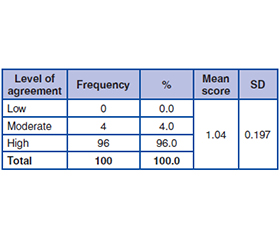
Актуальність. Дітям з інвалідністю необхідно забезпечити підтримувальні освітні, сімейні та суспільні умови, що дозволить їм брати участь у навчанні та залучатися до шкільного життя загалом. Обізнаність, сприйняття і методи підтримки вчителями, батьками й громадою є ключовими чинниками, що обумовлюють якість допомоги таким дітям та формування інклюзивного освітнього середовища. Мета: визначити сприйняття, обізнаність, практики догляду й підтримки серед вчителів, які працюють з дітьми з інвалідністю в початкових школах Багдада. У роботі також проаналізовано сприйняття вчителями обізнаності батьків і громади. Пряму оцінку поведінкових результатів дітей не виконували. Матеріали та методи. Для дослідження в період з листопада 2023 року до травня 2024 року було відібрано початкові школи районів Аль-Карх та Аль-Русафа. Цільову вибірку становили 100 учителів початкових класів, які заповнили структуровану анкету для самостійного опитування, що охоплювала соціально-демографічні характеристики, сприйняття інвалідності, оцінку обізнаності батьків і громади, а також практики догляду й підтримки. Для забезпечення змістовної валідності проведено експертну оцінку, а для перевірки зрозумілості інструменту — пілотне дослідження. Продемонстровано задовільну внутрішню узгодженість (α Кронбаха 0,78). Аналіз даних здійснювався за допомогою програми SPSS версії 24. Результати. Більшість респондентів були жінками (55 %), мали 6–8 років педагогічного досвіду (41 %) та диплом про середню спеціальну освіту (32 %). Учителі відзначили високий рівень обізнаності батьків (96 %), високу особисту обізнаність щодо питань, пов’язаних з інвалідністю (72 %). Рівень обізнаності громад коливався від середнього до високого (41–53 %). Також повідомлялося, що підтримувальні практики та догляд переважно оцінювалися як середні (60 %), що може свідчити про недостатню послідовність їх застосування. Висновки. Незважаючи на середній і високий рівні обізнаності, підтримувальні методи потребують посилення шляхом професійного розвитку вчителів і впровадження громадських ініціатив, спрямованих на вдосконалення інклюзивної початкової освіти.
Background. The children living with disabilities need to be provided with supportive educational, family, and community contexts that will enable them to participate, be included, and engage in the school in general. Teacher, parent and community awareness, perceptions and reported supportive practices are key contextual variables that determine the quality of support that can be offered to these children and the formation of inclusive learning environments. The purpose of the study was to determine the perception, awareness, reported caregiving and supportive practices of teachers working with children with disabilities in primary schools in Baghdad. The paper also examined the perception of teachers regarding parental and community awareness. There was no direct assessment of child behavioral outcomes. Materials and methods. The selected primary schools of the Al-Karkh and Al-Rusafa districts were chosen and carried out to conduct a descriptive assessment design between November 2023 and May 2024. A purposive sample of 100 primary school teachers was used to respond to a structured self-administered questionnaire that covered the socio-demographic factors, disability perception, perceived parental and community awareness and caregiving and supportive practices. Expert review was conducted to attain content validity and pilot study was conducted to guarantee clarity and ability. The instrument had shown a satisfactory internal consistency (Cronbach’s α 0.78). Analytical data were processed using SPSS version 24. Results. Most of the respondents were women (55 %), had 6–8 years of teaching experience (41 %), and diploma-level education (32 %). Teachers indicated high parental awareness (96 %), high personal awareness of disability-related issues (72 %). The awareness of communities was moderate to high (41–53 %). Supportive practices and caregiving were also reported to be largely moderate (60 %), that is, the findings may show where supportive practices seem to be less consistently reported. Conclusions. Despite the moderate to high levels of awareness, the supportive practices still need to be reinforced with the help of a specific professional development and community-based interventions so that inclusive primary schools could be encouraged.
діти з інвалідністю; обізнаність учителів; ставлення батьків; сприйняття громади; початкові школи
children with disabilities; teacher awareness; parental attitudes; community perception; primary schools
Для ознакомления с полным содержанием статьи необходимо оформить подписку на журнал.
- Dekker MC, Koot HM, van der Ende J, Verhulst FC. Emotional and behavioral problems in children and adolescents with and without intellectual disability. J Child Psychol Psychiatry. 2002;43(8):1087-1098.
- Kazdin AE. Developmental psychopathology: current research, issues, and directions. Am Psychol. 1989;44(2):180-187.
- Flynn S. Critical disability studies and the affirmative non-tragedy model: presenting a theoretical frame for disability and child protection. Disabil Soc. 2024;39(2):269-290.
- Amendola S, Hengartner MP, Spensieri V, Grillo L, Cerutti R. Patterns of internalizing symptoms and disability functioning in children and adolescents. Eur Child Adolesc Psychiatry. 2022;31(9):1455-1464.
- Lapshina N, Stewart SL. Traumatic life events, polyvictimization, and externalizing symptoms in children with IDD and mental health problems. Res Dev Disabil. 2021;116:104028.
- Aro T, Eklund K, Eloranta AK, et al. Learning disabilities elevate children’s risk for behavioral-emotional problems: differences between LD types, genders, and contexts. J Learn Disabil. 2022;55(6):465-481.
- Shirama A, Sugimoto M, Nishimura T, et al. Emotional and behavi–oral problems in Japanese preschool children with subthreshold autistic traits: findings from a community-based sample. BMC Psychiatry. 2022;22(1):499.
- Savari K, Naseri M, Savari Y. Evaluating the role of perceived stress, social support, and resilience in predicting the quality of life among parents of disabled children. Int J Disabil Dev Educ. 2023;70(5):644-658.
- Faught GG, Phillips BA, Conners FA. Permissive parenting mediates parental stress and child emotions in families of children with Down syndrome. J Appl Res Intellect Disabil. 2022;35(6):1418-1428.
- Sapiets SJ, Totsika V, Hastings RP. Factors influencing access to early intervention for families of children with developmental disabilities: A narrative review. J Appl Res Intellect Disabil. 2021;34(3):695-711.
- Smythe T, Almasri NA, Moreno Angarita M, et al. The role of parenting interventions in optimizing school readiness for children with disabilities in low and middle income settings. Front Pediatr. 2022;10:927678.
- Schiariti V, Simeonsson RJ, Hall K. Promoting developmental potential in early childhood: a global framework for health and education. Int J Environ Res Public Health. 2021;18(4):2007.
- Zaks Z. Changing the medical model of disability to the normali–zation model of disability. Disabil Soc. 2024;39(12):3233-3260.
- Charitaki G, Soulis SG, Georgiadi M, et al. Teachers’ attitudes towards inclusive education: a cross-national exploration. Trends Psychol. 2024;32:1120-1147.
- Jury M, Perrin AL, Rohmer O, Desombre C. Attitudes toward inclusive education: an exploration of the interaction between teachers’ status and students’ type of disability within the French context. Front Educ. 2021;6:655356.
- Lopatina H, Pavliuk T, Salko O, et al. Inclusive education in –higher education institutions: faculty readiness. Res Educ. 2024;118(1):49-72.
- Bani Odeh K, Lach LM. Barriers to, and facilitators of, education for children with disabilities worldwide: a descriptive review. Front Public Health. 2024;11:1294849.
- Sone BJ, Lee J, Roberts MY. Comparing instructional approa–ches in caregiver-implemented intervention: an interdisciplinary syste–matic review and meta-analysis. J Early Interv. 2021;43(4):339-360.
- Vanegas SB, Dueñas AD, Kunze M, Xu Y. Adapting parent-focused interventions for diverse caregivers of children with intellectual and developmental disabilities: lessons learned during global crises. J Policy Pract Intellect Disabil. 2023;20(1):45-57.
- Smythe T, Scherer N, Nanyunja C, Tann CJ, Olusanya BO. Strategies for addressing the needs of children with or at risk of developmental disabilities in early childhood by 2030: a systematic umbrella review. BMC Med. 2024;22(1):51.
- Huang W, Weinert S, Wareham H, et al. The emergence of 5-year-olds’ behavioral difficulties: analyzing risk and protective pathways in the United Kingdom and Germany. Front Psychol. 2022;12:769057.
- Aazami A, Valek R, Ponce AN, Zare H. Risk and protective factors and interventions for reducing juvenile delinquency: a systematic review. Soc Sci. 2023;12(9):474.
- Da Fonseca IB, Santos G, Santos MA. School engagement, school climate and youth externalizing behaviors: direct and indirect effects of parenting practices. Curr Psychol. 2023;43:3029-3046.
- Zhang L, Wang R, Chen L. The Impact of Harsh Parental Discipline and Emotional Warmth on Adolescent Problem Behaviors. Psychol Res Behav Manag. 2024 Jun 6;17:2309-2319. doi: 10.2147/PRBM.S466830.