
Международный эндокринологический журнал Том 22, №4, 2026
Вернуться к номеру
Кардіоренальні та вегетативні порушення в родичів військовослужбовців, які зазнали стресу під час війни: роль діабетичної нефропатії
Авторы: D.A. Volynskyi, N.B. Tymochko, V.Yu. Vyshyvaniuk, V.T. Rudnyk, A.S. Herashchenko, M.V. Bielinskyi, Ya.L. Vandzhura
Ivano-Frankivsk National Medical University, Ivano-Frankivsk, Ukraine
Рубрики: Эндокринология
Разделы: Клинические исследования
Версия для печати
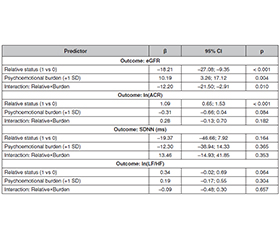
Актуальність. Хронічний психоемоційний стрес, обумовлений війною, є вагомим нетрадиційним чинником серцево-судинного ризику. Особливо вразливою групою є родичі військовослужбовців, у яких тривалий стрес може модифікувати перебіг артеріальної гіпертензії та ішемічної хвороби серця. За наявності діабетичної нефропатії цей вплив може мати синергічний негативний характер. Мета: оцінити клінічні асоціації хронічного психоемоційного стресу, обумовленого війною, з показниками автономної регуляції серцевої діяльності, функціонального стану нирок у пацієнтів з артеріальною гіпертензією та ішемічною хворобою серця залежно від наявності діабетичної нефропатії та статусу родича військовослужбовця. Матеріали та методи. Проведено одноцентрове обсерваційне порівняльне поперечне дослідження 66 пацієнтів віком ≥ 40 років з артеріальною гіпертензією та ішемічною хворобою серця. Сформовано дві групи: особи з діабетичною нефропатією без родинного статусу військовослужбовця; пацієнти з діабетичною нефропатією — родичі військовослужбовців. Оцінювали рівень хронічного стресу, тривоги та депресивних симптомів, варіабельність серцевого ритму, показники функції нирок. Результати. Найвищі показники сприйнятого стресу, тривоги й депресивних симптомів виявлено в пацієнтів із діабетичною нефропатією — родичів військовослужбовців. Аналіз варіабельності серцевого ритму продемонстрував зниження загальної та парасимпатичної активності з переважанням симпатичного впливу. Функція нирок у цих пацієнтів характеризувалася нижчою швидкістю клубочкової фільтрації та вищим рівнем альбумінурії, причому виявлено позитивний зв’язок між рівнем стресу й альбумінурією. Висновки. Поєднання діабетичної нефропатії з хронічним психоемоційним стресом, обумовленим війною, асоціюється з найбільш несприятливим кардіоренальним та автономним профілем у пацієнтів з артеріальною гіпертензією та ішемічною хворобою серця. Отримані результати підтверджують синергічний негативний вплив цих факторів і обґрунтовують доцільність комплексної оцінки психоемоційного стану для персоналізації стратифікації ризику й ведення пацієнтів.
Background. Prolonged war-related psychoemotional stress has emerged as an important non-traditional cardiovascular risk factor. Relatives of military personnel represent a particularly vulnerable population, as sustained stress may modify the course of hypertension and coronary heart disease. In the presence of diabetic nephropathy, this influence may be amplified through cardiorenal and autonomic mechanisms. Materials and methods. The study tested these associations in a single-center observational cross-sectional design including 66 patients aged 40 years and older with hypertension and coronary heart disease. Participants were stratified into two groups: patients with diabetic nephropathy without military family status; those with diabetic nephropathy who were relatives of military personnel. The study assessed perceived chronic stress, anxiety and depressive symptoms, heart rate variability indices, renal functional markers. Results. Patients with diabetic nephropathy who were relatives of military personnel demonstrated the highest levels of perceived stress, anxiety, and depressive symptoms. Consequently, this group exhibited higher prevalence of adverse circadian profiles. Heart rate variability analysis revealed a marked reduction in overall variability and parasympathetic activity, accompanied by sympathetic predominance. Renal involvement was more severe, with lower estimated glomerular filtration rates and higher levels of albuminuria; moreover, stress severity showed a positive association with urinary albumin excretion. Conclusions. The combination of diabetic nephropathy and chronic war-related psychoemotional stress is associated with the most unfavorable cardiorenal and autonomic profile in patients with hypertension and coronary heart disease. These findings highlight a synergistic adverse effect of metabolic renal impairment and sustained stress, supporting the benefits of integrating psychoemotional assessment into comprehensive cardiovascular risk stratification and personalized patient management under conditions of prolonged stress.
хронічний психоемоційний стрес; родичі військовослужбовців; діабетична нефропатія; варіабельність серцевого ритму; ішемічне навантаження
chronic psychoemotional stress; relatives of military personnel; diabetic nephropathy; heart rate variability; ischemic load
Для ознакомления с полным содержанием статьи необходимо оформить подписку на журнал.
- Kuzikova SB, Zlyvkov VL, Lukomska SO. Traumatic expe–rience of residents of the de-occupied territories of Ukraine. Insight: The Psychological Dimensions of Society. 2023;9:228-243. doi: 10.32999/KSU2663-970X/2023-9-13.
- Oleshko O, Berladir K, Oleshko T, Hlushchenko V, Korol O, Bilokonskyi V, et al. Neurobiological aspects of pathogenetic mechanisms in the development of post-traumatic stress disorder (literature review). Eastern Ukrainian Medical Journal. 2025;13(1):39-54. doi: 10.21272/eumj.2025;13(1):39-54.
- Anjum G, Aziz M, Hamid HK. Life and mental health in limbo of the Ukraine war: How can helpers assist civilians, asylum seekers and refugees affected by the war? Front Psychol. 2023 Feb 17;14:1129299. doi: 10.3389/fpsyg.2023.1129299.
- Wu C, Smit E, Davis CS, Han W, Siscovick DS, Psaty BM, Heckbert SR. Caregiver strain and 10-year risk of coronary heart disease: the Cardiovascular Health Study. JACC Heart Fail. 2022 May;10(5):350-8. doi: 10.1016/j.jchf.2021.12.004.
- Carey IM, Shah SM, DeWilde S, Harris T, Victor CR, Cook DG. Increased risk of acute cardiovascular events after partner bereavement: a matched cohort study. JAMA Intern Med. 2014 Apr;174(4):598-605. doi: 10.1001/jamainternmed.2013.14558.
- Feng LS, Wang YM, Liu H, Ning B, Yu HB, et al. Hyperactivity in the Hypothalamic-Pituitary-Adrenal Axis: An Invisible Killer for Anxiety and/or Depression in Coronary Arteriosclerotic Heart Disease. J Integr Neurosci. 2024;23(12):222. doi: 10.31083/j.jin2312222.
- Yang L, Li J, Wei W, Pu Y, Zhang L, Cui T, et al. Blood Pressure Variability and the Progression of Chronic Kidney Disease: a Systematic Review and Meta-Analysis. J Gen Intern Med. 2023 Apr;38(5):1272-1281. doi: 10.1007/s11606-022-08001-6.
- Alshahrani S. Renin-angiotensin-aldosterone path modulators in chronic kidney disease: A comparative review. Front Pharmacol. 2023 Feb 13;14:1101068. doi: 10.3389/fphar.2023.1101068.
- Banerjee D, Winocour P, Chowdhury TA, De P, Wahba M, Montero R, et al.; Association of British Clinical Diabetologists and The Renal Association. Management of hypertension and renin-angiotensin-aldosterone system blockade in adults with diabetic kidney disease: Association of British Clinical Diabetologists and the Renal Association UK guideline update 2021. BMC Nephrol. 2022 Jan 3;23(1):9. doi: 10.1186/s12882-021-02587-5.
- Doskaliuk B. How the Russian invasion affects Ukrainian rheumatology health care. Nat Rev Rheumatol. 2022;18:491-492. doi: 10.1038/s41584-022-00809-0.
- Volynskyi DA, Zvonar PP, Vandzhura YL, Denina RV, Tymochko NB. War-induced stress and pseudocardiac complaints: implications for cardiology services in Ukraine. Precarpathian Bulletin of the Shevchenko Scientific Society. Pulse. 2025;24(80):7-15. doi: 10.21802/2304-7437-2025-24(80)-7-15.
- Mijalevich-Soker E, Taubman-Ben-Ari O. Bereavement during wartime: psychological distress among Israeli widows. J Loss Trauma. 2025;30(1–2):1-25. doi: 10.1080/15325024.2024.1812394.
- Kurapov A, Kalaitzaki A, Keller V, Danyliuk I, Kowatsch T. The mental health impact of the ongoing Russian-Ukrainian war 6 months after the Russian invasion of Ukraine. Front Psychiatry. 2023 Jul 27;14:1134780. doi: 10.3389/fpsyt.2023.1134780.
- Pisaruk A, Asanov E, Naskalova S, Antoniuk-Shcheglova I, Bondarenko O, Dyba I, et al. Effects of war-related stress on the cardiovascular system, metabolism and the rate of aging in women. Aging and Longevity. 2024;5(1):21-28. doi: 10.47855/jal9020-2024-5-3.
- Kindrativ EO, Vasylyk VM, Matskevych VM, Kostyuk VM, Semchenko VA, Voronych VO. Retrospective analysis of coronavirus disease lethal cases. Fiziol Zh. 2021;67(4):76-85. doi: 10.15407/fz67.04.076.
- Bielinskyi M, Seredyuk N, Fedorov S, Herashchenko A, Volynskyi D. Effectiveness of metabolic therapy in patients with myocardial infarction and type 2 diabetes. Emergency Medicine. 2023;19(5):339-344. doi: 10.22141/2224-0586.19.5.2023.1609.
- Kidney Disease: Improving Global Outcomes (KDIGO) CKD Work Group. KDIGO 2024 Clinical Practice Guideline for the Evaluation and Management of Chronic Kidney Disease. Kidney Int. 2024 Apr;105(4S):S117-S314. doi: 10.1016/j.kint.2023.10.018.
- Tobe SW, Bajaj HS, Tangri N, Jain R, Pham T, Beaudin V, McFarlane P; Diabetes Canada Clinical Practice Guideline Steering Committee. Chronic Kidney Disease in Diabetes: A Clinical Practice Guidelines. Can J Diabetes. 2025 Mar;49(2):73-86.e14. doi: 10.1016/j.jcjd.2025.01.004.
- Cao B, Guo Z, Li DT, Zhao LY, Wang Z, Gao YB, Wang YX. The association between stress-induced hyperglycemia ratio and cardiovascular events as well as all-cause mortality in patients with chronic kidney disease and diabetic nephropathy. Cardiovasc Diabetol. 2025 Feb 6;24(1):55. doi: 10.1186/s12933-025-02610-1.
- Qin C, Wu Y, Zou Y, Zhao Y, Kang D, Liu F. Associations between depressive and anxiety symptoms and incident kidney fai–lure in patients with diabetic nephropathy. BMC Nephrol. 2025 Feb 4;26(1):54. doi: 10.1186/s12882-025-03983-x.
- Cho I, Lim S, Kwon M, Chung SM, Moon JS, Yoon JS, Won KC. Cardiovascular autonomic neuropathy and the risk of diabetic kidney disease. Front Endocrinol (Lausanne). 2024 Sep 12;15:1462610. doi: 10.3389/fendo.2024.1462610.
- Vaccarino V, Bremner JD. Stress and cardiovascular disease: an update. Nat Rev Cardiol. 2024 Sep;21(9):603-616. doi: 10.1038/s41569-024-01024-y.
- Soomra H, Mukhtar A, Asif F, Khalid A, Noureen S, Qamar Z, Haider U. Autonomic Nervous System Dysregulation in Meta–bolic Syndrome: An Association With Hypertension and Cardiovascular Risk. Cureus. 2025 Dec 10;17(12):e98932. doi: 10.7759/cureus.98932.
- Gong F, Li H, Huang T, et al. Association of diurnal blood pressure patterns with heart rate variability and retinopathy in patients with essential hypertension. Sci Rep. 2026;16:240. doi: 10.1038/s41598-025-29694-9.
- Wang C, Ye Z, Li Y, Zhang J, Zhang Q, Ma X, et al. Prognostic Value of Reverse Dipper Blood Pressure Pattern in Chronic Kidney Disease Patients not Undergoing Dialysis: Prospective Cohort Study. Sci Rep. 2016 Oct 7;6:34932. doi: 10.1038/srep34932.
- Jeong JH, Fonkoue IT, Quyyumi AA, DaCosta D, Park J. Nocturnal blood pressure is associated with sympathetic nerve activity in patients with chronic kidney disease. Physiol Rep. 2020 Oct;8(20):e14602. doi: 10.14814/phy2.14602.
- Motrenikova M, Boyanov K, Bojinova N, Bivolarska A. Stress Pathways in Chronic Kidney Disease: Linking Cortisol, Oxidative Stress, and Inflammation. Antioxidants. 2025;14(10):1259. doi: 10.3390/antiox14101259.
- Wang N, Zhang C. Oxidative Stress: A Culprit in the Progression of Diabetic Kidney Disease. Antioxidants. 2024;13(4):455. doi: 10.3390/antiox13040455.