
Международный эндокринологический журнал Том 22, №4, 2026
Вернуться к номеру
Експресія транскрипційних факторів ЕМТ Twist1 і Slug у доброякісних та злоякісних пухлинах щитоподібної залози
Авторы: P.P. Zinych, V.M. Pushkarev, N.I. Levchuk, Ye.A. Shelkovoi, M.Yu. Bolhov
V.P. Komisarenko Institute of Endocrinology and Metabolism of NAMSU, Kyiv, Ukraine
Рубрики: Эндокринология
Разделы: Клинические исследования
Версия для печати
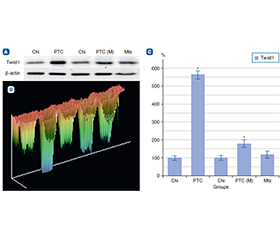
Актуальність. Папілярна карцинома щитоподібної залози (ПКЩЗ) зазвичай має сприятливий прогноз, однак метастазування в лімфатичні вузли, екстратиреоїдне поширення та рефрактерність щодо радіойодтерапії значною мірою обумовлюють рецидиви і зниження виживання. Епітеліально-мезенхімальний перехід (ЕМП) є ключовим механізмом, який керує інвазивною та метастатичною поведінкою при ПКЩЗ, проте його центральні транскрипційні регулятори залишаються не до кінця визначеними. Мета: зіставити рівні транскрипційних факторів Twist1 та Slug (SNAI2), пов’язаних з ЕМП, у гістологічно незміненій умовно нормальній (УН) тканині, вузловому зобі, тканині ПКЩЗ і метастазах. Матеріали та методи. Для оцінки експресії транскрипційних факторів ЕМП Twist1 та Slug у тканині вузлового зоба, ПКЩЗ та метастазах використано вестерн-блотинг. Результати. Не виявлено відмінностей в експресії Slug між УН тканиною та вузловим зобом. Невелике, але вірогідне збільшення концентрації Slug спостерігалося в тканинах ПКЩЗ без метастазів. Експресія Slug у первинних пухлинах ПКЩЗ із метастазами була більше ніж у 12 разів вищою порівняно з УН тканиною та перевищувала рівень у ПКЩЗ без метастазів більше ніж у 4 рази. Надзвичайно високі рівні Slug також виявлено в метастатичних тканинах. У тканинах ПКЩЗ із метастазами та без них експресія Twist1 була вищою, ніж в УН тканині. Висновки. Сучасні дані ідентифікують Twist1 та Slug як центральні регулятори інвазії та метастазування, зумовлених EMП, при ПКЩЗ. Механістично вісь Twist1/Slug — EMП — метастази лімфатичних вузлів лежить в основі втрати епітеліальної диференціації, набуття інвазивних ознак і поширення метастазів при ПКЩЗ. Наші дані демонструють значні відмінності в концентрації Slug між тканинами ПКЩЗ із метастазами та без них. Експресія Slug у пухлинній тканині ПКЩЗ із метастазами може слугувати біомаркером метастатичного потенціалу й діагностичним маркером диференціації доброякісних і злоякісних новоутворень щитоподібної залози.
Background. Papillary thyroid carcinoma (PTC) usually has a favorable prognosis; however, lymph node metastases, extrathyroidal extension, and radioiodine refractoriness significantly contribute to recurrence and reduced survival. Epithelial-mesenchymal transition (EMT) is a key mechanism driving invasive and metastatic behavior in PTC, yet its central transcriptional regulators remain incompletely defined. The purpose of the study was to compare the levels of the EMT-associated transcription factors Twist1 and Slug in histologically unchanged conditionally normal (CN) tissue, nodular goiter, PTC tissues, and metastases. Materials and methods. Western blotting was used to evaluate the expression of EMT transcription factors Twist1 and Slug (SNAI2) in tissues of nodular goiter, PTC and metastasis. Results. No differences in Slug expression were found between CN tissue and nodular goiter. A small but significant increase in Slug concentration was observed in PTC tissues without metastases. In PTC tissues with metastases, Slug expression in the primary tumor was more than 12-fold higher than in CN tissue and more than 4-fold higher than in PTC tissues without metastases. Extremely high levels of Slug were also detected in metastatic tissues. In PTC tissues with and without metastases, Twist1 expression was higher than in CN tissue. Conclusions. Current evidence identifies Twist1 and Slug as central regulators of EMT-driven invasion and metastases in PTC. Mechanistically, a Twist1/Slug-EMT-lymph node metastases axis underlies loss of epithelial differentiation, acquisition of invasive traits, and metastatic spread in PTC. Our data demonstrate significant differences in Slug concentration between PTC tissues with and without metastases. Slug expression in PTC tumor tissue with metastases may serve as a biomarker of metastatic potential and as a diagnostic marker for distinguishing benign from malignant thyroid neoplasms.
папілярна карцинома щитоподібної залози; Twist1; Slug (SNAI2); епітеліально-мезенхімальний перехід; метастазування
papillary thyroid carcinoma; Twist1; Slug (SNAI2); epithelial-mesenchymal transition; metastases
Для ознакомления с полным содержанием статьи необходимо оформить подписку на журнал.
- Xing M. Molecular pathogenesis and mechanisms of thyroid cancer. Nat Rev Cancer. 2013 Mar;13(3):184-99. doi: 10.1038/nrc3431.
- Tronko ND, Pushkarev VM. 30 years of the Chernobyl accident. Molecular genetic mechanisms of carcinogenesis of thyroid gland. Cytol Genet. 2016 Nov-Dec;50(6):15-22.
- Guda BB, Pushkarеv VM, Kovalenko AE, Pushkarev VV, Kovzun OI, Tronko MD. Molecular genetic mechanisms of the pathogenesis of thyroid malignant tumors (review of literature and own data, part 1). Endokrynologia. 2019;24(1):53-65. doi: 10.31793/1680-1466.2019.24-1.53 (in Ukrainian).
- Li Z, Wang N, Li X, et al. Thyroid cancer: From molecular insights to therapy (Review). Oncol Lett. 2025 Sep 10;30(5):520. doi: 10.3892/ol.2025.15266.
- Debnath P, Huirem RS, Dutta P, Palchaudhuri S. Epithelial-mesenchymal transition and its transcription factors. Biosci Rep. 2022 Jan 28;42(1):BSR20211754. doi: 10.1042/BSR20211754.
- Zinych PP, Pushkarev VM, Levchuk NI, Tronko M. ZEB1 as a marker of metastasis in thyroid carcinomas: review of literature and own data. 2024;20(7):517-28. doi: 10.22141/2224-0721.20.7.2024.1451 (in Ukrainian).
- Ghafoor S, Garcia E, Jay DJ, Persad S. Molecular Mechanisms Regulating Epithelial Mesenchymal Transition (EMT) to Promote Cancer Progression. Int J Mol Sci. 2025 May 3;26(9):4364. doi: 10.3390/ijms26094364.
- Singh S, Chakrabarti R. Consequences of EMT-Driven Chan–ges in the Immune Microenvironment of Breast Cancer and Therapeutic Response of Cancer Cells. J Clin Med. 2019 May 9;8(5):642. doi: 10.3390/jcm8050642.
- Tseng JC, Chen HF, Wu KJ. A twist tale of cancer metastasis and tumor angiogenesis. Histol Histopathol. 2015 Nov;30(11):1283-94. doi: 10.14670/HH-11-638.
- Zhu QQ, Ma C, Wang Q, Song Y, Lv T. The role of TWIST1 in epithelial-mesenchymal transition and cancers. Tumour Biol. 2016 Jan;37(1):185-97. doi: 10.1007/s13277-015-4450-7.
- Zhao Z, Rahman MA, Chen ZG, Shin DM. Multiple biological functions of Twist1 in various cancers. Oncotarget. 2017 Mar 21;8(12):20380-20393. doi: 10.18632/oncotarget.14608.
- Zhang J, Cheng Q, Zhou Y, Wang Y, Chen X. Slug is a key mediator of hypoxia induced cadherin switch in HNSCC: correlations with poor prognosis. Oral Oncol. 2013 Nov;49(11):1043-50. doi: 10.1016/j.oraloncology.2013.08.003.
- Hardy RG, Vicente-Dueñas C, González-Herrero I, Anderson C, Flores T, et al. Snail family transcription factors are implicated in thyroid carcinogenesis. Am J Pathol. 2007 Sep;171(3):1037-46. doi: 10.2353/ajpath.2007.061211.
- Xiang J, Lv N, Yin S, et al. TGF-β induces EMT in thyroid cancer cells by regulating transcription factors. Thyroid Res. 2025 Jun 10;18(1):25. doi: 10.1186/s13044-025-00243-w.
- Buehler D, Hardin H, Shan W, et al. Expression of epithelial-mesenchymal transition regulators SNAI2 and TWIST1 in thyroid carcinomas. Mod Pathol. 2013 Jan;26(1):54-61. doi: 10.1038/modpathol.2012.137.
- Wu J, Zhang Y, Cheng R, et al. Expression of epithelial-me–senchymal transition regulators TWIST, SLUG and SNAIL in follicu–lar thyroid tumors may relate to widely invasive, poorly differentiated and distant metastasis. Histopathology. 2019 Apr;74(5):780-791. doi: 10.1111/his.13778.
- Pawlicka M, Gumbarewicz E, Błaszczak E, Stepulak A. Transcription Factors and Markers Related to Epithelial-Mesenchymal Transition and Their Role in Resistance to Therapies in Head and Neck Cancers. Cancers (Basel). 2024 Mar 29;16(7):1354. doi: 10.3390/cancers16071354.
- Lv N, Liu F, Cheng L, Liu F, Kuang J. The Expression of Transcription Factors is Different in Papillary Thyroid Cancer Cells during TNF-α induced EMT. J Cancer. 2021 Mar 10;12(9):2777-2786. doi: 10.7150/jca.53349.
- Ledford H. Cancer theory faces doubts. Nature. 2011 Apr 21;472(7343):273. doi: 10.1038/472273a.
- Stemmler MP, Eccles RL, Brabletz S, Brabletz T. Non-redundant functions of EMT transcription factors. Nat Cell Biol. 2019 Jan;21(1):102-112. doi: 10.1038/s41556-018-0196-y.
- Buyuk B, Jin S, Ye K. Epithelial-to-Mesenchymal Transition Signaling Pathways Responsible for Breast Cancer Metastasis. Cell Mol Bioeng. 2021 Sep 2;15(1):1-13. doi: 10.1007/s12195-021-00694-9.
- Lv N, Shan Z, Gao Y, et al. Twist1 regulates the epithelial-mesenchymal transition via the NF-κB pathway in papillary thyroid carcinoma. Endocrine. 2016 Mar;51(3):469-77. doi: 10.1007/s12020-015-0714-7.
- Huang Y, Hong W, Wei X. The molecular mechanisms and therapeutic strategies of EMT in tumor progression and metastasis. J Hematol Oncol. 2022 Sep 8;15(1):129. doi: 10.1186/s13045-022-01347-8.
- Bustamante A, Baritaki S, Zaravinos A, Bonavida B. Relationship of Signaling Pathways between RKIP Expression and the Inhibition of EMT-Inducing Transcription Factors SNAIL1/2, TWIST1/2 and ZEB1/2. Cancers (Basel). 2024 Sep 17;16(18):3180. doi: 10.3390/cancers16183180.
- Casas E, Kim J, Bendesky A, Ohno-Machado L, Wolfe CJ, Yang J. Snail2 is an essential mediator of Twist1-induced epithelial mesenchymal transition and metastasis. Cancer Res. 2011 Jan 1;71(1):245-54. doi: 10.1158/0008-5472.CAN-10-2330.
- Baldini E, Tuccilli C, Pironi D, et al. Expression and Clinical Utility of Transcription Factors Involved in Epithelial-Mesenchymal Transition during Thyroid Cancer Progression. J Clin Med. 2021 Sep 9;10(18):4076. doi: 10.3390/jcm10184076.
- Calangiu CM, Mărgăritescu C, Cernea D, Stepan A, Simionescu CE. The expression of twist in differentiated thyroid carcinomas. Curr Health Sci J. 2014 Jul-Sep;40(3):184-9. doi: 10.12865/CHSJ.40.03.05.
- Di Maro G, Orlandella FM, Bencivenga TC, et al. Identification of targets of Twist1 transcription factor in thyroid cancer cells. J Clin Endocrinol Metab. 2014 Sep;99(9):E1617-26. doi: 10.1210/jc.2013-3799.
- Wang N, Dong CR, Jiang R, et al. Overexpression of HIF-1α, metallothionein and SLUG is associated with high TNM stage and lymph node metastasis in papillary thyroid carcinoma. Int J Clin Exp Pathol. 2013 Dec 15;7(1):322-30.
- Sun W, Yang S, Ma Q, et al. SLUG promotes invasion and metastasis of anaplastic thyroid cancer cells through repression of E-cadherin. International Journal of Clinical and Experimental Pathology. 2016;9(8):8373-8379.
- Dongre A, Weinberg RA. New insights into the mechanisms of epithelial-mesenchymal transition and implications for cancer. Nat Rev Mol Cell Biol. 2019 Feb;20(2):69-84. doi: 10.1038/s41580-018-0080-4.