
Журнал «Травма» Том 27, №3, 2026
Вернуться к номеру
Рандомізоване порівняльне дослідження ефективності оригінального пролонгованого бетаметазону дипропіонату та його генерика при плантарному фасціїті
Авторы: Блонський Р.І., Килимнюк Л.О.
Медичний центр європейської ортопедії, м. Київ, Україна
Рубрики: Травматология и ортопедия
Разделы: Клинические исследования
Версия для печати
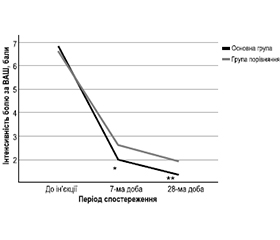
Актуальність. Плантарний фасціїт — це захворювання з хронічним перебігом, яке є однією з найпоширеніших причин болю в ділянці п’ятки. Незважаючи на широкий спектр методів лікування, у значної частини пацієнтів симптоми зберігаються протягом тривалого часу, що обмежує їх функціональну активність і якість життя. Мета: порівняти клінічну ефективність застосування оригінального пролонгованого бетаметазону дипропіонату та його генерика у лікуванні пацієнтів з плантарним фасціїтом. Матеріали та методи. Проведено проспективне рандомізоване дослідження за участю 60 пацієнтів із плантарним фасціїтом, розподілених на дві групи у співвідношенні 1 : 1. Пацієнтам основної групи виконували локальну ін’єкцію оригінального препарату, пацієнтам групи порівняння — генеричного. Аналізували інтенсивність болю, частоту ускладнень, локальні зміни за даними ультразвукового дослідження (УЗД) та потребу у повторному введенні препарату. Оцінку здійснювали при первинному зверненні, на 7-му та 28-му добу спостереження. Результати. Встановлено статистично нижчі показники інтенсивності больового синдрому у пацієнтів основної групи як на 7-му добу (2,03 ± 0,61 бала проти 2,63 ± 0,85 бала; p = 0,009), так і на 28-му добу спостереження (1,37 ± 0,72 бала проти 1,97 ± 0,89 бала; p = 0,03). Відносне зниження інтенсивності болю в основній групі становило 70,40 ± 8,07 % на 7-му добу та 80,54 ± 9,74 % на 28-му добу, у групі порівняння — 60,46 ± 12,04 % та 70,52 ± 12,88 % відповідно. У пацієнтів основної групи локальних ускладнень та патологічних змін за даними УЗД не фіксували. У групі порівняння локальні ускладнення спостерігали у 2 (6,67 %) пацієнтів, зміни за результатами УЗД — у 4 (13,33 %). Водночас відмінності між групами досягли статистичної значущості лише за частотою патологічних змін за даними УЗД (р = 0,04). У пацієнтів основної групи потреби у повторному введенні препарату не виникало на відміну від групи порівняння, у якій зазначений показник становив 20,00 % (p = 0,02). Висновки. Оригінальний пролонгований бетаметазону дипропіонат продемонстрував статистично нижчий рівень залишкового болю на 7-му та 28-му добу, більший відносний відсоток зниження інтенсивності болю та відсутність потреби у повторному введенні препарату протягом періоду спостереження порівняно з генеричною формою. За частотою локальних ускладнень та патологічних змін за даними УЗД спостерігали тенденцію на користь оригінального препарату.
Background. Plantar fasciitis is a chronic condition and one of the most common causes of heel pain. Despite a wide range of available treatment options, a significant proportion of patients experience long-term symptoms that limit their functional activity and quality of life. The purpose was to compare the clinical effectiveness of the original long-acting betamethasone dipropionate and its generic form in the treatment of patients with plantar fasciitis. Materials and methods. A prospective randomized study was conducted in 60 patients with plantar fasciitis, allocated into two groups in a 1 : 1 ratio. Participants in the study group received a local injection of the original drug, while patients in the comparison group received the generic formulation. Pain intensity, complication rate, local changes assessed by ultrasound, and the need for repeat injection were evaluated. Assessments were performed at baseline, on days 7 and 28. Results. Statistically lower pain intensity scores were observed in patients of the study group both on day 7 (2.03 ± 0.61 points vs 2.63 ± 0.85 points; p = 0.009) and on day 28 of the follow-up (1.37 ± 0.72 points vs 1.97 ± 0.89 points; p = 0.03). The relative reduction in pain in the study group was 70.40 ± 8.07 % on day 7 and 80.54 ± 9.74 % on day 28, as opposed to 60.46 ± 12.04 % and 70.52 ± 12.88 %, respectively, in the comparison group. No local complications or pathological ultrasound changes were recorded in the study group. In the comparison group, local complications were observed in 2 (6.67 %) patients, while ultrasound changes were detected in 4 (13.33 %) people. However, differences between the groups were statistically significant only in terms of the frequency of pathological changes as determined by ultrasound (p = 0.04). No patients in the study group required repeat injection during the follow-up period, in contrast to the comparison group, where the corresponding rate was 20.00 % (p = 0.02). Conclusions. Original long-acting betamethasone dipropionate demonstrated a statistically lower level of residual pain on days 7 and 28, a greater relative reduction in pain intensity, and no need for repeat injection during the follow-up period compared to the generic formulation. Regarding the frequency of local complications and pathological ultrasound changes, a trend in favor of the original preparation was
observed.
плантарний фасціїт; запалення; больовий синдром; захворювання; лікування
plantar fasciitis; inflammation; pain; disease; treatment