
Інформація призначена тільки для фахівців сфери охорони здоров'я, осіб,
які мають вищу або середню спеціальну медичну освіту.

Підтвердіть, що Ви є фахівцем у сфері охорони здоров'я.

Журнал «Травма» Том 27, №3, 2026

Вернуться к номеру

Визначення клінічних фенотипів остеоартриту медіального відділу колінного суглоба шляхом кластерного аналізу
Авторы: O.O. Kostrub (1), R.I. Blonskyi (1, 2), L.O. Kylymniuk (1), O.Yu. Branitskyi (3), V.O. Movchaniuk (4), M.M. Matsipura (3)
(1) - Institute of Traumatology and Orthopedics of NAMSU, Kyiv, Ukraine
(2) - Private Higher Educational Institution “Kyiv Medical University”, Kyiv, Ukraine
(3) - Vinnytsia National Pirogov Memorial Medical University, Vinnytsia, Ukraine
(4) - Medical and Diagnostic Center “Medilux” Ltd, Vinnytsia, Ukraine

Рубрики: Травматология и ортопедия

Разделы: Клинические исследования

Версия для печати


Резюме

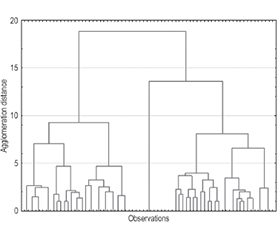
Актуальність. Остеоартрит колінного суглоба є надзвичайно поширеним і гетерогенним захворюванням, що підкреслює необхідність застосування фенотипорієнтованих підходів до стратифікації пацієнтів. Мета: визначити фенотипи остеоартриту медіального відділу колінного суглоба шляхом кластерного аналізу коморбідних характеристик та механічних факторів, пов’язаних із захворюванням. Матеріали та методи. Проведено ретроспективне обсерваційне дослідження даних 70 пацієнтів з остеоартритом медіального відділу колінного суглоба. Оцінювали демографічні, клінічні, коморбідні й механічні фактори. Для узагальнення доменних ознак формували композитні індекси (кількісний показник, розрахований як сума наявних ознак) та бінарні індикатори доменів (наявність домену визначали при виявленнi ≥ 1 ознаки). Фенотипування проводили за допомогою двохетапного кластерного аналізу (метод Варда з подальшим застосуванням алгоритму k-середніх). Міжкластерні відмінності оцінювали з використанням непараметричних статистичних методів. Відмінності вважали статистично значущими при p ≤ 0,05. ­Результати. У результаті кластерного аналізу ідентифіковано три фенотипи остеоартриту медіального відділу колінного суглоба. Для фенотипу 1 характерно накопичення кардіометаболічних факторів ризику та помірний рівень загальної коморбідності. Фенотип 2 вирізняли найвищі значення індексів коморбідності й більша частота серцево-судинних захворювань. Фенотип 3 обумовлений механічними факторами, пов’язаними із захворюванням, включаючи попередні хірургічні втручання в ділянці ураженого колінного суглоба, за мінімального системного коморбідного навантаження. Висновки. Ідентифіковано три фенотипи остеоартриту медіального відділу колінного суглоба, які відображають різні домінуючі клінічні й патогенетичні домени захворювання, зокрема метаболічний, мультиморбідний та механічний. Отримані дані свідчать про багатовимірну природу остеоартриту колінного суглоба і доцільність фенотипорієнтованої стратифікації пацієнтів.

Background. Knee osteoarthritis is a highly prevalent and heterogeneous disease, emphasizing the need for phenotype-based approaches to patient stratification. Aim: to identify phenotypes of medial knee osteoarthritis based on cluster analysis of comorbid characteristics and mechanical disease-related factors. ­Materials and methods. A retrospective observational study was conducted using data from 70 patients with medial knee osteoarthritis. Demographic, clinical, comorbid, and mechanical factors were assessed. To summarize domain-specific characteristics, composite indices were constructed (quantitative measures calculated as the sum of present features), as well as binary domain indicators (a domain was considered present if ≥ 1 feature was identified). Phenotyping was performed using a two-step cluster analysis approach (Ward’s method followed by the k-means algorithm). Inter-cluster differences were evaluated using nonparametric statistical methods. Diffe­rences were considered statistically significant at p ≤ 0.05. Results. Cluster analysis identified three phenotypes of medial knee osteoarthritis. Phenotype 1 was characterized by the accumulation of cardiometabolic risk factors and a moderate level of overall comorbidity burden. Phenotype 2 demonstrated the highest comorbidity index scores and a greater prevalence of cardiovascular involvement. Phenotype 3 was associated with mechanical disease-related factors, including prior surgical interventions in the affected joint, and was accompanied by minimal systemic comorbidity burden. Conclusions. Three phenotypes of medial knee osteoarthritis were identified, reflecting distinct dominant clinical and pathogenetic domains of the disease, including metabolic, multimorbid, and mechanical ones. These findings support the multidimensional nature of knee osteoarthritis and highlight the relevance of phenotype-oriented patient stratification.


Ключевые слова

остеоартрит колінного суглоба; кластерний аналіз; фенотипи; коморбідність; персоналізована медицина

knee osteoarthritis; cluster analysis; phenotypes; comorbidity; personalized medicine


Для ознакомления с полным содержанием статьи необходимо оформить подписку на журнал.


Список литературы

1. GBD 2021 Osteoarthritis Collaborators. Global, regional, and national burden of osteoarthritis, 1990–2020 and projections to 2050: a systematic analysis for the Global Burden of Disease Study 2021. Lancet Rheumatol. 2023;5(9):e508-e522. doi: 10.1016/S2665-9913(23)00163-7.
2. Ren JL, Yang J, Hu W. The global burden of osteoarthritis knee: a secondary data analysis of a population-based study. Clin Rheumatol. 2025;44:1769-1810. doi: 10.1007/s10067-025-07347-6.
3. Perruccio AV, Young JJ, Wilfong JM, Denise Po–wer J, Canizares M, Badley EM. Osteoarthritis year in review 2023: Epidemiology & Therapy. Osteoarthritis Cartilage. 2024;32(2):159-165. doi: 10.1016/j.joca.2023.11.012.
4. American Academy of Orthopaedic Surgeons. Management of osteoarthritis of the knee (non-arthroplasty): clinical practice guideline. 3rd ed. Rosemont (IL): AAOS; 2021. Avai–lable from: https://www.aaos.org/globalassets/quality-and-practice-resources/osteoarthritis-of-the-knee/oak3cpg.pdf.
5. Karasavvidis T, Pagan Moldenhauer CA, Lustig S, Vigdorchik JM, Hirschmann MT. Definitions and consequences of current alignment techniques and phenotypes in total knee arthroplasty (TKA) — there is no winner yet. J Exp Orthop. 2023;10(1):120. doi: 10.1186/s40634-023-00697-7.
6. Scientific Committee from the Personalized Arthroplasty Society (PAS). Standardizing definitions of the total knee alignment techniques: recommendations by the Personalized Arthroplasty Society. EFORT Open Rev. 2025;10(8):623-635. doi: 10.1530/EOR-2024-0120.
7. MacDessi SJ, Griffiths-Jones W, Harris LA, Bellemans J, Chen DB. Coronal Plane Alignment of the Knee (CPAK) classification. Bone Joint J. 2021;103-B(2):329-337. doi: 10.1302/0301-620X.103B2.BJJ-2020-1050.R1.
8. Grant S, Van de Graaf V, Chen D, Pagnano M, Bellemans J, Macdessi S. The Coronal Plane Alignment of the Knee Classification: How It Works, How to Apply It, and How It can Affect Outcomes in Knee Reconstruction Surgery. JB JS Open Access. 2025;10(4):e25.00165. doi: 10.2106/JBJS.OA.25.00165.
9. Klasan A, Jeremic D, Neri T, Jan Heyse T, Hirschmann MT. Functional alignment in total knee arthroplasty is an umbrella term — A call for better definition and reporting quality! Knee Surg Sports Traumatol Arthrosc. 2025;33(12):4275-4281. doi: 10.1002/ksa.12774.
10. Charlson ME, Pompei P, Ales KL, MacKenzie CR. A new method of classifying prognostic comorbidity in longitudinal studies: development and validation. J Chronic Dis. 1987;40(5):373-83. doi: 10.1016/0021-9681(87)90171-8.
11. Elixhauser A, Steiner C, Harris DR, Coffey RM. Comorbidity measures for use with administrative data. Med Care. 1998;36(1):8-27. doi: 10.1097/00005650-199801000-00004.
12. The World Medical Association (1964/2013). Declaration of Helsinki: Ethical Principles for Medical Research Involving Human Subjects. Ferney-Voltaire: WMA; 2013. Avai–lable from: https://www.wma.net/what-we-do/medical-ethics/declaration-of-helsinki/.
13. Council of Europe. Convention for the protection of human rights and dignity of the human being with regard to the application of biology and medicine: convention on human rights and biomedicine. Strasbourg: Council of Europe; 1997. Available from: https://zakon.rada.gov.ua/laws/show/994_334#Text (in Ukrainian).
14. Ministry of Health of Ukraine. Order No. 690: On approval of the procedure for conducting clinical trials of medicinal products and examination of clinical trial materials and model regulation on ethics committees. Kyiv: Ministry of Health of Ukraine; 2009. Available from: https://zakon.rada.gov.ua/laws/show/z1010-09#Text (in Ukrainian).
15. Blonskyi RI, Kylymniuk LO. Sagittal profile of knee joint morphotypes in osteoarthritis. Modern Medical Technology. 2025;17(4):279-290. doi: 10.14739/mmt.2025.4.335512 (in Ukrainian).
16. Blonskyi RI, Kylymniuk LO, Matsipura MM, Bra–nitsky OY, Kulyk YA. Morphotype-specific changes in the distal femur in knee osteoarthritis. Clinical and Preventive Medicine. 2025;8:47-58. doi: 10.31612/2616-4868.8.2025.06 (in Ukrainian).
17. Calvet J, Garca-Manrique M, Berenguer-Llergo A, Orellana C, Cirera SG, et al. Metabolic and inflammatory profiles define phenotypes with clinical relevance in female knee osteoarthritis patients with joint effusion. Rheumatology (Oxford). 2023;62(12):3875-3885. doi: 10.1093/rheumatology/kead135.
18. Pineda-Moncus M, Dernie F, Dell’Isola A, Kamps A, Runhaar J, et al. Classification of patients with osteoarthritis through clusters of comorbidities using 633  330 individuals from Spain. Rheumatology (Oxford). 2023;62(11):3592-3600. doi: 10.1093/rheumatology/kead038.
19. Zemedikun DT, Lee H, Nirantharakumar K, Raza K, Chandan JS, et al. Comorbidity phenotypes and risk of mortality in patients with osteoarthritis in the UK: a latent class analysis. Arthritis Res Ther. 2022;24(1):231. doi: 10.1186/s13075-022-02909-4.
20. Ma J, Zhang K, Ma X, Wang H, Ma C, et al. Clinical phenotypes of comorbidities in end-stage knee osteoarthritis: a cluster analysis. BMC Musculoskelet Disord. 2024;25(1):299. doi: 10.1186/s12891-024-07394-1.
21. Park D, Park YM, Ko SH, Choi YH, Min DU, et al. Association between knee osteoarthritis and the risk of cardiovascular disease and the synergistic adverse effects of lack of exercise. Sci Rep. 2023;13(1):2777. doi: 10.1038/s41598-023-29581-1.
22. Korzh O, Korzh I. Osteoarthritis and cardiovascular diseases: etiological and clinical-pathogenetic relationships, treatment and prevention. Orthopaedics Traumatology and Prosthetics. 2024;(2):88-98. doi: 10.15674/0030-59872024288-98.
23. Evers BJ, Van Den Bosch MHJ, Blom AB, van der Kraan PM, et al. Post-traumatic knee osteoarthritis; the role of inflammation and hemarthrosis on disease progression. Front Med (Lausanne). 2022;9:973870. doi: 10.3389/fmed.2022.973870.
24. Mndermann A, Nesch C, Ewald H, Jonkers I. Osteoarthritis year in review 2024: Biomechanics. Osteoarthritis Cartilage. 2024;32(12):1530-1541. doi: 10.1016/j.joca.2024.09.011.

Вернуться к номеру