
Журнал «Травма» Том 27, №3, 2026
Вернуться к номеру
Відновлення симетрії сили м’язів стегна після ендопротезування кульшового суглоба
Авторы: Бондаренко С.Є., Середа Д.І., Карпінська О.Д.
ДУ «Інститут патології хребта та суглобів імені професора М.І. Ситенка НАМН України», м. Харків, Україна
Рубрики: Травматология и ортопедия
Разделы: Клинические исследования
Версия для печати
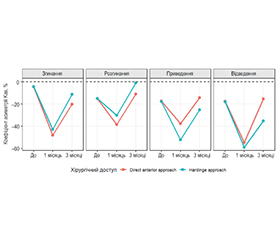
Актуальність. Після тотального ендопротезування кульшового суглоба зменшення болю не завжди супроводжується відновленням симетричності сили м’язів стегна. Доопераційна асиметрія при кокс-артрозі та асептичному некрозі головки стегнової кістки може зберігатися або посилюватися у ранньому післяопераційному періоді. Мета: оцінити динаміку коефіцієнта асиметрії сили м’язів стегна після ендопротезування залежно від хірургічного доступу та етапу реабілітації. Матеріали та методи. Проведено проспективне нерандомізоване порівняльне дослідження відповідно до TREND. Проаналізовано дані 41 пацієнта: 18 після прямого переднього доступу (DAA) та 23 після латерального доступу Hardinge (HA). Оцінку проводили до операції, через 1 та 3 місяці. Визначали коефіцієнт асиметрії (Kas, %) сили м’язів стегна. Використовували Welch t-test, парний t-test та mixed-design repeated-measures ANOVA з оцінкою g. Результати. До операції міжгрупових відмінностей Kas не виявлено. Через 1 місяць асиметрія збільшувалася в обох групах. Для відвідних м’язів Kas становив –54,55 ± 2,92 % для DAA та –58,78 ± 3,13 % для HA (p < 0,001). Через 3 місяці асиметрія зменшилася до –19,55 ± 6,66 % в групі DAA та –36,99 ± 3,10 % — HA (p < 0,001). У період 1–3 місяці поліпшення Kas було значущим для всіх м’язових груп (p < 0,001). Найбільша динаміка при DAA відзначена для відвідних м’язів — 39 процентних пунктів. ANOVA показав значущий ефект часу для всіх груп м’язів (g = 0,526–0,939) та взаємодію група час для відведення (F = 13,03; p < 0,001; g = 0,191). Висновки. Через 1 місяць після ендопротезування симетрія сили м’язів не відновлюється. Індивідуалізована реабілітація після функціонального контролю сприяє зменшенню асиметрії, однак через 3 місяці повна симетрія ще не досягається.
Background. Reduction of pain after total hip arthroplasty does not necessarily indicate restoration of thigh muscle strength symmetry. In patients with coxarthrosis and avascular necrosis of the femoral head, preoperative asymmetry may persist or even increase during the early postoperative period. The aim of this study was to evaluate the dynamics of thigh muscle strength asymmetry after total hip arthroplasty depending on the surgical approach and rehabilitation stage. Materials and methods. A prospective non-randomized comparative study was conducted according to the TREND principles. The study included 41 patients: 18 patients underwent total hip arthroplasty using the direct anterior approach (DAA), and 23 patients underwent surgery using the modified lateral Hardinge approach (HA). Assessments were performed before surgery and at 1 and 3 months postoperatively. The muscle strength asymmetry coefficient (Kas, %) was calculated. Statistical analysis included Welch’s t-test, paired t-test, and mixed-design repeated-measures ANOVA with generalized eta-squared (g). Results. No significant between-group differences in Kas were found preoperatively. At 1 month after surgery, muscle strength asymmetry increased in both groups. For hip abductors, Kas was –54.55 ± 2.92 % in the DAA group and –58.78 ± 3.13 % in the HA group (p < 0.001). At 3 months, abductor asymmetry decreased to –19.55 ± 6.66 % in the DAA group and –36.99 ± 3.10 % in the HA group (p < 0.001). From 1 to 3 months, Kas improved significantly in all muscle groups (p < 0.001). The greatest improvement in the DAA group was observed for abductors, reaching 39.0 percentage points. ANOVA demonstrated a significant time effect for all muscle groups (g = 0.526–0.939) and a significant group time interaction for abduction (F = 13.03; p < 0.001; g = 0.191). Conclusions. Muscle strength symmetry is not restored within the first month after total hip arthroplasty. Individualized rehabilitation after functional assessment contributes to a reduction in asymmetry; however, complete restoration of symmetry is not achieved by 3 months postoperatively.
тотальне ендопротезування кульшового суглоба; коксартроз; асептичний некроз голівки стегнової кістки; асиметрія м’язової сили; коефіцієнт асиметрії; прямий передній доступ; модифікований латеральний доступ Hardinge; реабілітаці
total hip arthroplasty; coxarthrosis; avascular necrosis of the femoral head; muscle strength asymmetry; asymmetry coefficient; direct anterior approach; modified lateral Hardinge approach; rehabilitation