
Журнал «Медицина неотложных состояний» Том 22, №5, 2026
Вернуться к номеру
Рання післяопераційна когнітивна дисфункція після операцій на верхній кінцівці
Авторы: Литвиненко А.О. (1), Лісний І.І. (2)
(1) - Київська міська клінічна лікарня № 7, м. Київ, Україна
(2) - Національний інститут раку, м. Київ, Україна
Рубрики: Медицина неотложных состояний
Разделы: Клинические исследования
Версия для печати
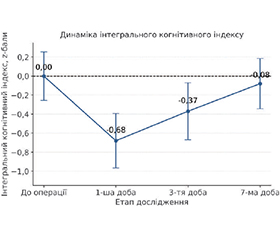
Актуальність. Раннє післяопераційне когнітивне зниження може ускладнювати активізацію пацієнта та виконання реабілітаційних рекомендацій після ортопедичних втручань на верхній кінцівці. Метою роботи було оцінити когнітивну динаміку, біль, сон, стрес-реакцію, NSE та гемодинаміку в ранньому післяопераційному періоді. Матеріали та методи. Проведено проспективний клінічний аналіз 45 дорослих пацієнтів після планових ортопедичних операцій на верхній кінцівці в умовах комбінованої анестезії із застосуванням пропофолу, фентанілу та регіонарного компонента. Когнітивні функції оцінювали до операції, на першу, третю і сьому добу за MoCA, MMSE, FAB, TMT-B та SDMT. Додатково аналізували біль, якість сну за RCSQ, глюкозу, кортизол, NSE та гемодинамічні показники. Використовували критерій Фрідмана, критерій Вілкоксона з поправкою Holm, Kendall’s W та Spearman’s rho. Результати. На першу добу зареєстровано односпрямоване погіршення всіх когнітивних тестів. Найбільші зміни стосувалися SDMT і TMT-B: SDMT знизився на 7,38 бала, а час TMT-B збільшився на 19,53 с порівняно з доопераційним рівнем (p < 0,001). Найбільший розмір ефекту був для SDMT (Kendall’s W = 0,797) і TMT-B (W = 0,625). Клінічно значуще погіршення за SDMT на першу добу виявлено у 77,8 % пацієнтів, а за TMT-B — у 48,9 %. На третю добу показники частково відновлювалися, а на сьому добу MoCA і TMT-B статистично не відрізнялися від вихідного рівня. Якість сну за RCSQ найбільше знижувалася на першу добу (на 18,49 мм; p < 0,001). Погіршення RCSQ було пов’язане з погіршенням TMT-B (ρ = 0,551; p Holm = 0,0016). Інтраопераційний приріст кортизолу також асоціювався з погіршенням TMT-B (ρ = 0,440; p Holm = 0,043). Гемодинаміка залишалася стабільною, потреба в морфіні була низькою (4,4 %), стійкого зв’язку NSE з когнітивними тестами не встановлено. Висновки. Після ортопедичних операцій на верхній кінцівці в умовах комбінованої анестезії спостерігалося раннє транзиторне зниження когнітивної функції. Найчутливішими тестами були SDMT і TMT-B. Приріст кортизолу та погіршення сну були асоційовані з погіршенням TMT-B.
Background. Early postoperative cognitive decline may interfere with mobilisation of a patient, and rehabilitation recommendations after orthopaedic surgery on the upper limb. The aim of the study was to assess early postoperative cognitive dynamics, pain, sleep quality, stress response, neuron-specific enolase (NSE) and haemodynamics. Materials and methods. A prospective clinical analysis included 45 adult patients who underwent elective orthopaedic surgery on the upper limb under combined anaesthesia with propofol, fentanyl and a regional component. Cognitive function was assessed before surgery and on postoperative days 1, 3 and 7 using Montreal Cognitive Assessment (MoCA), Mini-Mental State Examination, Frontal Assessment Battery, Trail Making Test, Part B (TMT-B) and Symbol Digit Modalities Test (SDMT). Additionally, the following parameters were analysed: pain intensity, sleep quality — by the Richards-Campbell Sleep Questionnaire (RCSQ), glucose, cortisol, NSE and haemodynamic variables. Friedman test, Wilcoxon test with Holm correction, Kendall’s W and Spearman’s ρ were used. Results. On postoperative day 1, all cognitive tests showed unidirectional deterioration. The greatest changes were observed in SDMT and TMT-B: SDMT decreased by 7.38 points, and TMT-B completion time increased by 19.53 s compared with the preoperative level (p < 0.001). The largest effect sizes were found for SDMT (Kendall’s W = 0.797) and TMT-B (W = 0.625). Clinically significant deterioration for SDMT on day 1 was recorded in 77.8 % of patients and in 48.9 % for TMT-B. On day 3, cognitive performance partially recovered; by day 7, MoCA and TMT-B no longer differed statistically from baseline. Sleep quality showed the greatest decrease on day 1, with RCSQ reduced by 18.49 mm (p < 0.001). Worsening of RCSQ was associated with deterioration in TMT-B (ρ = 0.551; Holm-adjusted p = 0.0016). Intraoperative cortisol increase was also associated with TMT-B deterioration (ρ = 0.440; Holm-adjusted p = 0.043). Haemodynamics remained stable, rescue morphine requirement was low (4.4 %), and no persistent association between NSE dynamics and cognitive tests was found. Conclusions. Combined anaesthesia for orthopaedic surgery on the upper limb was accompanied by early transient cognitive decline. SDMT and TMT-B were the most sensitive tests. Cortisol increase and reduced sleep quality were associated with deterioration in TMT-B.
післяопераційна когнітивна дисфункція; ортопедична хірургія; регіонарна анестезія; SDMT; TMT-B; післяопераційний сон
postoperative cognitive dysfunction; orthopaedic surgery; regional anaesthesia; Symbol Digit Modalities Test; Trail Making Test, Part B; postoperative sleep
Для ознакомления с полным содержанием статьи необходимо оформить подписку на журнал.
- Evered L., Silbert B., Knopman D.S., et al. Recommendations for the nomenclature of cognitive change associated with anaesthesia and surgery-2018. Br. J. Anaesth. 2018. Vol. 121(5). P. 1005-1012. doi: 10.1016/j.bja.2017.11.087.
- Rundshagen I. Postoperative cognitive dysfunction. Dtsch. Arztebl. Int. 2014. Vol. 111(8). P. 119-125. doi: 10.3238/arztebl.2014.0119.
- Monk T.G., Weldon B.C., Garvan C.W., et al. Predictors of cognitive dysfunction after major noncardiac surgery. Anesthesiology. 2008. Vol. 108(1). P. 18-30. doi: 10.1097/01.anes.0000296071.19434.1e.
- Tasbihgou S.R., Absalom A.R. Postoperative neurocognitive disorders. Korean J. Anesthesiol. 2021. Vol. 74(1). P. 15-22. doi: 10.4097/kja.20294.
- Yang T., Velagapudi R., Terrando N. Neuroinflammation after surgery: from mechanisms to therapeutic targets. Nat. Immunol. 2020. Vol. 21(11). P. 1319-1326. doi: 10.1038/s41590-020-00812-1.
- Neuman M.D., Feng R., Carson J.L., et al. Spinal anesthesia or general anesthesia for hip surgery in older adults. N. Engl. J. Med. 2021. Vol. 385(22). P. 2025-2035. doi: 10.1056/NEJMoa2113514.
- Li T., Li J., Yuan L., et al. Effect of regional vs general anesthesia on incidence of postoperative delirium in older patients undergoing hip fracture surgery: the RAGA randomized trial. JAMA. 2022. Vol. 327(1). P. 50-58. doi: 10.1001/jama.2021.22647.
- Khaled M., Sabac D., Fuda M., et al. Postoperative pain and neurocognitive outcomes after noncardiac surgery: a systematic review and dose-response meta-analysis. Br. J. Anaesth. 2025. Vol. 134(1). P. 89-101. doi: 10.1016/j.bja.2024.08.032.
- Toma O., Persoons B., Pogatzki-Zahn E., et al. PROSPECT guideline for rotator cuff repair surgery: systematic review and procedure-specific postoperative pain management recommendations. Anae–sthesia. 2019. Vol. 74(10). P. 1320-1331. doi: 10.1111/anae.14796.
- Свіргун М.В., Семененко А.І. Аналіз виникнення післяопераційної когнітивної дисфункції у пацієнтів із ожирінням після ендопротезування кульшового суглоба під спінальною анестезією. Клінічна анатомія та оперативна хірургія. 2023. Т. 22, № 3. С. 77-83. doi: 10.24061/1727-0847.22.3.2023.33.
- Rasmussen L.S., Larsen K., Houx P., et al. The assessment of postoperative cognitive function. Acta Anaesthesiol. Scand. 2001. Vol. 45(3). P. 275-289. doi: 10.1034/j.1399-6576.2001.045003275.x.
- Borchers F., Spies C.D., Feinkohl I., et al. Methodology of measuring postoperative cognitive dysfunction: a systematic review. Br. J. Anaesth. 2021. Vol. 126(6). P. 1119-1127. doi: 10.1016/j.bja.2021.01.035.
- Liu J., Huang K., Zhu B., et al. Neuropsychological tests in post-operative cognitive dysfunction: methods and applications. Front. Psychol. 2021. Vol. 12. Article 684307. doi: 10.3389/fpsyg.2021.684307.
- Benedict R.H.B., DeLuca J., Phillips G., et al. Validity of the Symbol Digit Modalities Test as a cognition performance outcome measure for multiple sclerosis. Mult. Scler. 2017. Vol. 23(5). P. 721-733. doi: 10.1177/1352458517690821.
- Arbuthnott K., Frank J. Trail Making Test, Part B as a measure of executive control: validation using a set-switching paradigm. J. Clin. Exp. Neuropsychol. 2000. Vol. 22(4). P. 518-528. doi: 10.1076/1380-3395(200008)22:4;1-0;FT518.
- Desborough J.P. The stress response to trauma and surgery. Br. J. Anaesth. 2000. Vol. 85(1). P. 109-117. doi: 10.1093/bja/85.1.109.
- Rasmussen L.S., O'Brien J.T., Silverstein J.H., et al. Is peri-operative cortisol secretion related to post-operative cognitive dysfunction? Acta Anaesthesiol. Scand. 2005. Vol. 49(9). P. 1225-1231. doi: 10.1111/j.1399-6576.2005.00791.x.
- Wang X., Hua D., Tang X., et al. The role of perioperative sleep disturbance in postoperative neurocognitive disorders. Nat. Sci. Sleep. 2021. Vol. 13. P. 1395-1410. doi: 10.2147/NSS.S320745.
- Chen C., Zhai R.X., Lan X., et al. The influence of sleep disorders on perioperative neurocognitive disorders among the elderly: a narrative review. iBrain. 2024. Vol. 10(2). P. 197-216. doi: 10.1002/ibra.12167.
- Wang X., Chen X., Wu F., et al. Relationship between postoperative biomarkers of neuronal injury and postoperative cognitive dysfunction: a meta-analysis. PLoS One. 2023. Vol. 18(4). Article e0284728. doi: 10.1371/journal.pone.0284728.
- Kim N., Kim K.H., Choi Y.S., et al. Effect of dexmedetomidine on early postoperative cognitive function in patients undergoing arthroscopic shoulder surgery in beach chair position: a randomized double-blind study. J. Clin. Med. 2022. Vol. 11(11). Article 2970. doi: 10.3390/jcm11112970.
- Xu F., Li Y., Wang X., et al. Effect of pre-infusion of hypertonic saline on postoperative delirium in geriatric patients undergoing shoulder arthroscopy: a randomized controlled trial. BMC Anesthesiol. 2023. Vol. 23. Article 405. doi: 10.1186/s12871-023-02340-5.
- Rhee S.M., Kim S.Y., Kim C.H., et al. Postoperative delirium after reverse total shoulder arthroplasty: interscalene block versus ge–neral anesthesia. Clin. Orthop. Surg. 2025. Vol. 17(2). P. 283-290. doi: 10.4055/cios24084.
- Takayama K., Ichimura A., Ito H. Arthroscopic shoulder surgery in the beach chair position under single interscalene block does not affect patients' cognitive function. JSES Int. 2025 Oct 14. Vol. 10(1). Article 101387. doi: 10.1016/j.jseint.2025.09.007. eCollection 2026 Jan.
- Deng L., Jiao B., Cai J., et al. The use of peripheral nerve block decrease incidence of postoperative cognitive dysfunction following orthopedic surgery: a systematic review and meta-analysis. BMC Anesthesiol. 2024. Vol. 24. Article 354. doi: 10.1186/s12871-024-02743-y.
- Zhang X., Leng Y., Yuan X., et al. Efficacy of perioperative dexmedetomidine in postoperative pain and neurocognitive functions in orthopedic surgery: a systematic review and meta-analysis with trial sequential analysis of randomized controlled trials. Int. J. Surg. 2025. Vol. 111(5). P. 3525-3542. doi: 10.1097/JS9.0000000000002315.
- Lisnyy I., Zakalska O., Dmytriiev D., et al. Pre-emptive analgesia with nonsteroidal anti-inflammatory drugs. Randomized, double-blind placebo-controlled study. Lekársky Obzor. 2021. Vol. 70(5). P. 195-202.
- Sieber F.E., Zakriya K.J., Gottschalk A., et al. Sedation depth during spinal anesthesia and the development of postoperative delirium in elderly patients undergoing hip fracture repair. Mayo Clin. Proc. 2010. Vol. 85(1). P. 18-26. doi: 10.4065/mcp.2009.0469.
- Radtke F.M., Franck M., Lendner J., et al. Monitoring depth of anaesthesia in a randomized trial decreases the rate of postoperative delirium but not postoperative cognitive dysfunction. Br. J. Anaesth. 2013. Vol. 110, Suppl. 1. P. i98-i105. doi: 10.1093/bja/aet055.
- Langer T., Santini A., Zadek F., et al. Intraoperative hypotension is not associated with postoperative cognitive dysfunction in elderly patients undergoing general anesthesia for surgery: results of a randomized controlled pilot trial. J. Clin. Anesth. 2019. Vol. 52. P. 111-118. doi: 10.1016/j.jclinane.2018.09.021.
- Van Zuylen M.L., Gribnau A., Admiraal M., et al. The role of intraoperative hypotension on the development of postoperative cognitive dysfunction: a systematic review. J. Clin. Anesth. 2021. Vol. 72. Article 110310. doi: 10.1016/j.jclinane.2021.110310.
- Peden C.J., Miller T.R., Deiner S.G., et al. Improving peri–operative brain health: an expert consensus review of key actions for the perioperative care team. Br. J. Anaesth. 2021. Vol. 126(2). P. 423-432. doi: 10.1016/j.bja.2020.10.037.
- Berger M., Schenning K.J., Brown C.H., et al. Best practices for postoperative brain health: recommendations from the Fifth International Perioperative Neurotoxicity Working Group. Anesth. Analg. 2018. Vol. 127(6). P. 1406-1413. doi: 10.1213/ANE.0000000000003841.
- Ahmed H.M., Atterton B.P., Crowe G.G., et al. Recommendations for effective documentation in regional anesthesia: an expert panel Delphi consensus project. Reg. Anesth. Pain Med. 2022. Vol. 47(5). P. 301-308. doi: 10.1136/rapm-2021-103136.
- Semenko N., Kuchyn I., Frank M., et al. Sevoflurane reduces the cardiac toxicity of bupivacaine compared with propofol in rabbits: an experimental study using early electrocardiographic detection and measurement of toxic plasma concentration. Anaesthesiol. Intensive Ther. 2024. Vol. 56(4). P. 224-230. doi: 10.5114/ait.2024.145167.