
Журнал "Гастроэнтерология" Том 60, №3, 2026
Вернуться к номеру
Коморбідність запальних захворювань кишечника та метаболічного синдрому у військовослужбовців: психосоматичний та клінічний аспекти
Авторы: Стойкевич М.В., Недзвецька Н.В., Тарасова Т.С.
ДУ «Інститут гастроентерології НАМН України», м. Дніпро, Україна
Рубрики: Гастроэнтерология
Разделы: Клинические исследования
Версия для печати
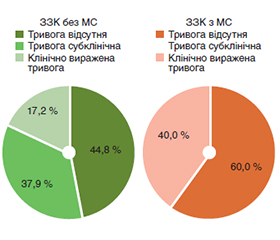
Актуальність. Вивчення психоемоційного стану військовослужбовців із запальними захворюваннями кишечника (ЗЗК) на тлі метаболічного синдрому (МС) є вкрай актуальним через синергію хронічного бойового стресу, системного запалення та метаболічних порушень, що значно погіршують адаптацію, збільшують ризик рецидивів ЗЗК та підвищують ризик тяжких депресивних і тривожних розладів. Мета: оцінити рівні тривоги, депресії та сприйняття стресу у військовослужбовців із запальними захворюваннями кишечника залежно від наявності МС. Матеріали та методи. Обстежено 36 військовослужбовців із ЗЗК. Для оцінки тривоги та депресії використовували госпітальну шкалу тривоги та депресії (Hospital Anxiety and Depression Scale, HADS), рівень сприйняття стресу визначали за шкалою Perceived Stress Scale (PSS-10). Пацієнтів розподілено на дві групи: із ЗЗК без МС (n = 31, з яких за шкалою HADS оцінено 29 обстежених, а за шкалою PSS-10 — 31 обстежений) та із ЗЗК у поєднанні з МС (n = 5). Результати. Загалом тривожні розлади виявлено у 52,9 % пацієнтів, депресивні — у 38,2 %. Середній рівень тривоги перевищував середній рівень депресії в 1,2 раза. У пацієнтів із МС середні показники тривоги та депресії були вищими, ніж у пацієнтів без МС. Коморбідні тривожно-депресивні розлади діагностовано у 32,3 % обстежених, причому серед пацієнтів із МС вони траплялися частіше. Встановлено тісний позитивний зв’язок між рівнями тривоги та депресії (r = 0,651; p < 0,0001), а також між рівнем депресії та показником сприйняття стресу (r = 0,651; p < 0,0001). За шкалою PSS-10 у більшості пацієнтів обох груп визначався помірний рівень стресу без статистично значущих міжгрупових відмінностей. Висновки. Психоемоційні порушення є поширеними серед військовослужбовців із ЗЗК. Наявність МС асоціюється з тенденцією до більшої вираженості тривожних і депресивних проявів, тоді як рівень суб’єктивного сприйняття стресу істотно не залежить від наявності МС.
Background. The study of the psychoemotional state of military personnel with inflammatory bowel disease (IBD) against the background of metabolic syndrome (MS) is extremely relevant due to the synergy of chronic combat stress, systemic inflammation and metabolic disorders, which significantly worsen adaptation, increase the risk of IBD relapses and severe depressive and anxiety disorders. The purpose is to assess the levels of anxiety, depression and stress perception in military personnel with inflammatory bowel disease depending on the presence of MS. Materials and methods. Thirty-six military personnel with IBD were examined. To assess anxiety and depression, the Hospital Anxiety and Depression Scale (HADS) was used, the level of stress perception was determined by means of the Perceived Stress Scale (PSS-10). Patients were divided into two groups: with IBD without MS (n = 31; 29 of them were examined using the HADS and 31 using the PSS-10), and with IBD with MS (n = 5). Results. Anxiety disorders were detected in 52.9 % of patients, depressive disorders in 38.2 %. The average level of anxiety exceeded the average level of depression by 1.2 times. In participants with MS, the average indicators of anxiety and depression were higher than in those without MS. Comorbid anxiety-depressive disorders were diagnosed in 32.3 % of the examinees, and among patients with MS, they occurred more often. A close positive correlation was found between the levels of anxiety and depression (r = 0.651; p < 0.0001), as well as between the level of depression and the indicator of stress perception (r = 0.651; p < 0.0001). According to the PSS-10, most patients in both groups had a moderate level of stress without statistically significant intergroup differences. Conclusions. Psychoemotional disorders are common among military personnel with IBD. The presence of MS is associated with a tendency to greater severity of anxiety and depressive manifestations, while the level of subjective stress perception does not significantly depend on the presence of MS.
запальні захворювання кишечника; військовослужбовці; тривога; депресія; HADS; PSS-10; метаболічний синдром
inflammatory bowel diseases; military personnel; anxiety; depression; HADS; PSS-10; metabolic syndrome
Для ознакомления с полным содержанием статьи необходимо оформить подписку на журнал.
- From gut inflammation to psychiatric comorbidity: mechanisms and therapies for anxiety and depression in inflammatory bowel disease / K. Luo et al. J Neuroinflammation. 2025. Vol. 22. P. 149. https://doi.org/10.1186/s12974-025-03476-6.
- Cui Y., Huang Y. The gut-brain axis in comorbidity of inflammatory bowel disease and anxiety/depression: mechanisms, controversies, and future directions. Int J Gen Med. 2026. Vol. 6. (19). P. 612029. doi: 10.2147/IJGM.S612029. PMID: 42281655; PMCID: PMC13252037.
- Gut microbiota alterations associated with anxiety and depression in inflammatory bowel disease: a systematic review of prospective cohorts and randomized trials / T. Zhang et al. Front Microbiol. 2026. Vol. 2(17). P. 1853009. doi: 10.3389/fmicb.2026.1853009. PMID: 42311388; PMCID: PMC13269098.
- Zhang S.X., Li L.Z. War anxiety: a review. Curr Psychiatry Rep. 2025. Vol. 27(2). P. 140-146. doi: 10.1007/s11920-024-01583-4. Epub 2024 Dec 30. PMID: 39738916.
- Tse C.S., Singh S., Sandborn W.J. A framework for clinical trials of neurobiological interventions that target the gut-brain axis in inflammatory bowel disease. Inflammatory Bowel Diseases. 2022. Vol. 28(5). P. 788-800. https://doi.org/10.1093/ibd/izab153.
- Prevalence of symptoms of anxiety and depression in patients with inflammatory bowel disease: a systematic review and meta-ana–lysis / B. Barberio et al. Lancet Gastroenterol Hepatol. 2021. Vol. 6(5). P. 359-370. doi: 10.1016/S2468-1253(21)00014-5.
- Depression and anxiety in inflammatory bowel disease: epidemiology, mechanisms and treatment / T.H. Bisgaard et al. Nat Rev Gastroenterol Hepatol. 2022. Vol. 19. P. 717-726. https://doi.org/10.1038/s41575-022-00634-6.
- The burden of psychiatric manifestations in inflammatory bowel diseases: a systematic review with meta-analysis / S. Massironi et al. Inflammatory Bowel Diseases. 2025. Vol. 31. P. 1441-1459. https://doi.org/10.1093/ibd/izae206.
- The bidirectional risk of inflammatory bowel disease and an–xiety or depression: A systematic review and meta-analysis / T.H. Bisgaard et al. Gen Hosp Psychiatry. 2023. Vol. 83. P. 109-116. doi: 10.1016/j.genhosppsych.2023.05.002. Epub 2023 May 5. PMID: 37172544.
- Risk factors for adverse health in military and law enforcement personnel; an umbrella review / P. Stegerhoek et al. BMC Public Health. 2024. Vol. 24(1). P. 3151. doi: 10.1186/s12889-024-20553-2. PMID: 39538210; PMCID: PMC11562480.