
Международный эндокринологический журнал Том 22, №6, 2026
Вернуться к номеру
Комплексна оцінка статевих гормонів, прозапальних цитокінів та біомаркерів оксидативного стресу при жіночому безплідді
Авторы: Mohammed Jasim Mohammed (1), Wasan Saher Hassan (1), Abdullah Mohammed Abdulkarim (2), Osama A. Mohsein (3)
(1) - University of Diyala, Diyala, Iraq
(2) - Religious Education and Islamic Studies Directorate, Iraq
(3) - Thi-Qar Health Directorate, Al Habbobi Teaching Hospital, Thi-Qar, Iraq
Рубрики: Эндокринология
Разделы: Клинические исследования
Версия для печати
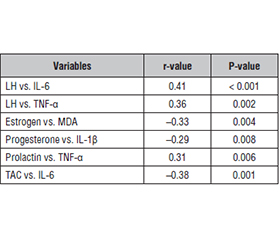
Актуальність. Комбінований вплив статевих гормонів, прозапальних цитокінів i маркерів оксидативного стресу тісно пов’язаний із жіночим безпліддям, визначає репродуктивну функцію та обумовлює негативні результати фертильності. Мета: визначити взаємозв’язок статевих гормонів, прозапальних цитокінів і маркерів оксидативного стресу у жінок із безпліддям та співвіднести їх із патогенетичними механізмами захворювання, а також клінічними результатами. Матеріали та методи. Проведено дослідження типу «випадок — контроль» у період з березня 2015 року до лютого 2016 року за участю 140 жінок (95 — із безпліддям, 45 — контрольної групи). Здійснювали забір 5 мл крові, відокремлювали сироватку та зберігали її при температурі –20 °C. Рівні статевих гормонів (фолікулостимулюючий, лютеїнізуючий гормон, естроген, прогестерон, пролактин) та цитокінів (інтерлейкін-6, фактор некрозу пухлини альфа, інтерлейкін-1 бета) визначали за допомогою наборів ELISA (BioTechne, США). Індекси оксидативного стресу, як-от малоновий діальдегід, супероксиддисмутаза, глутатіонпероксидаза й загальна антиоксидантна ємність, оцінювали з використанням звичайних спектрофотометричних і колориметричних методів. Результати. Не виявлено вірогідної різниці за показниками віку обстежених, індексом маси тіла чи статусом куріння (P > 0,05), що вказує на порівнянність вихідних даних. Безплідні жінки демонстрували високий рівень гормонального дисбалансу з підвищеним умістом фолікулостимулюючого, лютеїнізуючого гормону й пролактину і зниженим — естрогенів та прогестерону (P < 0,01). Концентрації прозапальних цитокінів (інтерлейкін-6, фактор некрозу пухлини альфа, інтерлейкін-1 бета) і малонового діальдегіду вірогідно збільшилися (P < 0,001), тоді як антиоксидантних маркерів (супероксиддисмутаза, глутатіонпероксидаза й загальна антиоксидантна ємність) — знизилися. Спостерігалися вірогідні кореляції між гормонами, цитокінами й маркерами оксидативного стресу, що свідчить про сильну взаємодію між ендокринною дисфункцією та запаленням і оксидативним стресом при безплідді. Висновки. Гормональний дисбаланс, підвищений рівень запальних цитокінів та оксидативний стрес виявляють при жіночому безплідді. Ці зміни відображають багатогранну роль ендокринних порушень, запальних процесів й антиоксидантного дефіциту та вказують на можливість їх використання як діагностичних і терапевтичних мішеней.
Background. A combination of sex hormones, pro-inflammatory cytokines and oxidative stress markers is associated with female infertility, affect reproductive function and is responsible for poor fertility outcomes. The purpose was to evaluate a broad spectrum of sex hormones, pro-inflammatory cytokines and oxidative stress markers in women with infertility and to relate them to the pathogenetic mechanisms of the disease, as well as clinical outcomes. Materials and methods. A case-control study was conducted between March 2015 and February 2016 in 140 women (95 infertile, 45 controls). We took 5 mL of blood, separated the serum and stored it at –20 °C. Sex hormones (follicle-stimulating hormone, luteinizing hormone, estrogen, progesterone, prolactin) and cytokines (interleukin-6, tumor necrosis factor-alpha, interleukin-1 beta) were measured with ELISA kits (BioTechne, USA). Oxidative stress indices, such as malondialdehyde, superoxide dismutase, glutathione peroxidase and total antioxidant capacity, were evaluated by conventional spectrophotometric and colorimetric techniques. Results. There was no significant difference in age, body mass index or smoking status (P > 0.05) indicating baseline comparability. Infertile women showed a high level of hormonal imbalance, having more follicle-stimulating hormone, luteinizing hormone, and prolactin, and less estrogen and progesterone (P < 0.01). The levels of pro-inflammatory cytokines (interleukin-6, tumor necrosis factor-alpha, interleukin-1 beta) and malondialdehyde increased significantly (P < 0.001), whereas the levels of antioxidant markers (superoxide dismutase, glutathione peroxidase and total antioxidant capacity) decreased. There were significant correlations among hormones, cytokines and oxidative stress markers showing a strong interaction between endocrine dysfunction and inflammation and oxidative stress in infertility. Conclusions. Hormonal imbalance, elevated inflammatory cytokines and oxidative stress are found in female infertility. These alterations reflect the multi-faceted roles of endocrine, inflammatory and antioxidant deficits, and indicate they may be diagnostic and therapeutic targets.
фолікулостимулюючий гормон; лютеїнізуючий гормон; пролактин, жіноче безпліддя; інтерлейкін-6; фактор некрозу пухлини альфа; інтерлейкін-1 бета; оксидативний стрес; антиоксидантні біомаркери
follicle-stimulating hormone; luteinizing hormone; prolactin; female infertility; interleukin-6; tumor necrosis factor-alpha; interleukin-1 beta; oxidative stress; antioxidant biomarkers
Для ознакомления с полным содержанием статьи необходимо оформить подписку на журнал.
- Nik Hazlina NH, Norhayati MN, Shaiful Bahari I, Nik Muhammad Arif NA. Worldwide prevalence, risk factors and psychological impact of infertility among women: a systematic review and meta-analysis. BMJ Open. 2022 Mar 30;12(3):e057132. doi: 10.1136/bmjopen-2021-057132.
- Hanson B, Johnstone E, Dorais J, Silver B, Peterson CM, Hotaling J. Female infertility, infertility-associated diagnoses, and comorbidities: a review. J Assist Reprod Genet. 2017 Feb;34(2):167-177. doi: 10.1007/s10815-016-0836-8.
- Bala R, Singh V, Rajender S, Singh K. Environment, Lifestyle, and Female Infertility. Reprod Sci. 2021 Mar;28(3):617-638. doi: 10.1007/s43032-020-00279-3.
- Ashraf N, Qayyum A, Bashir R, Zubair Ahmed S, Shafiq M, Batool M, et al. Metabolic Dysregulation and Female Infertility: A Systematic Review of Hormonal and Reproductive Outcomes From Recent Clinical Trials. Cureus. 2025 Aug 24;17(8):e90887. doi: 10.7759/cureus.90887.
- Okafor IA, Okpara UD, Ibeabuchi KC. The Reproductive Functions of the Human Brain Regions: A Systematic Review. J Hum Reprod Sci. 2022 Apr-Jun;15(2):102-111. doi: 10.4103/jhrs.jhrs_18_22.
- Samir M, Glister C, Mattar D, Laird M, Knight PG. Follicular expression of pro-inflammatory cytokines tumour necrosis factor-α (TNFα), interleukin 6 (IL6) and their receptors in cattle: TNFα, IL6 and macrophages suppress thecal androgen production in vitro. Reproduction. 2017 Jul;154(1):35-49. doi: 10.1530/REP-17-0053.
- Kany S, Vollrath JT, Relja B. Cytokines in Inflammatory Disease. Int J Mol Sci. 2019 Nov 28;20(23):6008. doi: 10.3390/ijms20236008.
- Oală IE, Mitranovici MI, Chiorean DM, Irimia T, Crișan AI, Melinte IM, et al. Endometriosis and the Role of Pro-Inflammatory and Anti-Inflammatory Cytokines in Pathophysiology: A Narrative Review of the Literature. Diagnostics (Basel). 2024 Jan 31;14(3):312. doi: 10.3390/diagnostics14030312.
- Agarwal A, Gupta S, Sharma RK. Role of oxidative stress in female reproduction. Reprod Biol Endocrinol. 2005 Jul 14;3:28. doi: 10.1186/1477-7827-3-28.
- Barati E, Nikzad H, Karimian M. Oxidative stress and male infertility: current knowledge of pathophysiology and role of antioxidant therapy in disease management. Cell Mol Life Sci. 2020 Jan;77(1):93-113. doi: 10.1007/s00018-019-03253-8.
- Alahmar AT. Role of Oxidative Stress in Male Infertility: An Updated Review. J Hum Reprod Sci. 2019 Jan-Mar;12(1):4-18. doi: 10.4103/jhrs.JHRS_150_18.
- Wang L, Tang J, Wang L, Tan F, Song H, Zhou J, Li F. Oxi–dative stress in oocyte aging and female reproduction. J Cell Physiol. 2021 Dec;236(12):7966-7983. doi: 10.1002/jcp.30468.
- Hart RJ. Physiological Aspects of Female Fertility: Role of the Environment, Modern Lifestyle, and Genetics. Physiol Rev. 2016 Jul;96(3):873-909. doi: 10.1152/physrev.00023.2015.
- Nath CK, Barman B, Das A, Rajkhowa P, Baruah P, Ba–ruah M, Baruah A. Prolactin and thyroid stimulating hormone affecting the pattern of LH/FSH secretion in patients with polycystic ovary syndrome: A hospital-based study from North East India. J Family Med Prim Care. 2019 Jan;8(1):256-260. doi: 10.4103/jfmpc.jfmpc_281_18.
- Al-Joubour ZТ, et al. Hormonal changes during acute stress response. International Journal of Health & Medical Research. 2024:266-71. doi: 10.58806/ijhmr.2024.v3i06n02.
- Zhu Q, Li Y, Ma J, Ma H, Liang X. Potential factors result in diminished ovarian reserve: a comprehensive review. J Ovarian Res. 2023 Oct 25;16(1):208. doi: 10.1186/s13048-023-01296-x.
- Muhammad YA. Reproductive aging in biological females: mechanisms and immediate consequences. Front Endocrinol (Lau–sanne). 2025 Sep 12;16:1658592. doi: 10.3389/fendo.2025.1658592.
- Hortal M, Fabregat A, Lledo B, Ortiz JA, Moliner B, Ber–nabeu A, Bernabeu R. IL-6/IL-10 and IL-1β/IL-4 ratios associated with poor ovarian response in women undergoing in-vitro fertilization. Eur J Obstet Gynecol Reprod Biol. 2023 Jan;280:68-72. doi: 10.1016/j.ejogrb.2022.11.012.
- Kniotek M, Zych M, Roszczyk A, Szafarowska M, Jerzak MM. Decreased Production of TNF-α and IL-6 Inflammatory Cytokines in Non-Pregnant Idiopathic RPL Women Immunomodulatory Effect of Sildenafil Citrate on the Cellular Response of Idiopathic RPL Women. J Clin Med. 2021 Jul 15;10(14):3115. doi: 10.3390/jcm10143115.
- Adamczak R, Ukleja-Sokołowska N, Lis K, Dubiel M. Function of Follicular Cytokines: Roles Played during Maturation, Deve–lopment and Implantation of Embryo. Medicina (Kaunas). 2021 Nov 16;57(11):1251. doi: 10.3390/medicina57111251.
- Wang Q, Sun Y, Fan R, Wang M, Ren C, Jiang A, Yang T. Role of inflammatory factors in the etiology and treatment of recurrent implantation failure. Reprod Biol. 2022 Dec;22(4):100698. doi: 10.1016/j.repbio.2022.100698.
- Dai M, Hong L, Yin T, Liu S. Disturbed Follicular Microenvironment in Polycystic Ovary Syndrome: Relationship to Oocyte Quality and Infertility. Endocrinology. 2024 Feb 20;165(4):bqae023. doi: 10.1210/endocr/bqae023.
- Kian M, Soleimanzadeh A, Javadi S, Najafi G. Efficacy of zinc oxide nanoparticles in chemical castration of male Wistar rats. Sci Rep. 2025 Dec 29;15(1):44702. doi: 10.1038/s41598-025-28667-2.
- Badr AM. Organophosphate toxicity: updates of malathion potential toxic effects in mammals and potential treatments. Environ Sci Pollut Res Int. 2020 Jul;27(21):26036-26057. doi: 10.1007/s11356-020-08937-4.
- Cordiano R, Di Gioacchino M, Mangifesta R, Panzera C, Gangemi S, Minciullo PL. Malondialdehyde as a Potential Oxidative Stress Marker for Allergy-Oriented Diseases: An Update. Molecules. 2023 Aug 9;28(16):5979. doi: 10.3390/molecules28165979.
- Całyniuk B, et al. Malondialdehyde (MDA) — product of li–pid peroxidation as marker of homeostasis disorders and aging. Annales Academiae Medicae Silesiensis. 2016;70:224-228. doi: 10.18794/aams/65697.
- Barabás K, Szabó-Meleg E, Ábrahám IM. Effect of Inflammation on Female Gonadotropin-Releasing Hormone (GnRH) Neurons: Mechanisms and Consequences. Int J Mol Sci. 2020 Jan 14;21(2):529. doi: 10.3390/ijms21020529.
- Goldsammler M, Merhi Z, Buyuk E. Role of hormonal and inflammatory alterations in obesity-related reproductive dysfunction at the level of the hypothalamic-pituitary-ovarian axis. Reprod Biol Endocrinol. 2018 May 9;16(1):45. doi: 10.1186/s12958-018-0366-6.
- Ou Y, Wang H, Zhou C, Chen Y, Lyu J, Feng M, Huang X. Endometriosis-associated infertility: Multi-omics insights into pathogenesis and precision therapeutics. Front Endocrinol (Lausanne). 2025 Oct 2;16:1613334. doi: 10.3389/fendo.2025.1613334.
- Dutta S, Sengupta P. Infertility Through the Lens of Psychoneuroimmunology: Revealing the Impact of Stress and Immune Disruption. In: Rezaei N, Yazdanpanah N (eds). PsychoNeuroImmunology. Integrated Science, vol. 31. Cham: Springer; 2024. doi: 10.1007/978-3-031-72079-6_29.