
Журнал «Медицина неотложных состояний» Том 22, №6, 2026
Вернуться к номеру
Інновації в методах зупинки кровотечі при проникній травмі живота у військових та цивільних умовах
Авторы: E. Nikolaev (1), M. Vylcheva (2)
(1) - Clinic of General Surgery, Military Medical Academy, Varna, Bulgaria
(2) - Military Medical Academy, Varna, Bulgaria
Рубрики: Медицина неотложных состояний
Разделы: Клинические исследования
Версия для печати
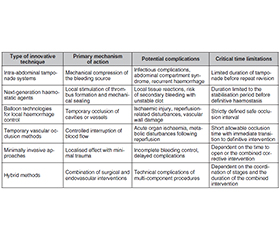
Актуальність. Актуальність дослідження зумовлена високою смертністю від внутрішньочеревної кровотечі та залежністю результатів лікування від наявності й ефективності методів місцевого гемостазу за різних організаційних умов медичної допомоги. Мета: теоретично обґрунтувати застосування інноваційних методів місцевого контролю внутрішньочеревної кровотечі. Матеріали та методи. Дослідження мало теоретичний та аналітичний характер і базувалося на аналітичному огляді та структурно-логічному синтезі наукових джерел, що відображають клінічний та організаційний досвід військової і цивільної медицини, з посиланням на навчальні й наукові матеріали, що використовуються в Болгарії, зокрема у місті Варна. Результати. Показано, що інноваційні методи місцевого гемостазу суттєво відрізняються за механізмами дії, анатомічними мішенями й допустимим часом застосування, що впливає на їх ефективність і безпеку на різних рівнях медичної допомоги. Тимчасова судинна оклюзія вимагала суворих часових обмежень через ризик ішемічного пошкодження органів, тоді як надмірна механічна компресія та місцеве утворення тромбу супроводжувалися підвищеним ризиком інфікування й повторної кровотечі. Гібридні технології розширили можливості контролю кровотечі, але вимагали високої кваліфікації персоналу і чіткої координації послідовних етапів догляду. Висновки. Отримані результати теоретично підтверджують диференційований підхід до вибору методів локального гемостазу відповідно до наявних ресурсів, організаційних умов та рівня медичної допомоги. Практичне значення полягає в інтеграції інноваційних рішень у клінічні алгоритми для військової та цивільної медицини. Результати можуть допомогти хірургам, спеціалістам з медицини катастроф та розробникам протоколів невідкладної допомоги у стандартизації підходів до контролю масивної внутрішньочеревної кровотечі.
Background. The relevance of the study is conditioned by high mortality from intra-abdominal haemorrhage and the dependence of treatment results on the availability and effectiveness of local haemostasis techniques under different organisational conditions of medical care. This study purposed to theoretically substantiate the application of innovative techniques of local control of intra-abdominal haemorrhage. Materials and methods. The study was of a theoretical and analytical nature and was based on the analytical review and structural-logical synthesis of scientific sources, reflecting the clinical and organisational experience of military and civilian medicine, with reference to educational and scientific materials used in Bulgaria, in particular, in Varna. Results. The analysis showed that innovative local haemostasis techniques differed significantly in their mechanisms of action, anatomical targets and permissible application times, affecting their effectiveness and safety at different levels of care. Temporary vascular occlusion required strict time limits because of the risk of ischemic organ damage, while prolonged mechanical compression and local thrombus formation carried increased risks of infection and recurrent bleeding. Hybrid technologies expanded bleeding-control capabilities but required highly trained personnel and clear coordination of successive care stages. Conclusions. The findings theoretically support a differentiated approach to selecting local haemostasis techniques according to available resources, organisational conditions and level of medical care. The practical significance lies in integrating innovative solutions into clinical algorithms for military and civilian medicine. The results may assist surgeons, disaster medicine specialists and emergency-care protocol developers in standardising approaches to controlling massive intra-abdominal haemorrhage.
клінічні результати; хірургічні технології; судинна оклюзія; рівень обладнання; гемостатичні засоби; стандартизація підходів
clinical outcomes; surgical technologies; vascular occlusion; level of equipment; haemostatic agents; standardisation of approaches
Для ознакомления с полным содержанием статьи необходимо оформить подписку на журнал.
- Jarrassier A, Boutonnet M, Duranteau J, et al. Initial management of haemorrhagic war casualties: tactical priorities and innovative approaches in modern and future warfare. Crit Care. 2025 Nov 28;29(1):509. doi: 10.1186/s13054-025-05752-6.
- Kyle E, Grice S, Naumann DN. Penetrating abdominal trauma. Br J Surg. 2024 Aug 2;111(8). doi: 10.1093/bjs/znae206.
- Remondelli MH, Rhee J, Barzanji NK, et al. Advancements in prehospital, en-route, and damage control casualty care and areas of future research for large-scale combat operations. Curr Trauma Rep. 2025 Feb 20;11(1):7. doi: 10.1007/s40719-025-00284-4.
- Adams D, McDonald PL, Holland S, et al. Management of non-compressible torso hemorrhage of the abdomen in civilian and military austere environments: a scoping review. Trauma Surg Acute Care Open. 2024 Feb 14;9(1). doi: 10.1136/tsaco-2023-001189.
- Dilday J, Holcomb JB. Strategies to control hemorrhage in the trauma patient. In: Aseni P, Grande AM, Leppäniemi A, Chiara O, eds. The High-risk Surgical Patient. Cham: Springer; 2023. 867-881. doi: 10.1007/978-3-031-17273-1_78.
- Moparthi KP, Javed H, Kumari M, et al. Acute care surgery: navigating recent developments, protocols, and challenges in the comprehensive management of surgical emergencies. Cureus. 2024 Jan 14;16(1). doi: 10.7759/cureus.52269.
- Lammers D, Henry R, Betzold R, et al. Pushing advanced he–morrhage control interventions forward: reducing prehospital mortality from traumatic hemorrhage through further adoption of effective military prehospital strategies. J Trauma Acute Care Surg. 2025 Aug;99(3 Suppl 1). doi: 10.1097/TA.0000000000004674.
- Lenormand P. Fragments in the cavity: reassessing conventional warfare through abdominal wounding (late nineteenth to early twenty-first century). Crit Mil Stud. 2025 Sep 12;11(4):425-448. doi: 10.1080/23337486.2025.2527993.
- König T. The changing face of traumatic injury: increasing experiences of penetrating gun and knife injuries and their treatment. In: Williams R, Kemp V, Porter K, Healing T, Drury J, eds. Major Incidents, Pandemics and Mental Health: The Psychosocial Aspects of Health Emergencies, Incidents, Disasters and Disease Outbreaks. Cambridge: Cambridge University Press; 2024. 99-106. doi: 10.1017/9781009019330.017.
- Kostov S, Kornovski Y, Yordanov A, et al. Damage control surgery in obstetrics and gynecology: abdomino-pelvic packing in multimodal hemorrhage management. J Clin Med. 2025 Oct 13;14(20):7207. doi: 10.3390/jcm14207207.
- Evrev D, Sekulovski M, Gulinac M, Dobrev H, Velikova T, Hadjidekov G. Retroperitoneal and abdominal bleeding in anticoagulated COVID-19 hospitalized patients: case series and brief literature review. World J Clin Cases. 2023 Mar 6;11(7):1528-1548. doi: 10.12998/wjcc.v11.i7.1528.
- Chernopolsky PM. Intraabdominal abscesses [dissertation abstract on the Internet]. Varna: Medical University “Prof. Dr. Paraskev Stoyanov”; 2023. Available from: https://www.mu-varna.bg/BG/Research/Documents/2023%20-%20proceduri/dmn/plamen%20chernopolski/avtoreferat.pdf.
- Jaunoo SS, Harji DP. Damage control surgery. Int J Surg. 2009 Apr;7(2):110-113. doi: 10.1016/j.ijsu.2009.01.008.
- Malgras B, Prunet B, Lesaffre X, et al. Damage control: concept and implementation. J Visc Surg. 2017 Dec;154 Suppl 1. doi: 10.1016/j.jviscsurg.2017.08.012.
- Roberts DJ, Bobrovitz N, Zygun DA, et al. Evidence for use of damage control surgery and damage control interventions in civilian trauma patients: a systematic review. World J Emerg Surg. 2021 Mar 11;16(1):10. doi: 10.1186/s13017-021-00352-5.
- Volpin G, Pfeifer R, Saveski J, Hasani I, Cohen M, Pape HC. Damage control orthopaedics in polytraumatized patients-current concepts. J Clin Orthop Trauma. 2021 Jan;12(1):72-82. doi: 10.1016/j.jcot.2020.10.018.
- Marietta M, Burns B. Penetrating abdominal trauma. In: StatPearls. Treasure Island (FL): StatPearls Publishing; 2025. Avai–lable from: https://www.ncbi.nlm.nih.gov/books/NBK459123/.
- Richardson JD, Spain DA, Livingston DH. Trauma and acute care surgery: the evolution of a specialty. J Trauma Acute Care Surg. 2022 Feb 1;92(2):242-249. doi: 10.1097/TA.0000000000003456.
- American College of Surgeons Committee on Trauma. Advanced trauma life support: student course manual. 10th ed. Chicago: American College of Surgeons; 2018. Available from: https://cirugia.facmed.unam.mx/wp-content/uploads/2018/07/Advanced-Trauma-Life-Support.pdf.
- North Atlantic Treaty Organization. Emergency war surgery. Washington (DC): US Government Printing Office; 1975. Avai–lable from: https://theswissbay.ch/pdf/Books/Survival/Bush%20Medicine/%28MM%29%20NATO%20Emergency%20War%20Surgery.pdf.
- Fadden S. Trauma resuscitation and the damage control approach. Surgery (Oxf). 2024 Jul;42(7):479-486. doi: 10.1016/j.mpsur.2024.04.005.
- Wang C, Shirzaei Sani E, Shih CD, et al. Wound management materials and technologies from bench to bedside and beyond. Nat Rev Mater. 2024 Aug;9(8):550-566. doi: 10.1038/s41578-024-00693-y.
- Favaloro EJ, Pasalic L. Innovative diagnostic solutions in hemostasis. Diagnostics (Basel). 2024 Nov 11;14(22):2521. doi: 10.3390/diagnostics14222521.
- Rabello G, Monteiro R, Meneghini B, Jatene FB. When innovation meets patient blood management — a new way to see blee–ding. Hematol Transfus Cell Ther. 2025 Jan-Mar;47(1):103691. doi: 10.1016/j.htct.2024.07.002.
- Tutchenko MI, Rudyk DV, Aslanian SA, Chub SL, Besedinskyi MS. Recurrent variceal bleeding in alcoholic liver cirrhosis (a case report). Gastroenterol (Ukraine). 2024 Sep 13;58(3):222-225. doi: 10.22141/2308-2097.58.3.2024.627.
- Rudyk DV, Tutchenko MI, Chub SL, Besedinskyi MS. Three cases of fatal postoperative thromboembolic complications in patients with liver cirrhosis and bleeding from esophageal varicose veins after COVID-19. Wiad Lek. 2024 Sep 3;77(8):1627-1632. doi: 10.36740/WLek202408114.
- Brancato G, Donati M, Gandolfo L, Privitera A, Ciancio F. Extraperitoneal prosthesis repair in the surgical treatment of inguinal hernias. Chir Ital. 2002 Mar-Apr;54(2):219-225.
- Wang H, Yang L. Applications of injectable hemostatic materials in wound healing: principles, strategies, performance requirements, and future perspectives. Theranostics. 2023 Aug 21;13(13):4615-4635. doi: 10.7150/thno.86930.
- Du J, Wang J, Xu T, Yao H, Yu L, Huang D. Hemostasis strategies and recent advances in nanomaterials for hemostasis. Mo–lecules. 2023 Jul 7;28(13):5264. doi: 10.3390/molecules28135264.
- Zhong Y, Hu H, Min N, Wei Y, Li X, Li X. Application and outlook of topical hemostatic materials: a narrative review. Ann Transl Med. 2021 Apr;9(7):577. doi: 10.21037/atm-20-7160.
- Banasiewicz T, Machała W, Wysocki MB, et al. Principles of minimize bleeding and the transfusion of blood and its components in operated patients — surgical aspects. Pol Przegl Chir. 2023 Sep 20;95(5):14-39. doi: 10.5604/01.3001.0053.8966.
- Latka K, Kolodziej W, Domisiewicz K, et al. Outpatient spine procedures in Poland: clinical outcomes, safety, complications, and technical insights into an ambulatory spine surgery center. Healthcare (Basel). 2023 Nov 10;11(22):2944. doi: 10.3390/healthcare11222944.
- Latka K, Kolodziej W, Pawus D, Bielecki M, Latka D. Performance of successful ambulatory cervical spine surgery: safety, efficacy, and early experiences of first 100 cases in Poland. Br J Neurosurg. 2025 Dec;39(6):807-812. doi: 10.1080/02688697.2024.2378825.
- Schonauer C, Mastantuoni C, Somma T, de Falco R, Cappabianca P, Tessitore E. Topical hemostatic agents in neurosurgery, a comprehensive review: 15 years update. Neurosurg Rev. 2022 Apr;45(2):1217-1232. doi: 10.1007/s10143-021-01684-1.
- Faenza M, Molle M, Mazzarella V, Crisci E, Pieretti G, Nicoletti MM. Reconstruction of the columella with interposition of nasogenian flaps: a case report. Int J Surg Case Rep. 2024 Feb;115:109238. doi: 10.1016/j.ijscr.2024.109238.
- Molle M, Uderzo S, D’Addato C, Gesuete FP, Nicoletti GF, Ferraro GA. Is quality of life after breast reduction influenced by diffe–rent surgery’s technique? A prospective study. Aesthetic Plast Surg. 2024 Dec;48(23):4973-4978. doi: 10.1007/s00266-024-04050-w.
- Campana MD, Aliberti A, Acerra A, et al. The effectiveness and safety of autologous platelet concentrates as hemostatic agents after tooth extraction in patients on anticoagulant therapy: a syste–matic review of randomized, controlled trials. J Clin Med. 2023 Aug 17;12(16):5342. doi: 10.3390/jcm12165342.
- Leshchyshyn IM, Markulan LY, Okhotska OI, Susak YM, Byk PL. Quality of life in patients with chronic slow-transit constipation according to the PAC-QOL scale one year after surgical treatment: comparison with preoperative data and reference values. Wiad Lek. 2025 Apr 30;78(4):726-734. doi: 10.36740/WLek/203846.
- Brown KGM, Solomon MJ. Topical haemostatic agents in surgery. Br J Surg. 2024 Jan 3;111(1). doi: 10.1093/bjs/znad361.
- Thonon H, Van Nieuwenhove M, Thachil J, Lippi G, Hardy M, Mullier F. Hemostasis testing in the emergency department: a narrative review. Semin Thromb Hemost. 2025 Jun;51(5):506-523. doi: 10.1055/s-0044-1787661.
- Ramli NN, Iberahim S, Mohd Noor NH, et al. Haemostasis and inflammatory parameters as potential diagnostic biomarkers for VTE in trauma-immobilized patients. Diagnostics (Basel). 2023 Jan 2;13(1):150. doi: 10.3390/diagnostics13010150.
- Wilhelm G, Mertowska P, Mertowski S, et al. The crossroads of the coagulation system and the immune system: interactions and connections. Int J Mol Sci. 2023 Aug 8;24(16):12563. doi: 10.3390/ijms241612563.
- Spaska A, Grytsuliak B, Dolynko N. Pathological and vascular changes in the rat testicle after experimental trauma. Clin Exp Reprod Med. 2025 Jun;52(2):178-187. doi: 10.5653/cerm.2024.07080.
- Spaska A. Correlation of the anatomical variations of pancreatic blood vessels and occurrence of diseases of pancreas. Pol Merkur Lekarski. 2025 Jan-Feb;53(1):100-107. doi: 10.36740/Merkur202501114.
- Guo Y, Wang M, Liu Q, Liu G, Wang S, Li J. Recent advances in the medical applications of hemostatic materials. Theranostics. 2023 Jan 1;13(1):161-196. doi: 10.7150/thno.79639.
- Sydorova N, Kazmirchuk K, Kolisnyk O, Tsaralunha V, Kobirnichenko Y, Sydorova L. Calculation of integral indicators of the metabolic status and filtration function of kidneys in patients with a combat mine-explosive injury who lost significant body weight due to limb amputation. Acta Med Lituan. 2025 Feb 18;32(1):64-77. doi: 10.15388/Amed.2025.32.1.2.
- Moore EE, Moore HB, Kornblith LZ, et al. Trauma-induced coagulopathy. Nat Rev Dis Primers. 2021 Apr 29;7(1):30. doi: 10.1038/s41572-021-00264-3.