
Журнал «Травма» Том 27, №5, 2026
Вернуться к номеру
Кореляційний аналіз клінічних індексів активності та інтегральних гематологічних біомаркерів у пацієнтів з аксіальним спондилоартритом
Авторы: Гринь В.К., Проценко Г.О., Пастернак М.Л.
ДУ «Національний науковий центр «Інститут кардіології, клінічної та регенеративної медицини
імені академіка М.Д. Стражеска НАМН України», м. Київ, Україна
Рубрики: Травматология и ортопедия
Разделы: Клинические исследования
Версия для печати
Актуальність. Об’єктивна оцінка ступеня активності аксіального спондилоартриту (АксСпА) залишається складним завданням через суб’єктивність традиційних опитувальників (Bath Ankylosing Spondylitis Disease Activity Index, BASDAI) або часткову їх суб’єктивність (Ankylosing Spondylitis Disease Activity Score, ASDAS). ASDAS розраховують з використанням С-реактивного білка (C-reactive protein, CRP; ASDAS-CRP) та швидкості осідання еритроцитів (erythrocyte sedimentation rate, ESR; ASDAS-ESR). Однак, за даними досліджень, рівні цих гострофазових показників можуть бути в межах норми приблизно у третини пацієнтів з АксСпА, навіть якщо захворювання активне. Отже, є потреба у верифікації надійних, економічно доступних додаткових лабораторних маркерів запалення, що слугуватимуть для комплексної оцінки активності АксСпА. Мета: дослідити характер і силу кореляцій між індексами активності (BASDAI, ASDAS-CRP, ASDAS-ESR) та лабораторними біомаркерами запалення (CRP, ESR та співвідношеннями CRP і альбуміну (CRP to albumin ratio, CAR); нейтрофілів і лімфоцитів (neutrophil to lymphocyte ratio, NLR); тромбоцитів і лімфоцитів (platelet to lymphocyte ratio, PLR)) у пацієнтів з АксСпА та оцінити їх діагностичну значущість для комплексної оцінки активності захворювання. Матеріали та методи. Було обстежено 118 учасників дослідження, з яких 96 пацієнтів зі встановленим діагнозом АксСпА та 22 здорові особи контрольної групи. Дані з медичної документації опрацьовано за допомогою статистичної програми SPSS версії 26.0, досліджено кореляції та проведено ROC-аналіз. Результати. У дослідній групі встановлено статистично значущу позитивну кореляцію помірної сили між індексом BASDAI та CRP, ESR, CAR, NLR ( = +0,329, p < 0,002; = +0,323, p < 0,008; = +0,355, p < 0,015; = +0,379, p < 0,001, відповідно). Водночас кореляцію між BASDAI та показником PLR оцінено як слабку ( = +0,299, p = 0,013). Комбінований індекс ASDAS-ESR продемонстрував статистично значущий сильний зв’язок із CRP ( = +0,750, p = 0,033). Крім того, виявлено статистично значущий позитивний зв’язок помірної сили між лабораторними показниками: ESR, CAR, NLR та комбінованим індексом ASDAS-CRP ( = +0,528, p < 0,001; = +0,588, p < 0,01; = +0,569, p < 0,001, відповідно), а також між CAR, NLR та ASDAS-ESR
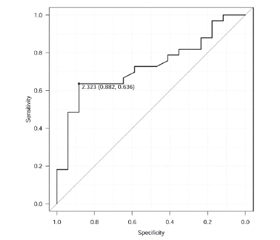
( = +0,545, p < 0,001; = +0,489, p = 0,004, відповідно). Натомість між співвідношенням PLR та індексом ASDAS-CRP виявлено статистично значущий слабкий зв’язок ( = +0,244 p < 0,034), тоді як із ASDAS-ESR встановлено зв’язок помірної сили ( = +0,423, p = 0,033). За результатами ROC-аналізу визначено порогове значення для співвідношень CAR (0,214), NLR (2,343) за індексом активності ASDAS-CRP (чутливість 78,6 %, специфічність 69,4 %; чутливість 85,7 %, специфічність 71,5 % відповідно). Висновки. Серед рутинних лабораторних тестів потенційними біомаркерами високої активності АксСпА (за ASDAS-CRP та ASDAS-ESR) можна вважати співвідношення CAR та NLR. Вони показали задовільну діагностичну здатність до розрізнення груп пацієнтів з низькою/помірною (ASDAS ≤ 2,1) або високою/дуже високою (ASDAS > 2,1) активністю захворювання за ASDAS-CRP та ASDAS-ESR. Отже, визначення цих співвідношень може слугувати допоміжним інструментом для комплексної об’єктивної оцінки активності АксСпА
Background. Objective assessment of the disease activity in patients with axial spondyloarthritis (axSpA) remains a challenging task due to the subjectivity of traditional questionnaires, such as the Bath Ankylosing Spondylitis Disease Activity Index (BASDAI), or their partial subjectivity, the Ankylosing Spondylitis Disease Activity Score (ASDAS). ASDAS is calculated using C-reactive protein
(ASDAS-CRP) or erythrocyte sedimentation rate (ASDAS-ESR). However, current data indicate that these acute-phase reactants may remain within the reference range in approximately one-third of axSpA patients, even in clinically active disease. Therefore, there is a need to verify reliable, cost-effective additional laboratory markers of inflammation that will serve for a comprehensive assessment of axSpA activity. Objective: to investigate the nature and strength of correlations between activity indices (BASDAI, ASDAS-CRP, ASDAS-ESR) and laboratory biomarkers of inflammation (CRP, ESR and CRP to albumin ratio (CAR); neutrophil to lymphocyte ratio (NLR); platelet to lymphocyte ratio (PLR)) in patients with axSpA and to assess their diagnostic significance for a comprehensive assessment of disease activity. Materials and methods. A total of 118 study participants were examined, including 96 patients with a confirmed diagnosis of axSpA and 22 healthy individuals as the control group. Data retrieved from medical records were processed using the SPSS statistical software package, version 26.0. Correlation analyses and receiver ope-rating characteristic (ROC) analyses were performed. Results. In the study group, a statistically significant positive correlation of moderate strength was found between the BASDAI score and CRP, ESR, CAR, and NLR ( = +0.329, p < 0.002; = +0.323, p < 0.008; = +0.355, p < 0.015; = +0.379, p < 0.001, respectively). Concurrently, the correlation between the BASDAI score and PLR was assessed as weak ( = +0.299, p = 0.013). The composite ASDAS-ESR index demonstrated a statistically significant strong correlation with CRP ( = +0.750, p = 0.033). Furthermore, a statistically significant positive correlation of moderate strength was revealed between laboratory parameters (ESR, CAR, NLR) and the composite ASDAS-CRP index ( = +0.528, p < 0.001; = +0.588, p < 0.01; = +0.569, p < 0.001, respectively), as well as between CAR, NLR, and ASDAS-ESR ( = +0.545, p < 0.001; = +0.489, p = 0.004, respectively). Conversely, a statistically significant weak correlation was observed between PLR and ASDAS-CRP index ( = +0.244, p < 0.034), whereas its correlation with ASDAS-ESR was of moderate strength ( = +0.423, p = 0.033). Based on ROC analysis, the optimal cutoff thresholds for predicting ASDAS-CRP activity were determined as 0.214 for CAR (78.6 % sensitivity, 69.4 % specificity) and 2.343 for NLR (85.7 % sensitivity, 71.5 % specificity). Conclusions. Among routine laboratory tests, CAR and NLR ratios can be potential biomarkers of high axSpA activity (as assessed by ASDAS-CRP and ASDAS-ESR). They demonstrated acceptable accuracy in identifying patients with low/moderate (ASDAS ≤ 2.1) or high/very high (ASDAS > 2.1) disease activity based on ASDAS-CRP and ASDAS-ESR. Therefore, these ratios may serve as a valuable complementary tool for comprehensive objective assessment of axSpA activity.
аксіальний спондилоартрит; структурні ураження хребта; ASDAS-CRP; ASDAS-ESR; співвідношення С-реактивного білка й альбуміну (CAR); співвідношення нейтрофілів і лімфоцитів (NLR)
axial spondyloarthritis; structural damage of the spine; ASDAS-CRP; ASDAS-ESR; C-reactive protein to albumin ratio; neutrophil to lymphocyte ratio